Amazon Just Bet $8B on Backup Power. Here’s What It Means for Bootstrapped AI Startups
Hey Indie Hackers,
While everyone in our community is building the next wrapper, fine-tuning models, or prompt engineering, something massive just happened on the physical infrastructure side that we can't afford to ignore.
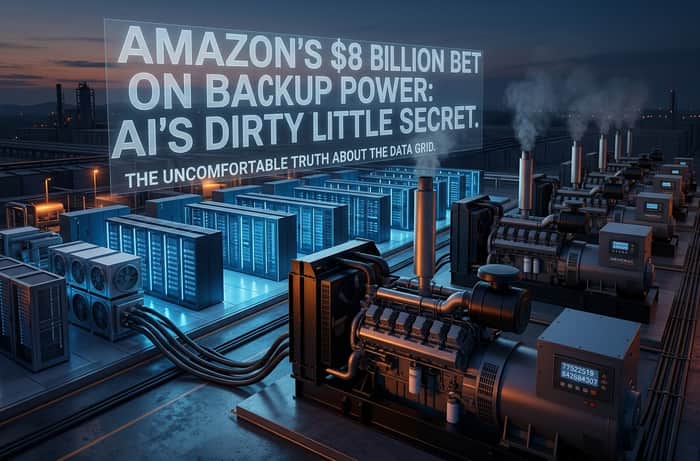
Amazon Web Services (AWS) just signed an $8 Billion deal with Generac Holdings for industrial backup generators. They even acquired a 2.6% stock warrant, sending Generac's stock up 40% in a single day.
Here is why I think this matters for indie builders and bootstrapped founders:
-
Infrastructure is Becoming a Moat
Hyperscalers (Amazon, Google, Microsoft) aren't just competing on algorithms anymore. They are locking in raw energy capacity. A single data center draws 100–500 MW-enough to power up to 375,000 homes. -
The Cost Trickle-Down
With governments passing laws like the US Ratepayer Protection Act (forcing data centers to cover full grid upgrade costs), API costs and compute overhead for smaller developers might see structural changes over time. -
The Hardware Bottleneck
Software iteration is fast, but energy grids move slowly. As power becomes the primary bottleneck, edge computing and energy-efficient models will open up huge opportunities for indie products.
Are you factoring energy infrastructure/compute costs into your long-term SaaS margins, or relying entirely on third-party API stability?
I wrote a detailed deep-dive breaking down the grid economics, investor implications, and what this signals for the future of tech: [https://www.thefluxread.com/2026/09/amazon-just-spent-8-billion-on.html]

This is great work — what's the biggest thing you'd do differently if you started over?
The timing angle here is underrated — most bootstrapped AI builders think about compute costs but rarely factor in power reliability as a constraint. If hyperscalers are betting $8B on backup power, it signals inference demand will keep spiking in ways that make resilient infrastructure a real differentiator. The takeaway for solopreneurs: lean on providers who've already solved this (Cloudflare Workers, Fly.io, etc.) rather than trying to self-host during the scaling chaos. Smart analysis!
Spot on! You nailed the core takeaway here - most devs completely ignore the physical layer until an outage or API price hike hits them in the face.
When hyperscalers are dropping $8B just on standby generators, it's a huge signal that compute availability isn't just about software optimization anymore; it's a literal grid-level bottleneck. Offloading that operational headache to platforms like Fly.io or Cloudflare early on is honestly the smartest move a lean team can make while the big players fight over transformers and power plants.
Appreciate you dropping this insight
The infrastructure signal is real, although I’d separate it from the assumption that indie API prices must rise.
The filing says $2.4B of initial deliveries in 2027–28; the $8B figure is the cumulative purchase threshold tied to full warrant vesting through 2033. That still shows how seriously Amazon is treating power resilience, but it is not quite an $8B committed order today.
For a bootstrapped SaaS, the practical response may be simpler: model routing, caching, bounded agent loops and a fallback provider, then test whether the business still works if inference costs double. Are you seeing evidence that power costs are already reaching API pricing, or treating this mainly as a longer-term risk?
we aren't seeing power costs directly push up baseline token prices today - competition and model optimization are keeping baseline inference cheap for now.
Instead, it's more of a long-term availability and margin risk. The real danger isn't token prices doubling overnight, but rather budget API tiers hitting tighter rate limits or experiencing latency spikes during grid stress.
That's why the practical playbook you mentioned - smart caching, bounded loops, and multi-provider fallbacks - is the exact right defense. Appreciate the sharp breakdown