Frameworks for discovering startup ideas
Here are some frameworks for discovering startup ideas using the Jobs-to-be-done (JTBD) framework:
(1) Bundling
(2) Unbundling
(3) Lower Coordination Cost
(4) Luxury at scale
(5) Reduce Adoption Friction
(6) Low NPS incumbents
(7) Solving issues due to older solutions
(8) One improved Vector of Success
(9) Demand Aggregation
Every company uses a combination of the above. They aren’t meant to be mutually exclusive. 😃
Let’s get down to it.
1. Bundling
A bundling strategy works when
(a) you are defining your JTBD broadly enough and
(b) you can offer additional products at marginal cost.
Create products that align with your main JTBD and offer them at a lower price and/or tremendous value.
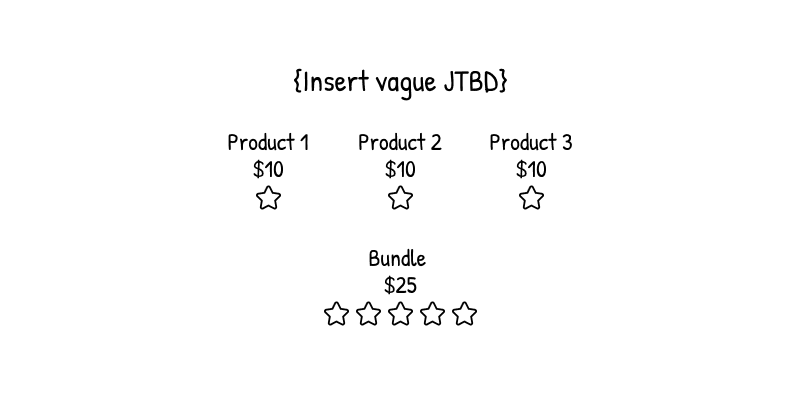
Microsoft is the common example of a bundler but there isn’t always a clear overlap between their products (e.g. Excel & OneNote).
I think HubSpot does it better in terms of solving for a particular job:

In most cases, startups should avoid this strategy. If your product strategy involved requiring you to build a lot, it will take you a very long time to launch.
But, there are exceptions, Notion had quite a feature-rich product at launch.
2. Unbundling
An unbundling strategy involves carving out a job from a bloated product.
A bloated product is almost always trapped because they need to satisfy the needs of the majority.

It works when
(a) there is a clear deviation in the Job-to-be-done and
(b) that niche is big enough and/or growing over time.

We use this strategy ourselves on avopos.
3. Lower Coordination Cost
This involves recognizing the friction around certain workflows and reducing this friction through software (or better processes).
This strategy works when the Jobs-to-be-done require
(1) High number of redundant steps or,
(2) High coordination cost or,
(3) Visibility into each step

Some other examples include filling accounting expenses and getting KYC procedures done.
4. Luxury at Scale
This strategy involves recognizing a Job-to-be-done that was only previously afforded to the rich and scaling it to the masses.
Some examples
(1) Flagging a black limo (Uber)
(2) Getting food delivered to your doorstep (Foodpanda)

This works in the B2B world as well
(1) Engineers to build basic automation (Every no-code tool)
(2) Engineers to manage small but important component (API-first company)
(3) Translators to manage different website versions (Lokalise)

5. Lower Adoption Friction
This strategy involves identifying a known job and removing friction from the current adoption process.

Note: Reducing adoption friction might give you a headstart but it isn’t really a sustainable competitive advantage in the long run.
6. Low NPS Incumbents
This strategy also involves identifying a known job but focusing specifically on areas where people are unhappy with the incumbent players.
Recommended Reading: How to build better products

The internet is full of unhappy customers. It shouldn’t be too hard to identify one that piques your interest.
7. Solving issues due to older solutions
Some old solutions never seem to go out of date.
BUT those solutions might not be perfect. They could create issues that unlock new Jobs.
An example would be a drill.
It is, I think, still the best product if I need a hole in the wall.

But what about the mess it creates after?
WordPress is still okay for websites, and they have an entire ecosystem dedicated to solving its shortfalls.

8. One improved Vector of Success
This strategy involves identifying an obvious Job-to-be-done and building a product that is better in just One Vector of Success.

Recommended Reading: Vectors of Success
9. Demand Aggregation
This strategy involves looking for almost identical Jobs-to-be-done across multiple users and aggregating that demand.
The key here is that they have to be almost identical.
Marketplaces
In most cases, the aggregation of demand will allow you to build a marketplace.
But:
The more varied the demand, the more difficult it will be to build up your supply base.

If the demand is similar but not identical, you might need to build a service layer to manage the idiosyncratic matching of demand and supply.
Others
Demand aggregation can be monetized in other forms.
If you consider “distract and entertain me for 5min” as a Job-to-be-done, Facebook & Twitter do a great job at aggregating that demand for advertising.
If you consider “inspire and teach me about bootstrapping” as a Job-to-be-done, IndieHackers & Startups for The Rest Of Us do a great job at aggregating that demand for advertising.
That's all for now 😃
Share/ Upvote if this was useful 🚀
Here is the original Twitter thread
Drop me a DM on Twitter if you have any questions 😀
I tweet about lessons building avopos
