🚀 From Notes to Product: Building RedNote for Creative Workflows

"We didn’t want to build just another note-taking app. We wanted to build the right one—for creators."
That’s the vision that drove us when we started building RedNote: a tool designed specifically for writers, bloggers, and creators who think in fragments but publish in flow.
🧭 The Problem: Why RedNote Exists
Traditional note-taking apps don’t work well for creative workflows:
- Evernote feels outdated
- Notion is too bloated for fast ideation
- Obsidian is powerful but intimidating for new users
As creators ourselves, we wanted something different:
- A distraction-free space to jot down ideas instantly
- Markdown-first, with smart tagging
- A lightweight system to manage fragments, drafts, and writing progress
- Optional AI features that assist, not overwhelm
That’s how RedNote was born.
🧩 Feature Breakdown: What Powers RedNote
1. ✍️ Fast Capture
- Launch via keyboard shortcut, no need to open the browser
- Supports enhanced Markdown + custom tags like
[@idea](/idea),#quote - Notes saved as "fragments" and auto-organized by date & tags
Tech stack: ServiceWorker + IndexedDB for local-first storage, synced via background API when online
2. 🎙️ Voice-to-Text + AI Assist
- Record quick voice notes, transcribed via Whisper
- Transcripts automatically sent to the "inspiration pool"
- Optional AI summarizes or generates titles using GPT-4
Implementation:
- Audio files are uploaded to a Node.js backend
- Whisper (via Python) transcribes
- GPT-4 summarizes or restructures content on demand
3. 🧱 Fragment → Draft → Publish Flow
- Drag and drop fragments into writing projects
- Kanban-style dashboard to manage writing stages
- Each draft tracks edit history, writing time, and keyword density
Built with: Vue 3 + Pinia (frontend), PostgreSQL + Prisma (backend)
4. 📤 One-Click Publish + Version History
- Publish to Medium, Ghost, or export Markdown with one click
- Auto-versioning allows you to roll back any changes
API integrations: OAuth & REST APIs from publishing platforms
Custom versioning service tracks edit diffs and timestamps
🧠 Architecture Overview
Backend: Node.js (Express) + PostgreSQL + Prisma
AI: Whisper (Python), OpenAI GPT-4 API
Cloud: Railway (backend), Supabase (auth & storage)
CI/CD: GitHub Actions + Docker
⚙️ Technical Challenges & Solutions
✅ Unifying Mixed Content
We support Markdown, voice input, and AI-generated content. To handle this, we designed a shared schema: every block is a ParagraphNode, annotated with metadata (source, tags, type).
✅ Real-Time Writing Metrics
We track writing time, draft structure, and changes. This is done via a MutationObserver that listens to editor events and passes data to a Web Worker for async analysis.
✅ Local-First Privacy
Everything is saved locally via IndexedDB by default. Sync and publish are opt-in. No silent data collection, ever.
🔍 What Makes RedNote Different?
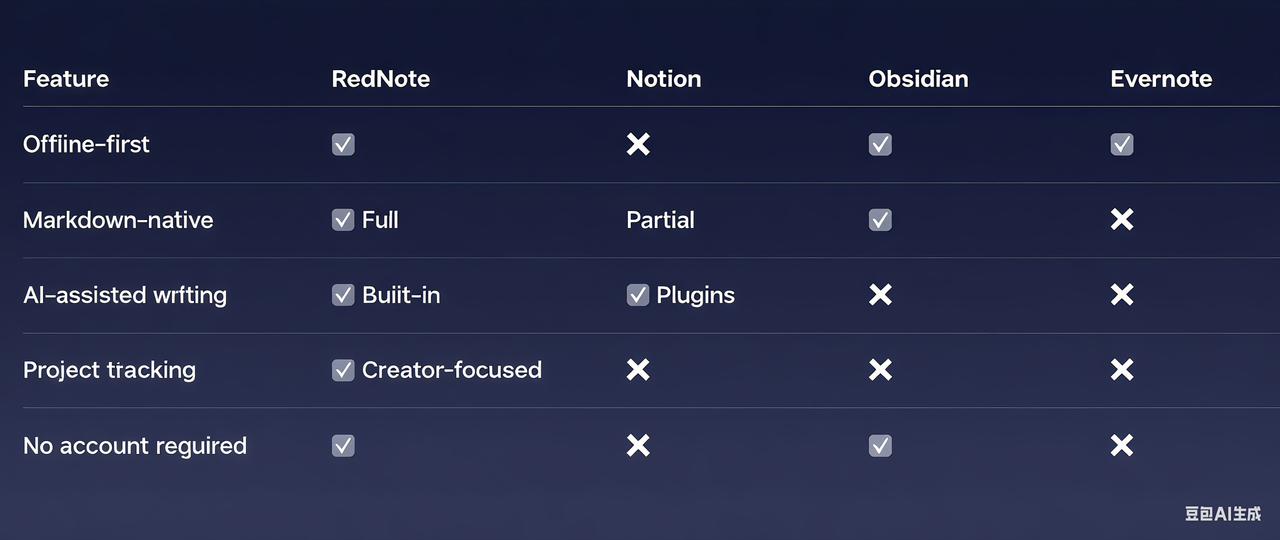
We’re not trying to be everything. We’re trying to be the best thing—for writing.
📈 Where We Are Now
- 🚀 Public beta live at rednoteapp.io
- 👥 1,200+ active users
- 🧪 A/B testing custom AI prompts for summarization
- 📱 PWA version in development
- 🛠️ Coming soon: Focus Mode with live grammar/clarity suggestions
🙌 Built for Writers, by Writers
If you write, blog, publish, or brainstorm creatively—you'll find RedNote refreshingly aligned with how you think.
Try it out at rednoteapp.io, and let me know what you think.
I’d love to hear your thoughts or connect with other indie makers building writing-first tools.
