I launched SubPulse with 0 users. Here's what happened after 90 days
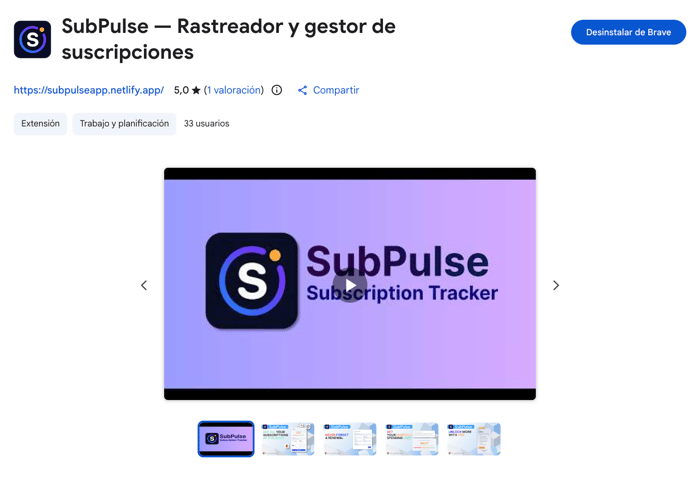
I launched SubPulse with 0 users. Here's what happened after 90 days.
About 90 days ago, I launched SubPulse — a Chrome extension I built to help people keep track of their subscriptions before they renew. When I launched, I had basically no users.
Now I have:
- 89 downloads
- 34 public users
- 9 uninstalls
- 225 Chrome Web Store impressions
- SubPulse 1.2.5 shipped
- Stripe payments fully set up
It's still very early, but I thought it would be useful to share what I've learned so far.
What SubPulse does:
SubPulse helps you keep track of recurring subscriptions, how much you're spending, and when your next payments are coming. I deliberately made it manual.
No bank connection.
No account.
No scraping emails.
No server storing your subscription list.
Your subscription data stays in your browser. The idea was to build something useful without requiring people to hand over their financial data.
What I've added since launch
The product has changed quite a lot since the first version. Some of the things I've added:
- Renewal notifications
- Chrome badge for upcoming/overdue renewals
- Spending history and trends
- Upcoming payments
- Multiple currencies
- Budget limits
- Calendar export
- CSV export
- Backup/import
- Search and filtering
- Pause/resume subscriptions
- Dark/light/automatic themes
- English and Spanish
- Weekly renewal summaries for Pro users
The current version is 1.2.5. The hardest part hasn't been building features. The hardest part so far has been figuring out what actually makes people come back.
Adding a subscription is easy.
Getting someone to install SubPulse, add their subscriptions, and then keep using it is a completely different problem. I initially thought the main value would be helping people understand how much they spend.
But I'm increasingly interested in the recurring reasons someone would open the extension again:
- A renewal reminder
- Checking upcoming payments
- Seeing how their spending is changing
- Realizing that a subscription has increased in price
- Checking whether they're approaching their monthly limit
I'm still too early to know which of these will matter most. So I'm trying not to guess. I'm trying to learn from actual users.
One thing I've learned
Building the product is only half the job. Getting people to discover it is a completely different challenge.
I've been experimenting with:
- Short-form videos
- Indie Hackers
- Product Hunt
- DEV
- X/Twitter
- Organic distribution
- And now Instagram
Some things work better than others, and I'm still figuring that part out.
What's next?
My next goal isn't to add 50 more features. It's to understand the existing users better.
I want to know:
- Why do people install SubPulse?
- What makes them add their subscriptions?
- What makes them come back?
- What eventually makes someone pay for Pro?
If you're building a SaaS or a small product, I'd love to hear:
What was the hardest part for you after getting your first users — acquisition, activation, retention, or monetization?
And if you want to take a look at SubPulse, you can find it here:
https://subpulseapp.netlify.app/
I'd also genuinely appreciate any feedback from other founders.

Your install → add subscriptions → return framing is exactly the funnel I’d use for any small product. I’d define activation as one completed job (for example, adding enough items to produce a useful total), then cohort only activated users for retention; otherwise installs muddy the read.
For a small paid info product, the same principle is a first completed worksheet or checklist, then whether the buyer returns or recommends it. That keeps feature requests from outrunning evidence.
This is such a clean way to look at it. Defining activation as "one completed job" is exactly what I need to focus on right now.
Currently, the Chrome Web Store dashboard definitely "muddies the read" because it lumps every single installed user into the Weekly Active User (WAU) metric, regardless of whether their dashboard is full or completely empty.
Applying your logic, my true retention cohort should strictly be the users who hit that 3-subscription threshold (producing a useful total). That is actually going to be the exact "activation" trigger I use for my local review prompt in the next update.
"Keeps feature requests from outrunning evidence" is a quote I need to frame on my wall! Do you mostly focus on paid info products right now, or are you building software too?
Really interesting to see how SubPulse evolved from a simple idea into a much more complete product in just 90 days. I can relate to the challenge of figuring out what users actually find valuable after launch.
We recently took a similar approach with our own project. We used vibe coding to build a tool called Destiny Matrix Chart, http://destinymatrixchart.co/ which was a great way for us to turn an idea into a working product without spending all our time on traditional development. The interesting part was that building the initial version was actually easier than figuring out how people would discover it, use it, and come back to it.
Your point about building being only half the job really resonates with us. Getting the first users and learning from their behavior can be much harder than writing the features themselves.
Thanks for the kind words, Andrew!
You absolutely nailed it: building the first version is the easy part compared to distribution and figuring out the actual use case. "Vibe coding" sounds like a great way to skip the initial friction and just get the product out the door.
Since you mentioned the challenge of discovering how people find the tool, what has been the most effective channel for you to get those first users for Destiny Matrix?
Thanks! So far, we’re still experimenting, but organic search and being active in relevant communities have been the most useful for getting early visitors to Destiny Matrix. We’ve also been creating content around numerology and self-discovery, which helps people discover the tool naturally rather than relying only on direct promotion.
Vibe coding definitely helped us move quickly from idea to a working product, but we’re now learning that getting the right people to discover it—and giving them a reason to come back—is the much bigger challenge. Still early, but it’s been a great learning experience so far.
That makes a lot of sense. Content-led SEO is a grind at first, but it pays off massively in the long run—especially for a niche like numerology where people are actively searching for answers.
Good luck with the next phase of growth! Figuring out the retention piece is definitely the ultimate boss fight for all of us.
adding a subscription being easy and coming back being the hard part is exactly where we are with our app, which turns a fridge photo into recipes. we had 10 testers and almost nobody opened it again the next day. the most useful thing people here told us was to split it into two questions, whether someone gets the one moment that proves the product works in their first session, and whether they have any reason to open it tomorrow, because those break for different reasons. for subpulse the renewal reminder feels like the natural reason to come back, so i'd be curious how many of your 34 users have actually gotten one yet. if most of them haven't hit a renewal date, some of your retention might just be waiting on the calendar
First off, that fridge photo to recipe idea sounds brilliant! The framework of splitting retention into the 'first session proof' vs 'tomorrow's trigger' is gold. You made me realize something huge: because Subpulse is entirely local and privacy-first, I actually have no way to see if those 34 users have triggered a reminder yet! But logically, you are 100% right. Most of them are probably just waiting on the calendar to hit a renewal date. That completely changes how I should look at my early retention numbers. Thanks for sharing this!
The install-to-return distinction is the right problem to focus on, and the manual/no-account choice makes the trust trade-off easy to understand. I’d separate “calendar-driven” retention from habit-driven retention by cohorting users whose first renewal is within 7, 14, or 30 days; otherwise the reminder feature may look weak simply because the event has not arrived yet. The first-session metric I’d watch is whether someone adds enough subscriptions to see a useful total, since an empty dashboard gives the later reminders nothing to build on.
This is incredibly insightful, thank you. You just completely shifted how I view retention for this specific type of tool.
Separating "calendar-driven" from "habit-driven" retention is a lightbulb moment. I was definitely at risk of misinterpreting "waiting for a renewal" as churn. Cohorting by that first renewal date (7, 14, 30 days) makes total sense for a reminder-based utility.
Spot on regarding the first-session metric, too. I actually noticed the "empty dashboard" friction recently and shipped quick-add presets (Netflix, Spotify, etc.) in the latest update just to ensure users hit a "useful total" in under 10 seconds.
I really appreciate you taking the time to write this. Are you currently building something in the product/growth space? You clearly know your stuff!
Yeah - closed Android beta for Veil, an 18+ fantasy confession app. Same acquisition/retention grind. If you know anyone who'd do a short closed Play test (keep it installed about 2 weeks), a Google-account email works. Either way, glad the cohort split helped.
Ah man, I would genuinely love to help you out, but I'm completely locked into the Apple ecosystem (iPhone user here!).
That 14-day Play Store rule is absolutely brutal though, I've heard horror stories from other Android devs.
Best of luck gathering the 20 testers for the beta! Definitely drop a link or reach out when you officially launch Veil — I'd be happy to support the launch or give you feedback on the landing page!
0 users to anything is the hardest stretch - 90 days of building in the void takes real stamina. we're in the same phase with swapfile.live (free in-browser file conversion) and the thing that finally moved our needle was showing up where users already complain about the problem, not where founders hang out. what channel worked best for you?
Thanks Mark! You are completely right, building in the void definitely takes stamina. Swapfile.live sounds like a super handy tool, by the way! I totally agree with your approach of finding where people are already complaining. For me, the channel that worked best was actually [Tiktok, YouTube shorts, instagram reels]. Finding those threads where people were frustrated with heavy subscription apps and offering a lightweight alternative was key. Best of luck with Swapfile!
The deliberate no-bank-connection choice is the part that would make me trust this. We made the same trade-off with Ajiez (everything computes locally, nothing uploads) — it costs you growth speed but buys a kind of word-of-mouth you cant buy. One thing worth tracking at day 90: the 9 uninstalls. If you can ask even 2-3 of those people why in a one-line email, that feedback is worth more than the next 100 downloads. Also, 225 store impressions in 90 days suggests the listing itself (first screenshot + first line) is your cheapest lever right now, before any marketing.
Thanks so much! It’s great to connect with someone who made the same local-only trade-off with Ajiez. You are totally right about the trust aspect—it’s a slower burn, but the word-of-mouth potential is much stronger.
Regarding the 9 uninstalls, because SubPulse is entirely account-free, I actually don't have their emails to reach out! But another commenter just suggested using an uninstall URL to catch that feedback, which I'm definitely going to implement.
Your point about the 225 impressions is spot on. Tweaking the Chrome Store screenshots and tagline is absolutely going to be my main focus this week. Really appreciate the actionable advice!
Wow, thanks to everyone's feedback and support in this thread, SubPulse just hit 97 downloads! 🎉
I have a huge favor to ask: I currently have exactly ONE review on the Chrome Web Store.
If any of you have installed it and appreciate the 'no bank connection / privacy-first' approach, leaving an honest review would mean the world to me. It’s the hardest part of starting from zero and I really need the social proof to cross the 100-user mark.
Here is the link: https://chromewebstore.google.com/detail/subpulse-—-rastreador-y-g/oilfoalnllbibcefadnollmchomhbple
Thanks again to this amazing community!
Going manual with no account is a smart way to earn trust. Do you know why the 9 people uninstalled? For me that's always the hardest number to get any signal on.
Hey doronk! Thanks for the kind words on the privacy approach.
Regarding the uninstalls: you are 100% right, that has been a total blind spot because of my zero-server, privacy-first setup. I couldn't figure out why people were leaving.
To solve this without breaking my privacy promise, I literally just shipped exit surveys (using Tally) yesterday! Now, whenever someone uninstalls, it triggers a clean goodbye page asking them why (e.g., empty screen, wrong features, or even because they successfully cleaned up all their subscriptions).
Can't wait to gather some real signal from those responses. It's the only way to bridge the feedback gap while keeping user data local!
For a product like Subpulse, I think the biggest lessons are likely around finding the right early users, understanding why they stay, and continuously improving based on real feedback. Getting those first few users must have been challenging, but that early feedback can be incredibly valuable for shaping the product.
Hey zinavoin! You hit the nail on the head. Getting those very first users and convincing them to trust a zero-server, local-only extension was definitely the hardest part.
That early feedback has completely shaped how I'm iterating right now. That's actually why I just shipped exit surveys—since I can't track users via backend analytics due to privacy, hearing directly from them (even when they leave) is the best compass to improve SubPulse.
Really appreciate the encouragement!
Congrats on getting to 34 public users—the retention question is the right one. I’d instrument the first-week path around the event that triggers a return (notification vs upcoming payments vs price change), then ask a few users to narrate why they opened it; that’s often more revealing than feature requests. I’m doing a small maker check with MP5 for non-eng PMs/ops/consultants/founders: could you spare ~20 minutes as a guest and reply yes/maybe/no on whether ~$5/mo feels useful? https://mp5-production.up.railway.app/ (Tip: ignore the Connect agents.)
Hey atriumai! Thanks for the congrats and the sharp advice.
You're totally right—focusing on the exact trigger that brings them back during that first week is key. Since I don't track users via servers for privacy reasons, leaning into qualitative feedback (like the exit surveys I just shipped) is definitely my go-to right now to understand why they open it.
Really appreciate the insights on the retention loop!
For a manual-entry tracker, I'd bet activation is the step to instrument first: how many of the 89 installs added 3+ subscriptions in their first session? That's usually the line between "tried it" and "relies on it". A pattern I've seen work with manual-entry tools is a one-click starter list (Netflix, Spotify, iCloud, Adobe, etc.) so the first session ends with a real monthly total instead of an empty screen. Renewal reminders look like your natural return trigger, so the key question is whether people enter enough to ever receive one. Do you know what share of active users have at least one renewal coming up in the next 30 days?
Hey Sameka! This is an incredible breakdown, thank you. You hit the nail on the head regarding the 'empty screen' friction.
Interestingly, I already integrated a quick-add preset system (like the ones you see for Netflix, Spotify, etc.) directly in the app to help users bypass that blank state and get a real monthly total in their first session.
As for the 30-day renewal visibility, since everything runs 100% locally with zero server analytics, I purposely can't see those aggregate numbers to protect user privacy. To bridge that feedback gap without breaking my privacy promise, I just shipped exit surveys (using Tally) to capture why users might leave.
Seriously appreciate the sharp analysis—spot-on product advice!
There is a category problem buried in your 9 uninstalls, and it is not a marketing problem, so no amount of channel work will fix it.
A subscription tracker has inverted retention. Its best outcome is that the user cancels what they came to find and then needs the tool less. Compare that with a tool whose value compounds, where every month of use makes the next month more necessary. Yours does the opposite: the better it performs, the weaker the reason to return. That means the shape of healthy retention is not the weekly habit the app-store numbers are usually read against, but something closer to an audit cycle, where long gaps are the expected state and the correct unit is the renewal interval rather than the day.
That has a direct consequence for your own measurement. Of those 9 uninstalls, an unknown share are people who got what they came for and had no further use, and the rest are people who never got past adding the first subscription. Those two groups look identical in your numbers and mean opposite things. One is your product working; the other is your product failing. Collapsing them into one churn figure means the number goes down either way the product improves.
The same property explains why your privacy choice costs more than growth speed. With no account and no bank connection you cannot send the uninstall survey that would separate the two groups, and you cannot see whether a returning user is returning for the reason you think. The trade-off is not privacy versus convenience, it is privacy versus legibility, and the second one is the expensive half. It is still the right call for this product, but it should be paid for deliberately, which usually means an opt-in event with the minimum payload, never a silent one.
The part I would want before optimising anything else: a way to tag the two kinds of uninstall, even crudely. Without it, every downstream improvement is being judged on a number that cannot move in the right direction.
On my side, so you can weigh the above: I work on Piramyd, which exists for exactly this class of measurement gap.
Of your 34 users, how many have hit a renewal date at all, and of those, how many opened the reminder?
Wow, Credo, this is probably the most insightful feedback I've received so far. The concept of 'inverted retention' is a brilliant way to frame it. You are absolutely right—someone uninstalling because they successfully cleaned up their subscriptions is a 'win' that currently looks exactly like a 'loss' in the metrics.
Your point about 'privacy versus legibility' perfectly captures the core struggle of building this way. Because I strictly keep all data local with no accounts, to answer your final question: I honestly have no idea how many of those 34 users have hit a renewal date or opened a reminder! It is a complete blind spot.
Another user recently suggested using an uninstall URL to catch feedback, which seems like the best minimal-payload way to separate those two groups of uninstalls (success vs. failure) exactly like you suggested.
I will definitely be checking out Piramyd—it sounds highly relevant for this exact headache. Thanks again for such a thoughtful breakdown!
Activation, by a distance. I also work on a personal-finance app with no bank connection, where the data comes in from a statement import or from the person entering it, and the whole game is the gap between installing and seeing your own numbers on screen. Someone who never gets past an empty screen has no reason to come back for any of your five return triggers, so I would make that first entry the metric before choosing between reminders and trends. The concrete thing that helped was instrumenting each step of that first session separately instead of only the install and the purchase. Until I did that I was guessing about where people dropped out.
You hit the nail on the head. That 'empty screen' hurdle is the absolute biggest enemy for apps like ours with no bank sync. The gap between installing and actually seeing value is everything.
The tricky part for SubPulse is instrumenting those onboarding steps without breaking the strict 'no server, local data only' privacy promise. It’s a tough balance! But you are 100% right—getting them to make that first entry is the real metric. Thanks for the insight!
Great post. I’m currently launching a new social app from zero users too, so this was really useful to read. For you, what was the single most effective thing that brought your first 10 real active users?
Thanks so much! Good luck with the social app launch. For me, the single most effective thing was posting genuinely in niche communities (like Reddit) where my target users hang out. Instead of just dropping a link, I shared the exact problem I was trying to solve, and that resonated with those first early adopters.
Thanks for sharing real numbers at 90 days. Keeping it manual with no bank connection, no account and data that stays in the browser is a deliberate trade-off, and for a lot of people it's exactly the reason they'd trust a subscription tracker in the first place.
Thanks, tsutsu! You nailed it. It’s definitely a deliberate trade-off, but giving users total privacy and peace of mind is 100% worth it. Really appreciate you taking the time to read the post!
Your privacy choices and your question pull against each other. No account and no server means you can't see why 34 people stayed or why 9 left, which is exactly what you want to learn.
Two cheap fixes that keep the promise. Chrome lets you set an uninstall URL (chrome.runtime.setUninstallURL), so those 9 could land on a one-question page: "what made you remove it?" And an opt-in weekly ping with counts only (subscriptions added, reminders opened) would tell you which of your five return reasons actually fires.
To answer your question: for us it's acquisition, by a mile. UtilitySEO sits at DA 3 with about four search visits a month, so analytics can't teach us much either. Most of what we know came from 31 replies across 403 community comments.
Which return reason are you betting on?
Spot on, James. Maintaining privacy definitely makes analytics a real challenge, and finding that balance is tough.
Regarding your first fix: funny you mentioned it, but I just implemented chrome.runtime.setUninstallURL today! I pushed an update (v1.2.6) that opens a super quick, one-question Tally form asking why they removed it. It is indeed a privacy-respecting way to gather crucial feedback without a server. Fast execution, eh?
I really like the idea of the opt-in weekly ping for counts. I might add that in a future version once I nail down the onboarding properly.
As for my bet, I’m putting my money on urgent utility/financial savings. I don't think people will "love" using SubPulse. The value is simply avoiding the "ADHD Tax." My bet is that the notification 3 days before the charge will be the "Aha moment" and the sole reason they keep it installed—to save money without thinking about it.
Thanks again for the thoughtful reply!
My honest opinion is that the privacy side feels like the actual product story here, not just a technical detail. There’s no shortage of subscription trackers out there, but “track your spending without linking a bank, signing up, or sending data to a server” is a super clear differentiator. It’d be fascinating to see if that privacy angle is what’s actually driving people to try SubPulse in the first place, or if it’s just a nice bonus they notice after installing.
You hit the nail on the head. This is the central question I’m grappling with right now: is privacy the 'why they come' or just the 'why they stay'?
My current hypothesis is that it's a major acquisition driver. The biggest barrier to entry for most subscription trackers (like Rocket Money) is the friction and anxiety of linking a bank account. By explicitly stating 'no sign-up, no bank required' in my recent messaging, I'm trying to lower that barrier for people who want clarity without the commitment or security risk.
I just started testing this angle more aggressively in some acquisition content today (highlighting the contrast between heavy apps and a simple local extension). If installs go up, I'll know privacy is the true hook.
I appreciate you articulating that so clearly!
That’s actually a much stronger positioning test than simply saying SubPulse is “privacy-focused.” You’re testing whether the privacy difference changes the decision to install, rather than assuming people care about it.It’ll be interesting to see whether the “no sign-up, no bank required” message changes installs compared with your previous messaging. If it does, you’ve got a pretty clear acquisition angle to build around.
Exactly! I'll let the test run for a bit to gather enough data. I'll definitely share the results here once I have them. Thanks again for the great chat
Do you have a breakout of where those downloads came from, such as X vs Indie Hackers vs short form videos? Did you do any paid advertising? If so where? If not, what did you do that worked on those other platforms? Do you know?
Great questions, marketotter!
To answer your first one: $0 spent on ads. It's been 100% organic so far.
Regarding the breakout: I'll be brutally honest—until today, I didn't have solid tracking in place. I was using the raw Chrome Web Store link everywhere (a classic beginner mistake!). However, I actually just crossed 97 downloads today, and my best guess is that YouTube Shorts and this very Indie Hackers community are doing the heavy lifting right now.
But I've just fixed the tracking issue. As of today, I've set up unique tracking links for my socials so I'll have hard data for my next update.
As for what works organically on short-form platforms: Authentic, emotional hooks about losing money. Videos just showing the UI features flop. But videos showing the frustration of a forgotten $10 subscription renewing automatically, followed by SubPulse as a simple, privacy-first solution (no bank connection needed), convert much better.
Zero users after launch usually means distribution, not the build. One channel over-indexed beats five half-tried — what’s the single free channel you’d double down on this week?
Thanks! Right now I’d probably double down on short-form video, mainly TikTok and Instagram Reels. I already have a repeatable content format around Chrome extensions, and it’s starting to give me some signal without spending money.
I’m still testing whether the traffic can actually turn into SubPulse installs, though. So my next step is to focus more heavily on that channel and track the full funnel from views → profile visits → installs rather than just views.
I’m also trying to keep the product itself in the content naturally instead of making every post feel like an ad.
The part about figuring out what makes people come back really resonates. I’m building a small tool around AI brand visibility that helps businesses see how often AI assistants mention their brand compared with their competitors.
What I find interesting is that the value isn't just in getting a single visibility number — it’s in seeing where competitors are appearing instead, and understanding how your brand is represented across different AI answers.
I’m also trying to learn whether that’s something founders and marketers would actually return to and use regularly. I am documenting my experiment so you can check out my post here on Indie hackers if you have time :)
Hey Signum, thanks for reading! The retention struggle is definitely the hardest part of building SaaS.
Your tool sounds incredibly timely—AI Search Optimization is basically the new SEO, so knowing where competitors show up in LLM answers is a very strong value proposition. Regarding your retention challenge: maybe pushing automated 'competitor shift' email alerts (e.g., 'Competitor X just overtook you in ChatGPT prompts') could create that recurring habit without forcing them to log in every day?
I'll definitely check out your post and drop some feedback there. Best of luck with the experiment!
Thanks so much for the thoughtful reply! 🙌 I really appreciate you taking the time to share that.
The idea of competitor-shift alerts is actually really interesting. I hadn’t thought about retention from that angle, and I can definitely see how meaningful changes could give people a reason to come back without needing to check the tool constantly.
I’m still very early in figuring this out, so feedback like this is genuinely helpful. And thanks again for taking a look at my post — I really appreciate it! 🙏
You're very welcome! Glad the alert idea sparked some inspiration. Keep up the great work and best of luck with the tool! 🙌
Thanks alot! 🙌 Wishing you the best of luck with your journey too. Hope it goes really well! 🚀
Really interesting journey. Building a SaaS product from zero users and learning about acquisition, activation, and retention along the way is a valuable experience. I especially like the focus on understanding user behavior before adding more features. For anyone exploring SaaS product development, this is a useful perspective.
Thanks Muzzamil! It is definitely tempting to just keep coding new features when growth feels slow, but forcing myself to stop and look at activation data (like setting up uninstall feedback) is proving to be way more valuable. Appreciate the support and thanks for reading!
Activation was the hard part, not acquisition. 89 downloads from 225 Chrome Web Store impressions is already a strong listing, so another channel will not tell you much until more of those installs reach a useful moment. The number I would watch is how many of the 34 users have a renewal inside the next 14 days. If the next charge is a month out, themes, CSV, and Spanish have nothing to bring them back for, and Pro only becomes obvious after a reminder actually saves someone money. The 9 uninstalls are the fastest read on that: a Chrome uninstall URL with one question (added a subscription vs never got to a useful date) beats guessing which feature to build next.
The distinction between “installed” and “reached a useful moment” is really interesting.
I’m building a tool that shows brands how visible they are in AI-generated answers compared with their competitors. It gives them a simple way to see whether AI is mentioning their brand or competitors more often.
I think the same activation question applies here too — getting someone to use the tool once is very different from them seeing enough useful insight to actually care about it.
Really interesting point about measuring the useful moment instead of just downloads or signups. I am documenting my experiment so you can check out my post on indie hackers if you have time: )
This is arguably the most valuable feedback I’ve received so far. You completely nailed the structural problem: the 'Aha!' moment (the notification actually saving them money) might be too far away from the installation moment.
If their first renewal is 25 days out, I'm relying on them keeping the extension installed based purely on a promise, and features like Dark Mode or CSV exports won't bridge that gap.
The uninstall URL is a brilliant, low-friction way to get qualitative data on this. I’ll set up a simple redirect today with a one-click survey to find out if the churn is happening before or after adding their first subscription.
I've been looking too closely at the CWS impressions and completely missed that my real bottleneck right now is 'Time to Value'. Thanks for the reality check, seriously.
Your 9 uninstalls might be the most useful number here. If you can reach even three of those people (an uninstall survey URL in the extension settings does this automatically), you'll learn more about activation than from the 34 who stayed.
On "what makes someone pay": before guessing, look at what the existing subscription trackers put behind their paywall and what they charge on their pricing pages. Whatever they consistently charge for is the part buyers have already shown they value. Your no-bank-connection angle is a real differentiator, so the question becomes whether privacy-focused people pay for reminders, for insights, or not at all, and competitors' pricing tells you where to test first.
I'd also narrow the channel list. Seven channels at 225 impressions usually means none gets enough attention to tell you if it works. Pick the one where your 34 users actually came from and go deep for a month.
The point about learning from the people who already tried the product really resonates.
I’m building a tool that shows brands how visible they are in AI-generated answers compared with their competitors. It helps make something that’s otherwise difficult to see — whether AI is mentioning your brand or consistently choosing your competitors.
I’m also finding that the interesting part isn’t just getting someone to try the tool, but understanding whether the result gives them enough useful insight to actually care about it.
Really like the advice on going deeper into one channel instead of spreading attention across too many. I am documenting my experiment so you can check out my post here on indie hackers if you have time :)
You are completely right, and it's funny because another commenter just pointed out the exact same thing about the uninstall URL. It was a huge blind spot for me. I'm implementing chrome.runtime.setUninstallURL in my next update today to catch those exit intents.
Your point about reverse-engineering competitor paywalls is brilliant. I've been trying to 'guess' my Pro features instead of looking at what the market has already validated. The local-privacy angle is my acquisition hook, but you are right: I need to see if privacy-focused users are willing to pay for insights, or if I need to pivot the Pro tier towards purely financial features (like advanced forecasting).
Regarding the channels: guilty as charged. I've been splitting my limited time between TikTok, YouTube Shorts, and Indie Hackers itself. I need to look closely at my CWS analytics, identify the exact source of those 34 active users, and just double down on that one platform for the next 30 days.
Thanks for taking the time to write this, it's incredibly actionable advice.
Glad it helped. One cheap way to answer the privacy-vs-insights question before building more Pro features: put a "Pro" label on two different features (say, price-increase alerts and spending forecasts), and when someone clicks either one, show a short "coming to Pro, want early access?" prompt. Clicks per feature from your existing users are a real signal, and it's a day of work instead of a month.
On the channel: if Chrome Web Store search turns out to be where most of the 34 came from, then the listing itself is the channel to go deep on. The title keywords and the first screenshot are probably worth more attention than a new platform.
One more thing, since you're right at the "what will people pay for" stage: I'm the founder of Demand Before Build, and I'd be happy to run a free validation on SubPulse's paid tier. It shows the real competitors already selling subscription tracking, the prices they publish, and which of them are paying for Meta ads, with every finding linked to its source.
If you want it, sign up at demandbeforebuild.com/?ref=ih and email support@demandbeforebuild.com from the same address, and I'll add the credit to your account. No strings attached, and if the report isn't useful I'd genuinely like to hear why.
Glad it helped. One cheap way to answer the privacy-vs-insights question before building more Pro features: put a "Pro" label on two different features (say, price-increase alerts and spending forecasts), and when someone clicks either one, show a short "coming to Pro, want early access?" prompt. Clicks per feature from your existing users are a real signal, and it's a day of work instead of a month.
On the channel: if Chrome Web Store search turns out to be where most of the 34 came from, then the listing itself is the channel to go deep on. The title keywords and the first screenshot are probably worth more attention than a new platform.
congrats that great
Thanks a lot, Victor! Let me know if you have any questions about the journey.
Congrats on 90 days of real shipping — 34 public users from zero is honest progress, and 1.2.5 shows you kept going where most people quit.
On your four questions: my bet is activation and retention are really the same question for you. A subscription tracker has no recurring reason to be opened until a renewal is near, so the "aha" isn't adding subscriptions — it's receiving the first timely renewal reminder. The person who adds 5 subscriptions but never gets a notification is less activated than the person who adds one and gets warned about a price increase a week later.
One concrete experiment: cohort your 34 users by whether they received a renewal reminder within their first 30 days, and check 30-day retention for each group. If the gap is big, you know the next feature isn't a feature — it's getting the first notification delivered faster, e.g. asking for one upcoming renewal date right at install.
Also, don't sleep on the "no server storing your list" angle as distribution, not just architecture. Trackers that require bank connections scare a specific audience; being the privacy-safe alternative is a positioning story that can carry a lot of organic reach.
Thanks! I really like the distinction between “adding subscriptions” and actually reaching the first useful moment.
The idea of cohorting users based on whether they received a renewal reminder within their first 30 days is especially interesting. I hadn't thought about activation that way, but it makes a lot of sense for SubPulse.
I'm going to start tracking that and compare it with 30-day retention. If the difference is significant, it would give me a much clearer direction than just adding more features.
I also agree about the privacy angle. I initially treated “no account, no bank connection, no server storing your subscription list” mostly as an architectural choice, but I probably haven't pushed that positioning enough in the distribution.
Thanks for the thoughtful feedback — this gives me a couple of things I can actually test.
The insight here is that you're measuring when each signal value emerges. A user adding subscriptions on day 1 is one motion — but renewal reminders hitting on day 7 create a different motion. The stickier signal isn't the feature; it's the timing of the value delivery. Have you tracked which signal first creates a return — is it the reminder, the price-jump alert, or just the monthly spend report landing?
That's exactly what I'm trying to figure out right now, but I haven't tracked those signals separately yet.
My initial assumption was that renewal reminders would probably be the main trigger, while things like spending reports or price changes might create more occasional returns.
But with such a small user base, I don't want to treat that assumption as fact. I'm going to start tracking which event happens before each return and compare reminders, price changes, and spending reports.
The timing point is especially interesting to me — the feature might not be what creates the habit, but when the value actually reaches the user. Thanks for the idea!
Congrats on turning a zero-user launch into real usage and a shipped 1.2.5. At this stage I’d keep the feature set stable for a week and instrument a simple cohort funnel: install → first subscription added → first reminder viewed → return within 7/30 days. Then do five short calls with retained and churned users; the “why did you open it again?” answer is usually more actionable than a generic feature request, and it should make the next retention bet much clearer.
Thanks! I really like the idea of keeping the feature set stable for a bit and focusing on the funnel instead. I haven't instrumented those exact events yet, so this is actually a good push for me to do it. I also agree that asking users why they came back (or why they didn't) could be much more useful than guessing from feature requests. With such a small user base, I think those conversations could teach me a lot.
Among the 34 users, what behavior most strongly predicts retention—adding more subscriptions, responding to renewal reminders, or repeatedly checking upcoming spend?
That's actually something I don't know yet — and I think I need to start measuring it properly. My guess going in was that renewal reminders would be the main reason people come back, while spending and upcoming payments might drive more occasional usage. But I don't want to assume that's true. I'm going to start tracking those behaviors separately and see what actually correlates with users coming back.