Solving Customer Pain Points: Is Payment Orchestration The Answer?
There was a time when online businesses had absolutely no idea or interest in finding out who their clients were. All they knew was that business was coming in, and that was good enough. But things have changed significantly since then. Now, it’s all about the customers, their needs, preferences, and pain points.
Expanding businesses are extremely focused on all kinds of ways of keeping clients satisfied with the purchasing experience while also keeping costs low. But it’s a tough game to play, especially in the SaaS and software industry, with a whopping value market of no less than $237.55 billion, estimated in 2022.
The good news is that within this landscape, technology innovation, specifically in the payment ecosystem, has completely revolutionized the way in which online merchants respond to customer expectations. And at the heart of it lies the concept of payment orchestration.
What Is Payment Orchestration?
Payment orchestration is the end-to-end process of integrating and managing numerous payment providers, methods, and channels, as well as complex and essential operations like transaction handling, authorizations, and routing. It involves the coordination of different entities like processors, gateways, and financial institutions all under one unified solution with the purpose of ensuring flawless payment experiences for shoppers.
With a payment orchestration system on their side, start-ups, SMBs, and enterprises can become more agile and are able to scale worldwide faster. They can easily enter new markets, answer to region-specific payment preferences, and comply with different regulations, all while keeping growth expenses low and staying focused on product development.
Think of this concept as a unified payment infrastructure. Once your business taps into this ecosystem, you can outsource costly and complex operations and ultimately accelerate your business’s expansion.
Introducing the Payment Orchestration Flow
When it comes to digital payments, there are standard rules that govern how payments are processed and transactions are finalized. And the payment orchestration makes no exception to these rules up to a certain point.
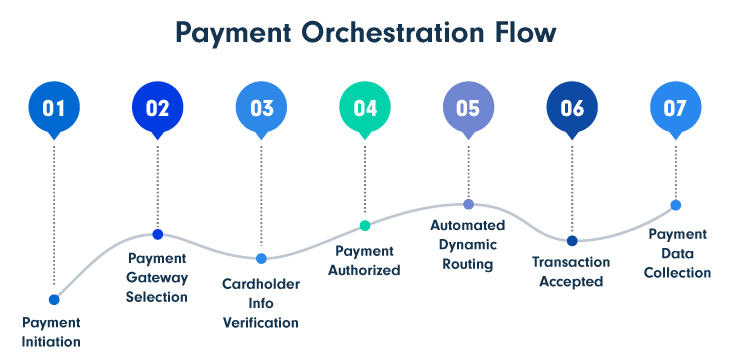
Step 1: Payment Initiation
The shopper reaches the checkout page and selects the preferred payment method.
Step 2: Payment Gateway Selection
The payment orchestration system decides which gateway is best suited to handle the transaction.
Step 3: Cardholder Info Verification
The client’s payment details are verified, and if there are sufficient funds available, the payment goes through.
Step 4: Payment Authorized
The customer is informed that the transaction has been successful.
Step 5: Automated Dynamic Routing
In case the payment is denied, the system will employ dynamic routing to quickly identify the right alternative and process the payment successfully.
Step 6: Transaction Accepted
Once the payment is settled, the system will inform the customer and merchant.
Step 7: Payment Data Collection
The orchestration platform collects payment data gathered from the operation, offering businesses the necessary information to analyze customer behaviours and better optimize their processes.
One of the biggest advantages of this digital payment process is that the platform will identify the best route for transactions to take, taking into consideration the region in which the payment is made.
With failed transactions causing businesses to lose up to 30% of their hard-earned revenue, it’s easy to understand why the automated dynamic routing feature of payment orchestration systems is such an important feature.
Of course, there are other reasons why payments fail like:
- Fraud
- Invalid cardholder data
- Insufficient funds
Still, mitigating the failed transaction rate will undoubtedly lead to increased revenue and happier clients. And that’s always a reason to celebrate.
Discover the benefits of payment orchestration platforms and** its dark side** on PayPro Global’s Blog.
