Things you WANT to do vs things you SHOULD do
As a solopreneur indie hacker, it’s easy to be permanently distracted by tasks that you want to do - microscopic UX improvements, esoteric little features that only you will ever use or starting new projects.
But in the back of your mind, if you ask yourself honestly, you probably know what you should be doing.
Maybe you’ve been meaning to try advertising but you don’t know where to start, or you need to write a blog post but the words aren’t coming.
The reason we gravitate towards coding activities is because this is where we have great skill and experience, so we feel happy and confident when we work on them. The other skills, which we can generally feature under the banner of “marketing”, are more alien to us, and we can tell we’re not so good at them.
We want to feel good about ourselves but we can’t grow without pushing through a pain barrier, the “taste” barrier, where our taste is so far ahead of our ability that we feel genuinely ashamed of our work.
How to overcome this problem?
Like any skill, we can only improve by doing. For this sort of thing, that “doing” must, to some extent, be forced.
You probably need a routine. A “don’t-break-the-chain” new habit where you invest a little time each day to get better.
Guess what? Soon you’ll be really good at this stuff, and then you’ll enjoy it. Your time investment will begin to compound and you’ll be drumming up new business at an accelerating rate.
The better you get, the more eyes you’ll have on you, and the more people will be angling to get involved. They’ll see the energy and skill that sets you apart from the crowd and they’ll want to become a part of what you are doing.
But it starts slow and difficult.
And afterwards you're exhausted, and you just want to go back to coding.
It’s frustrating as you grapple with unfamiliar tools. Writing is a fundamental part of marketing but writing feels utterly unproductive, requiring an enormous amount of procrastination and avoidance.
But then, suddenly, you'll blurt out an entire blog post in one sitting.
You never know what's going to work. I try to avoid spending weeks on a single video, because it's so hard to know which ones will take off and which ones won't. It's the same for everything - a short post that I typed in anger is the most successful thing I've ever shared on this site. Meanwhile, things I've spent months on have come to nothing.
Some tips
Tip 1. Always finish an entire draft in one sitting
Don't leave posts, scripts or even tweets half-written. Once you're in it, you need to finish. Otherwise when you come back, you'll have to start again.
Tip 2. Measure the outcome
Make sure that you're able to track the success of different campaigns.
I use a query string parameter for links to squares.tv that gets attached to new sign-ups on the website and is passed through to App Store links so I see it in my Apple reporting.
I'd suggest assembling a report each week. I do this in public and print each one out so I have a physical history.
Tip 3. Make a game of it
I use Coda (here's my referral link) to create data-driven documents (it's similar to Notion, but I discovered it first).
If I have, say, a load of emails to send, I create a table and make myself a little UI that shows me who I have to email next and when I tick it off it tells me how long it took, and I can start competing with myself to improve my time (aka decrease procrastination).
I made a content planning document this week. I settled on two guiding principles: 1. "can it stop the scroll? and 2. "is it funny?"These goals are baked into the data structures of my document.
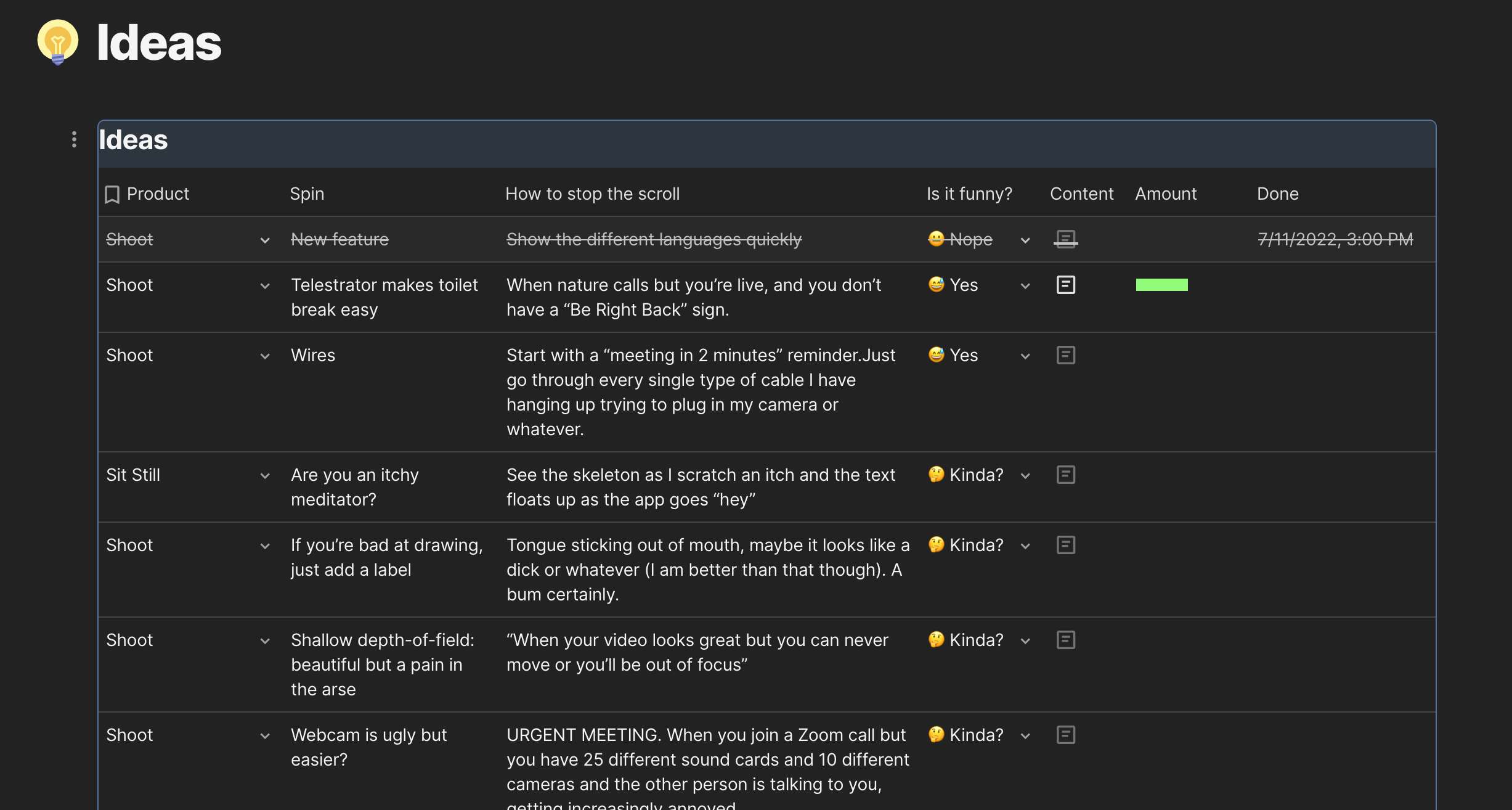
This is my list of ideas. I start with unstructured ideas in text below this table and then promote them to the table if I think they might work.
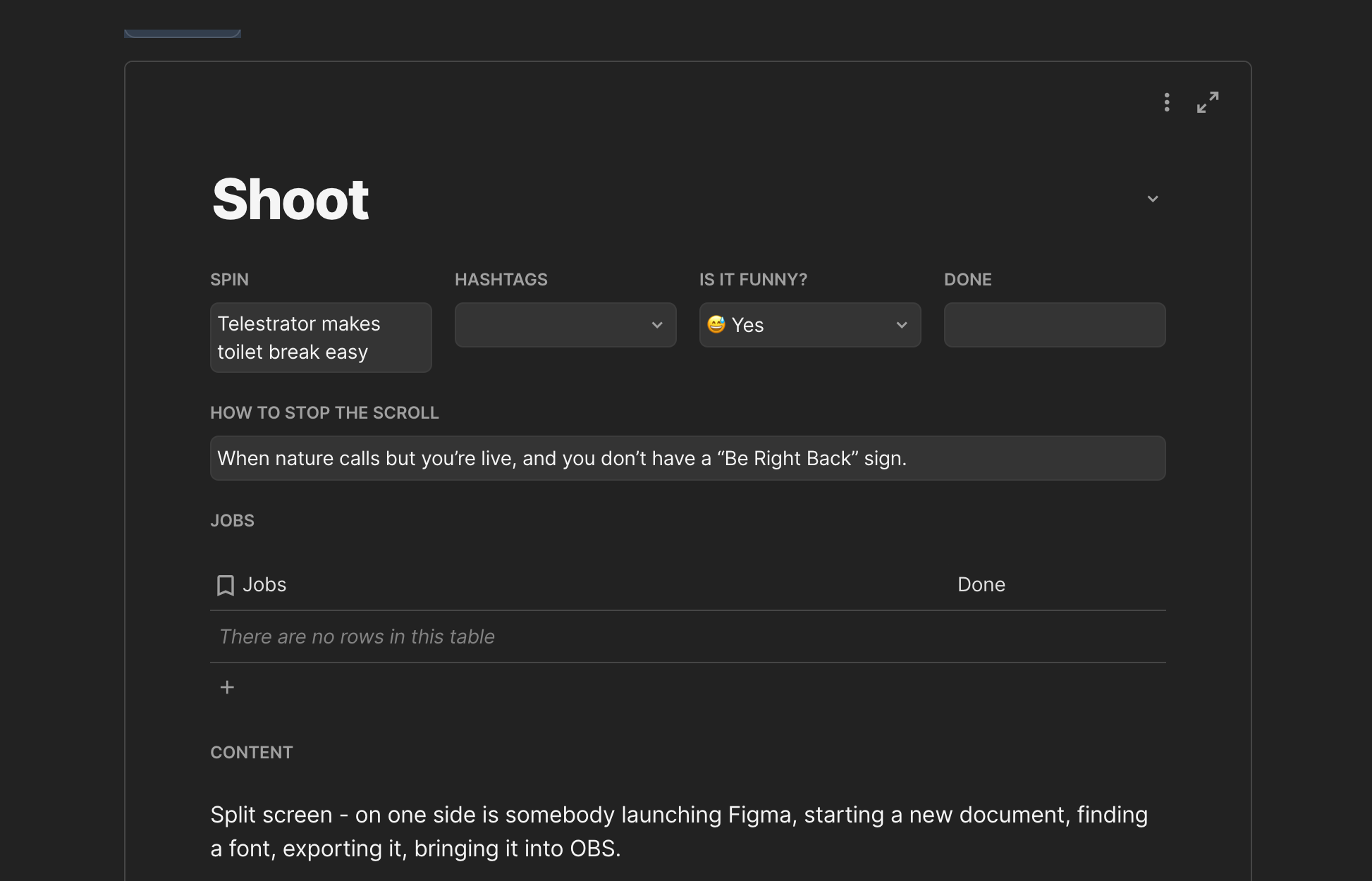
This is my "working" view, showing me whatever is at the top of the list, so that I don't get distracted by other ideas.
Bonus (self-promoting) tip
I made myself a tool called Donegood that lets me time-box my daily activities. This is how I plan my life. On Mondays I work on things I've been thinking about over the weekend. Tuesdays, Wednesdays and Fridays should be mostly marketing and talking to people. I give myself Thursdays to prototype my latest crazy idea, with the intention of turning it into an MVP I can share ASAP. I use Donegood to track all my time and keep myself honest about where I've been focusing my energy.
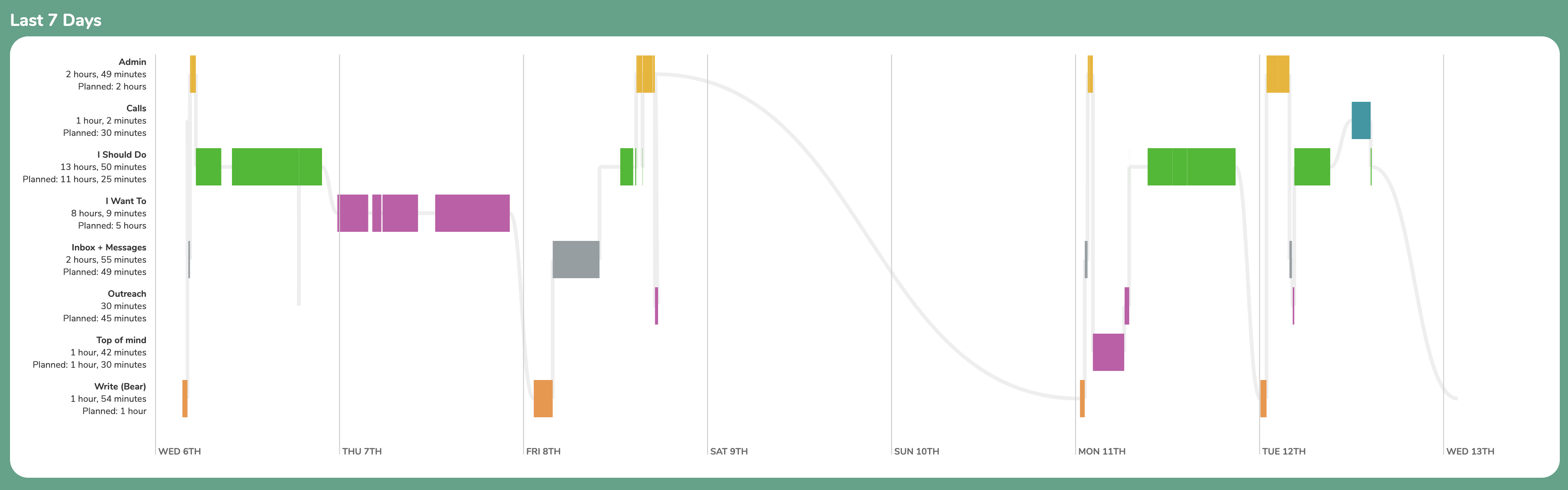
Donegood as a SAAS is one of my failed projects (with only one paying user who is not actually using it) but I still use it every day so it wasn't a complete waste of time! It occurred to me while I was writing this post that there might people here who would find it useful so if you give it a try and like it, I'll have an excuse to convert it from React+Redux+Rest APIs into a much snappier Phoenix LiveView version!
What do you think?
How do you "encourage" yourself to work on marketing when you really don't feel like it?

As they say, "the best marketing doesn't feel like marketing".
I find "building in public" is the best marketing when you don't feel like marketing,
I find that approach makes less sense for me as most of what I would "naturally" talk about is too technical for my target audience, and I'm mostly not marketing to other entrepreneurs (not programmers anyway).
Thanks for sharing, Michael 🙏
You gave an excellent example of how marketing can be done. You promote your product, but! You give a ton of value, and you share what you are really interested in.
I started my marketing activities recently, in June. And after a month of marketing, I got my first paying customer. It reinforced what I have done, and now I have the motivation to continue.
What helps? I look at marketing as engineering, not as an art or magic.
Suppose we need to get to the first page of Google Search. I reverse-engineer activities I need to do and then do them.
Results? Astonishing!