Understanding Cross-Border Payments: Challenges and Best Practices
Estimated to reach $290.2 trillion by 2030, the B2B sector alone will be $56 trillion, proving the cross-border market is incredibly attractive for merchants looking to grow their revenue.
However, as simple as it might seem, orchestrating the sending and receiving of funds internationally can be an extremely complicated undertaking.
Prone to constant transformation due to dynamic customer demands or legislative changes, unfortunately, the global market is ripe for disruption.
In this article, we’ll be taking a deep dive into the world of online cross-border transactions, exploring the hurdles of selling across borders, and sharing some insights on how to boost your profits while doing it.
- What Are Cross-Border Payments?
- Types of International Payments
- How Do Cross-Border Payments Work?
- Cross-border Payment Method Examples
- The Benefits of Global Benefits
- 6 Challenges of Going Global
What are Cross-Border Payments?
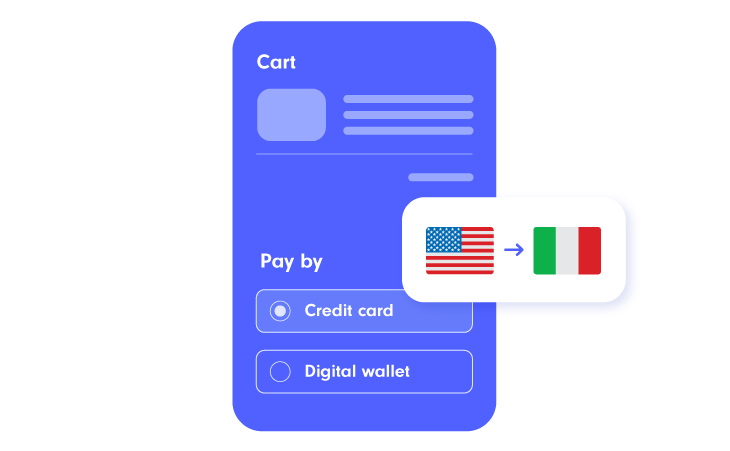
Cross-border payments are financial transactions that take place between parties located in separate countries. Initiated by either individuals or businesses, they involve multiple currencies, payment methods and abide by specific taxation and compliance regulations.
Types Of Cross-Border Payments
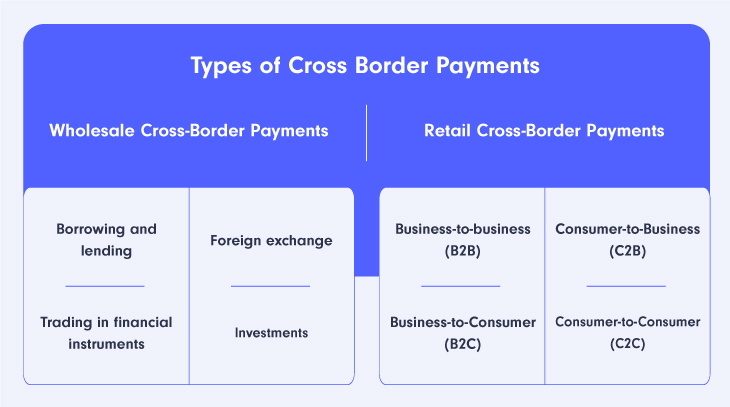
Within the cross-border payments landscape, there are two transaction sections:
Wholesale Cross-Border Payments
Wholesale cross-border transactions take place between financial institutions, governments, corporations and other relevant international organisations, facilitating different purposes within the international trade sphere like:
- Borrowing and lending
- Foreign exchange
- Trading in financial instruments
- Investments
These transactions generally involve considerable amounts of money, which is why they require specialized expertise and an elaborate infrastructure to professionally cater to the complexities associated with large-scale global operations.
Retail Cross-Border Payments
These are international transactions that occur between individual consumers and businesses, located in different countries. These are generally regarded as small-scale online transactions, meant to cater to everyday needs or personal spending. Retail cross-border payments are of several types:
-
Business-to-business (B2B): these are transactions that take part between two or more businesses.
-
Consumer-to-Business (C2B): in this scenario, the consumer is the provider of goods or services to the business.
-
Business-to-Consumer (B2C): in this case, the business is the provider of the good or service to the consumer.
-
Consumer-to-Consumer (C2C): these are person to person payments with no intermediary businesses involved.
How Do Cross-Border Payments Work?
At first glance, online cross-border transactions seem fairly simple, as they are not that different from domestic payments. Yes, your website still requires a checkout page, where your shoppers will provide the requested payment data.
However, on the backend, is where things get a bit more complicated, so to make sure that they work adequately, a lot of attention to detail and planning is required.
The best chance your business has to succeed internationally is working with a strong cross-border payments platform ready to sustain your growth efforts. But before we get into that, let’s take a look at the step-by-step process:
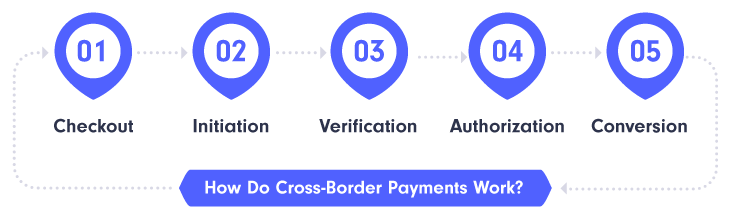
Step One: Checkout Page Visit
The customer decides to make a purchase on your website, so they head out to the checkout page.
Step Two: Transaction Initiation
The sender selects the right option from the cross-border payment methods offered and provides the required data. The tax amount associated with the purchase will be determined based on the merchant's and customer's location.
Step Three: Transaction Verification
The payment gateway transfers the customer data to the merchant’s payment processor (the acquiring or merchant bank), to verify if there are sufficient available funds. During this step, a number of global payment rules, including anti-money laundering regulations and various fraud verifications, are taken into consideration.
Step Four: Transaction Authorization
Next, an authorization request is sent to the credit card’s issuing bank for verification, and the response will then be forwarded back to the payment processor. As soon as this happens, the merchant and the customer are informed through a payment message if the transaction was successful.
Step Five: Transaction Conversion
If the customer's bank account has a different currency, this is when they are converted into the merchant’s currency.
6 Challenges of Going Global
While global trade is currently the land of opportunities for brands looking to expand, there are also pitfalls you might stumble upon that might cost you your business. Before deciding whether or not to go global, it would be wise to be aware of the problems you might face along the way.
Complex Compliance and Tax Regulations
As a merchant, you need to determine, collect, and file the tax when starting to sell worldwide. However, with the growth of international trade came not only profit for entrepreneurs but significant changes in tax and compliance legislation. In the US alone, there are now over 11,000 sales jurisdictions.
Errors, missed deadlines, and misinterpreted tax collection and reporting guidelines are all valid reasons for tax collectors to apply hefty fines, thereby putting your global growth at risk.
Even if it seems the obvious solution to overcoming this cross-border payments market challenge is to have a dedicated in-house department to handle taxation and compliance, we’re here to tell you it’s actually not the answer.
Be warned: The operational work associated with selling products online is such a heavy burden that it could seriously affect both business performance and profitability.
Payment Methods and Currencies
Going global means staying local. An ambiguous concept, but very true, nonetheless. However, plenty of businesses fail to understand the importance of payment preferences and put into place the one-model-fits-all approach. By doing so, they have made a big mistake and then failed miserably at delivering what is expected.
Whether they find offering multiple payment options complicated, unnecessary, or believe the transaction fees are too high, the truth is that a lack of a flexible offer will significantly undermine their global growth efforts.
Slow Processing Times
Even though cross-border payment systems have benefited from numerous innovations, we’re still seeing a common hurdle among brands wishing to expand internationally.
Slow payment processing is a serious issue for shoppers because they have zero tolerance for order delays. Risk of system overload, customer frustration, increased wait times, higher cross-border transaction costs, and declined payments, are all likely due to a weak processing system.
And with funds taking forever to move between financial institutions, eCommerce brands are losing good business and ultimately stalling their expansion.
Increased Fraud and Chargebacks
While an open international market is the driver of greater revenue, it is also the proper environment for risk and fraud to grow.
Areas like Venezuela, Brazil, and Indonesia have among the highest eCommerce fraud rates, making businesses decide not to enter these markets for security reasons.
Without a strong global fraud prevention strategy, you are liable for chargebacks. Once labeled as high-risk, you could expose your business to serious consequences such as significant fines, account termination, or even permanent blacklisting.
High Transaction Costs
While international payments bring about widespread benefits, they can also bring to your business additional operational costs.
Managing global transactions can be a costly endeavor due to certain factors, such as:
- Currency exchange fees
- Intermediary bank fees
- Local payment methods ( some payment methods can have additional fees)
- Increased costs to transfer funds
- Little to No Customer Support
The cross-border payment process is notoriously known for causing friction and frustration among shoppers, who expect payments to be fast and easy.
Having a comprehensive customer support and assistance framework goes a long way in mitigating this type of frustration among shoppers. Unfortunately, this is something the majority of businesses overlook.
Needless to say, poor support in the customer’s language or, worse, the complete lack of it can permanently damage a company’s reputation, causing significant revenue losses.
