100+ installs, a 5.0 rating, and our first 2 Pro customers — what actually got us here
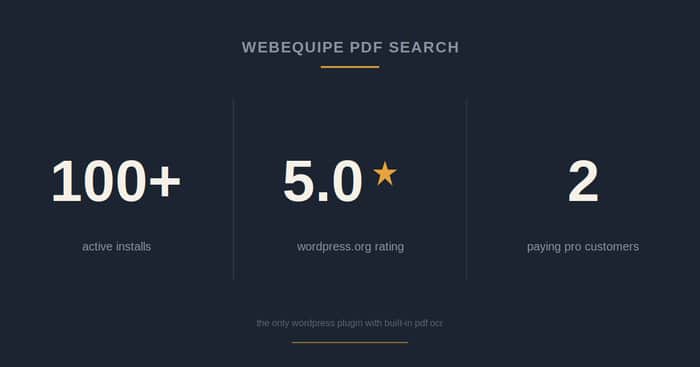
We just crossed a couple of milestones for WebEquipe PDF Search that felt worth writing up: 100+ active installs on the free plugin, a 5.0 rating on WordPress.org, and — the one I'm actually most nervous and excited about — our first 2 paying customers on the Pro tier we just shipped.
None of these numbers are going to impress anyone chasing 5-figure MRR. But each one taught us something I wish someone had told us before we started.
The free plugin got us further than we expected
WebEquipe PDF Search does one narrow thing: it makes WordPress's default search actually look inside PDF files, since out of the box it doesn't touch them at all. That's the whole product. No broader site-search ambitions, no attempt to compete with the bigger, general-purpose players like SearchWP or Relevanssi.
We made the free version fully functional — not a 14-day trial with training wheels, but something people can run forever without ever paying us a cent. That was a deliberate bet: if the free tier isn't good enough to earn trust on its own, nobody's going to hand us money for Pro down the line.
It's paid off slower than we hoped. But 100+ installs and a 5.0 rating later (small sample, we know — one review at the time of writing, but a real one), it looks like the right bet.
The near-miss that almost shipped broken
The plugin's search form is a single shortcode. On our own test site it looked exactly as designed. Then we dropped it into a site running the Avada theme and the whole thing fell apart — the button landed below the input, spacing broke, the form shrank to a fraction of its intended width.
Nothing crashed. Search still worked underneath. It just looked like something we'd never want a customer to actually see — and if we'd only ever tested on our own clean install, we wouldn't have caught it before shipping.
Turned out to be a straightforward CSS specificity fight: Avada's own styles were simply more specific than ours, so ours kept losing. The fix wasn't patching around Avada — it was wrapping our markup in a properly namespaced container and scoping every selector under it, so it could hold its own against any theme, not just that one. "Test on at least one real page-builder theme before shipping" is just part of the process now, not an afterthought we remember after something breaks.
Then we shipped Pro — and got our first 2 customers
A few weeks ago we launched the paid tier: OCR for scanned PDFs (as far as we can tell, nothing else in this category handles that natively), private search for logged-in-only content, and an analytics dashboard that surfaces zero-result searches. That last one might be the feature I'm proudest of — it turns "what are people even searching for on my site" from a guess into an answerable question.
Two people paid for it. That's the whole milestone. Two strangers looked at an upgrade page and decided it was worth real money.
It's not a number I'd normally think to write a post about. But it's the first time revenue has come from someone other than us believing this was worth building, and that changes how the next few months feel.
What we're taking from this
Free-forever, done properly, turned out to be a real acquisition channel — not just a funnel gimmick. It only works if the free tier can actually stand on its own merits.
A feature "working" and a feature "looking right on someone else's theme" are two different bars, and customers only ever see the second one.
Two paying customers isn't a business yet. But it's a different kind of proof than installs or ratings — someone decided the problem was worth paying to solve, not just worth installing something free for.
Curious how others here think about that free-to-paid moment — did your first paying customers convert out of your free tier, or come in from somewhere else entirely?

I like the distinction between someone installing a product and someone paying for it.
An install says the problem looks interesting. A payment says the problem is important enough to solve. Those are very different kinds of validation, even when the numbers are small.