5 Best Occupancy Sensors for Offices Evaluated for 2026
Empty offices are expensive. According to IWG research, the annual cost of a single unused workstation runs roughly $27,000 when you factor in lease obligations, utilities, cleaning, and furniture depreciation. Multiply that across a floor or a full portfolio, and the waste adds up fast.
Most companies care about utilization but can't measure it accurately. Badge data confirms entry but says nothing about what happens after the turnstile. Calendar bookings reflect intent, not reality. Without sensors measuring actual presence, occupancy decisions default to guesswork.
Occupancy sensor platforms aim to solve this visibility problem, but they vary widely in detection technology, deployment requirements, privacy architecture, and how freely data moves into the rest of your tech stack.
Below, we evaluate five platforms designed for corporate and commercial environments — covering what each does well, where it falls short, and which types of organizations are the best fit.
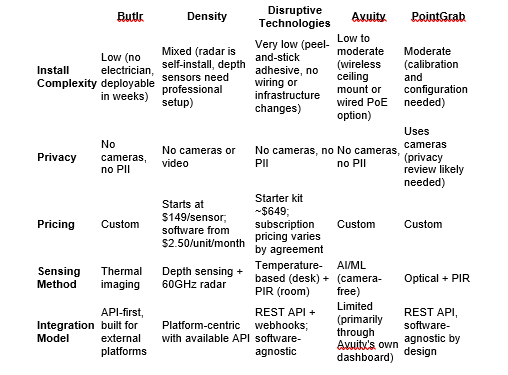
Office Occupancy Sensors at a Glance
1. Butlr
Butlr’s occupancy sensors use thermal imaging to measure how people move through and occupy commercial buildings. The sensors detect heat signatures exclusively, so they cannot capture faces, identities, or any form of personally identifiable information. This distinction is architectural, not configurable. Privacy is a hardware guarantee, built into the sensor design itself.
Core Capabilities
Thermal presence and movement tracking: Sensors deliver real-time headcounts, spatial coordinates, dwell time, and movement data at 95% accuracy, far exceeding the binary occupied/vacant output of traditional motion detectors.
Two distinct operating modes: Presence mode maps activity and pathing within a defined area, while Traffic mode captures directional entry and exit counts at doorways and corridors. Both modes run on the same sensor and can be switched without swapping hardware.
Open API and webhook architecture: Occupancy data flows outward into external systems by default. The platform feeds workplace management tools, building automation systems, energy platforms, cleaning software, and digital twin environments.
Multi-connectivity options: Sensors connect via wired, wireless, or cellular pathways, supporting multi-building and cross-region deployments without requiring a single networking standard.
Smart cleaning integration: Real-time usage data tells cleaning crews which restrooms and shared spaces need attention now and which can wait, replacing static schedules that clean empty rooms and skip busy ones. Every clean is logged and auditable.
Lightweight installation: No electrician or complex wiring needed. Most rollouts are fully operational within weeks, and the simple installation process keeps costs low.
SOC 2 Type II compliance: Data is encrypted with TLS 1.2 and AES256, and meets enterprise security requirements.
Strengths
The thermal-only hardware design eliminates privacy reviews, employee notification campaigns, and regional compliance hurdles before deployment can begin.
Sensors can go where cameras cannot, including restrooms, wellness rooms, healthcare facilities, and public lobbies. This enables true wall-to-wall coverage.
The platform functions as a data layer for your existing stack, feeding occupancy metrics to the tools your team already uses.
Limitations
Thermal detection prioritizes privacy over visual detail, so the system won't distinguish between objects or furniture configurations the way a camera-based alternative might.
Ideal Fit
Organizations where privacy is the first requirement. Workplaces where cameras would face employee pushback or regulatory barriers all need occupancy data without surveillance tradeoffs. Anonymous thermal data feeds directly into space planning, energy management, operational workflows, and employee experience decisions without collecting identifiable imagery at any point.
2. Density
Density builds a people-counting platform around two complementary hardware products: depth sensors that cover open floor plans and high-traffic entry points, and a 60GHz radar sensor (branded Waffle) designed for enclosed rooms, phone booths, and individual desks. Both feed into Density's Atlas software platform, which serves as the primary analytics and reporting interface.
Core Capabilities
Two sensor form factors: Depth-based units handle open areas and doorways with wide-area headcounts, while Waffle provides room-level people counts using radar.
Self-installable radar option: The Waffle sensor connects via powered WiFi with no professional installer required, so quick rollouts in smaller or enclosed spaces are straightforward.
Atlas analytics platform: Data breaks into 15-minute intervals across building and floor views. Utilization heatmaps overlay floor plans, and live wayfinding displays help employees locate available spaces.
Transparent per-unit pricing: Hardware starts at $149 per sensor, with software licensing from $2.50/unit/month for desks and $8/unit/month for rooms, billed annually.
Advisory and planning services: Density offers professional site assessments and workplace strategy consulting as add-on services.
Strengths
The self-install Waffle sensor cuts deployment friction for teams that want to start with meeting rooms and phone booths before committing to a larger rollout.
Published pricing lets procurement teams model costs early without requiring a sales engagement for basic budgeting.
Larger coverage per depth sensor in open zones reduces the total hardware count needed per floor.
Limitations
Depth sensors for open areas and entryways are hardwired and require professional installation, including coordination around electricians, network cabling, and ceiling access.
Radar-based sensing may draw scrutiny in regions with sensitivity to RF-based tracking, particularly across the EU and in healthcare settings.
Integrations exist via API, but the platform centers on its own Atlas analytics interface. Outbound data push is available but not the default.
Ideal Fit
Corporate real estate teams that want a blend of self-install convenience for enclosed spaces and professional-grade depth sensing for open areas, backed by a strong built-in analytics layer and upfront pricing.
3. Disruptive Technologies
Disruptive Technologies (DT) manufactures ultra-compact wireless sensors, some as small as a postage stamp, for building and asset monitoring. Its workspace solution pairs a desk occupancy sensor (which uses temperature data to determine whether someone is seated) with a ceiling-mounted PIR motion sensor for room-level presence detection. The company's broader sensor suite also covers temperature, humidity, CO2, and water detection.
Core Capabilities
Desk-level occupancy via temperature sensing: The desk sensor adheres to the underside of a desk and uses CMOS temperature readings to determine occupied or unoccupied status with no cameras, no wireless device tracking, and no identifiable data collected.
Room-level motion detection: A separate PIR motion sensor mounts to the ceiling with a 360° field of view and up to 14 meters of detection range, covering meeting rooms and common areas.
Extended battery life: Desk sensors last up to 9 years on a single battery. Motion sensors are rated for up to 15 years. Neither requires wired power or maintenance visits for battery swaps during typical deployment cycles.
Massive gateway scale: A single Cloud Connector supports up to 10,000 sensors and connects to the cloud via cellular (4G/LTE) or Ethernet. Infrastructure requirements stay minimal even across large portfolios.
DT Studio web application: A free cloud dashboard for visualizing sensor data, setting alerts and notifications, and managing sensor fleets. Drag-and-drop dashboards support kiosk-mode display for facilities teams.
Open data access at no extra cost: REST APIs and webhooks are included with every deployment. Teams can push sensor data into any external platform.
Strengths
Peel-and-stick installation with no wiring, no electricians, and no infrastructure changes makes this one of the simplest systems to roll out widely..
Battery life measured in years (not months) eliminates ongoing maintenance as a cost factor.
The sensor suite extends beyond occupancy into environmental monitoring (temperature, humidity, CO2). Building teams get a multi-data-source platform from a single vendor.
Software-agnostic design avoids vendor lock-in. Data flows wherever the customer directs it.
Limitations
Desk sensors report binary occupied/unoccupied status. They do not capture headcount, dwell time, movement patterns, or spatial coordinates.
The proprietary radio protocol (SecureDataShot) means sensors only communicate with DT's own Cloud Connectors and cannot be integrated into existing WiFi, Zigbee, or LoRaWAN infrastructure.
Room-level motion sensors detect presence but do not count the number of people in the space.
Ideal Fit
Organizations focused on understanding desk-level usage patterns in hot-desking or hybrid seating environments, especially those that value extremely simple hardware deployment, long maintenance-free lifecycles, and the flexibility to pair DT's data with a separate analytics platform.
4. Avuity
Avuity uses proprietary AI and machine learning sensors to detect occupancy and headcount without cameras. The hardware serves a dual purpose. Each ceiling-mounted sensor captures both people data and environmental conditions (temperature, humidity, ambient light, and noise) in a single device.
Core Capabilities
Camera-free AI/ML presence detection: The VuAI sensor uses machine learning algorithms to identify occupancy and count people without optical imaging. No personally identifiable information is collected at any point.
Environmental data capture: Temperature, humidity, light, and noise readings are collected alongside occupancy metrics, consolidating two measurement categories into one sensor.
Adaptive accuracy over time: Machine learning models refine detection precision as more data accumulates across a deployment. The system improves the longer it runs.
Dual power options: Wireless sensors run on battery with a 2.4 GHz gateway, while a wired Power over Ethernet configuration is available for permanent installations. Sensors can also be daisy-chained together.
IR sensors for short-term studies: Infrared-based sensors are available for temporary utilization studies, offering a lower-commitment entry point before a permanent rollout.
Object detection and line counting: Wired sensor models add object detection and directional line counting to the capability set.
Strengths
A single device covering both occupancy and environmental conditions reduces total sensor count and simplifies procurement.
The camera-free architecture sidesteps privacy review processes and employee communication hurdles entirely.
Limitations
The platform focuses on room-level and zone-level presence. It does not capture granular spatial data like movement coordinates, pathing, or individual dwell time.
Data access is primarily routed through Avuity's own analytics dashboard, with limited options for pushing metrics into external tools or platforms.
No SOC 2 or ISO 27001 certification is listed, which can create friction during enterprise procurement processes that require third-party security validation.
Ideal Fit
Workplace and facilities teams that want occupancy and environmental monitoring from a single camera-free sensor, particularly those seeking a low-risk starting point through temporary IR studies before scaling to a permanent deployment.
5. PointGrab
PointGrab produces ceiling-mounted CogniPoint sensors that combine optical and passive infrared technology to detect occupancy, count people, track movement, and monitor traffic lines. The platform positions itself as software-agnostic, emphasizing that its sensors deliver raw occupancy data through open APIs and are compatible with any analytics platform.
Core Capabilities
Multi-function sensing from one device: Each CogniPoint sensor handles occupancy counting, people-in-motion detection, object identification, and virtual traffic line monitoring, all from a single hardware unit.
On-device edge AI processing: Neural networks run directly on the sensor, processing raw data locally and transmitting only anonymized occupancy metrics to the cloud. This reduces bandwidth requirements and latency.
Cloud-based REST API: Sensor data is delivered through a RESTful API designed for maximum interoperability. The same data stream can simultaneously feed a BMS, a workplace analytics platform, a booking system, and an enterprise data warehouse.
Mixed wired and wireless deployment: Both PoE and wireless sensor models are available and feed into the same cloud management platform. Teams can match connectivity to building infrastructure as needed.
ISO 27001 certification: The platform carries internationally recognized information security management credentials.
Strengths
A single sensor covering counting, motion, traffic, and object detection reduces hardware complexity across different space types.
The software-agnostic approach gives building operations teams full control over where data flows, avoiding vendor lock-in on the analytics side.
Edge-based AI processing keeps raw imagery on the device. Only processed, anonymized metrics are transmitted.
Limitations
Optical sensing components mean teams will likely need to conduct a privacy assessment before deployment, especially in the EU or in spaces where employees may push back on camera-adjacent technology.
Installation involves per-sensor calibration and configuration. This adds time and complexity to large-scale rollouts compared to plug-and-play alternatives.
While the API is open, day-to-day sensor management still runs through PointGrab's own cloud platform.
Ideal Fit
Building operations and facilities teams that want a dedicated, software-agnostic sensor feeding raw occupancy data into an existing BMS or enterprise analytics stack, and are comfortable navigating the privacy review process that comes with optical sensing.

