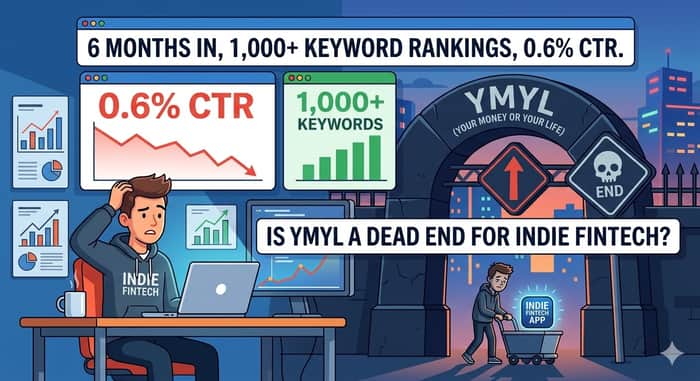
6 months in, 1,000+ keyword rankings, 0.6% CTR. Is YMYL a dead end for indie fintech?
Hi Indie Hackers,
Long post, but I'll try to make it worth your time. This is partly a build log, partly a cry for help, and partly a genuine question I can't find a good answer to anywhere.
What we built — and the timeline
13Radar (https://www.13radar.com) launched about six months ago. Since then we've shipped three major product pillars:
- 13F Filing Tracker — the quarterly SEC filings that institutional investors ($100M+ AUM) are required to submit. This is how you find out what Buffett, Ray Dalio, or Michael Burry are actually holding, not what they're saying on TV.
- Insider Trading Tracker — every Form 4 filing, meaning every time a company executive or board member buys or sells their own stock. Legal requirement, two-day filing window, publicly available, but genuinely painful to parse at scale.
- Pro membership — launched three days ago. Unlimited historical access, real-time alerts, CSV/Excel export, advanced filters across the full universe of 13F filers.
There are existing tools for both use cases. OpenInsider has been the go-to for Form 4 data for years. Dataroma covers the 13F side. Both are genuinely useful — but, I say this with respect, they look and feel like they were built in 2010 and haven't been significantly updated since.
We went deeper on every dimension: insider profile pages with relationship graphs (this person sits on the boards of X, Y, Z), net buy/sell momentum signals, full historical filing timelines, enriched context on each trade. We built the kind of UX that helps you actually make sense of the data, not just stare at a table of raw transactions.
We were targeting the person who already knows what Form 4 filings are — the semi-serious retail investor, the finance researcher, maybe a junior analyst at a small fund who can't justify a Bloomberg terminal.
The milestone: we shipped Pro
Three days ago we launched a paid tier. It includes:
- Unlimited historical access (free tier is capped at recent quarters)
- Real-time alerts when tracked insiders file new Form 4s
- Bulk export to CSV/Excel
- Advanced filters across the full universe of 13F filers
We've been working toward this for months. The day we flipped the switch felt like a big deal internally.
Seventy-two hours later: zero conversions.
The traffic problem — impressions up, clicks flat
Before I even get to the conversion question, there's a more fundamental issue: we're stuck at roughly 200 daily active users, and the SEO picture is genuinely confusing.
Impressions have been growing steadily over the six months since launch. That part feels good — Google is indexing us, ranking us, and showing us for more queries every month. But clicks have not followed. Our overall CTR sits at around 0.6% and refuses to budge.

We're ranking for 1,000+ long-tail keywords. Queries like:
- "berkshire hathaway 13f filing q4 2025"
- "state street walmart shares q4 2025 13f"
- "berkshire hathaway top 10 holdings q4 2025"
- "blackrock 13f walmart holdings q4 2025"
Many of these land in the Top 10.But here's the gut-punch:
Only 20–30 of those keywords are actually generating any meaningful click volume. And even on our best-ranking pages, CTR rarely breaks 0.6% — it's usually far lower.
A 0.6% blended CTR across 1,000+ keywords means the traffic ceiling is brutally low no matter how many more keywords we rank for. Something structural is suppressing clicks, and I have a theory about what it is.

The dashboard shows multiple financial search queries with strong impressions and rankings, but the click-through rate remains at zero across the board, highlighting a severe gap between visibility and user engagement.
The YMYL wall
Here's the part that keeps me up at night.
We're operating in what Google classifies as YMYL — "Your Money, Your Life." Financial information that could influence real investment decisions. Google holds YMYL pages to a much higher E-E-A-T standard: Experience, Expertise, Authoritativeness, Trustworthiness.
The incumbents — OpenInsider, Dataroma, SEC EDGAR itself — have been around for 10–15 years. They have thousands of inbound links, brand mentions across financial media, and implied institutional trust just from age alone. We have none of that yet.
Even if our product is technically better (and I genuinely believe the UX is), Google doesn't know that. The algorithm sees a young domain with limited backlinks pointing at financial data pages and ranks it conservatively. That trust gap is real, and it doesn't close quickly.
My AI Overview hypothesis
There's a second force at work on top of the YMYL problem.
When someone types "peter thiel investments list" into Google right now, in many cases they're getting a direct answer in the AI Overview box without ever needing to click anything. Google is synthesizing our structured data — the stuff we spent months parsing, cleaning, and presenting — and serving it straight at the top of the results page.
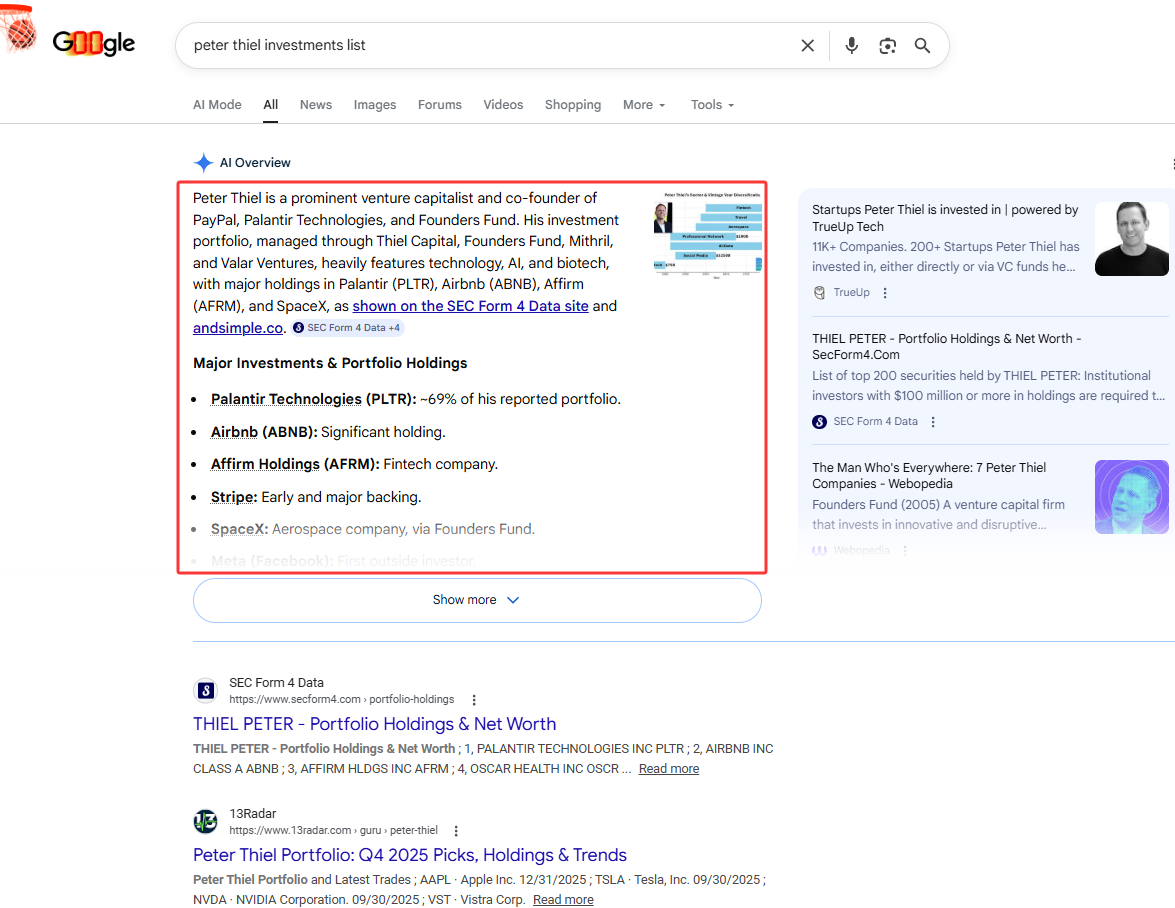
This isn't a theory. I can see it happening in manual searches. The AI Overview is essentially being powered by sources like ours, and in return, we get... nothing. No click, no session, no chance to show the user why our deeper analysis is worth paying for.
We are the data layer. Google is the product.
The harder question: is the intent even right for a subscription?
Set aside the traffic problem for a second. Even if we doubled our DAU to 400, I'm not sure the conversion math works.
Someone running a query like "[Guru name] stock picks" is probably in a research mindset — casual curiosity, maybe light due diligence. They want a quick answer. The willingness to pay for that specific micro-moment is low.
The users who might actually pay are the ones who come back repeatedly — the person who has a watchlist of insiders they track every quarter, the researcher who needs to bulk-export data for a model, the analyst who wants alerts. That's a different user journey entirely, and SEO is a terrible acquisition channel for it.
We built a great tool for the repeat power user, and then tried to acquire users through queries that attract one-time curiosity visitors. The mismatch is ours to own.
Where I'm at and what I'm asking
We're now seriously debating whether to shift our distribution entirely away from organic search — at least in the short term — toward communities and "push" channels: Twitter/X threads breaking down interesting insider trades, Substack posts with our own analysis, Reddit finance communities, or even direct outreach to investment newsletters that might find our data useful.
But I'm not sure that's the right call either. It feels like abandoning months of SEO infrastructure we've already built.
A few specific questions for people who've been here:
- If you're in fintech or data SaaS, have you found a channel that works better than SEO for acquiring the first 50–100 paying customers? Not eventually — right now, early stage.
- Has anyone successfully competed against an established incumbent in a YMYL niche without having years of domain authority? What actually moved the needle?
- For those of you tracking AI Overview's impact on your traffic: are you seeing this across verticals, or is it particularly brutal for data-heavy informational sites?
- Is 200 DAU with 0 paid conversions a product problem, a pricing problem, or an audience problem? My gut says audience — we're getting the wrong users from SEO — but I'd love a second opinion.
Honest feedback only. If we're making a fundamental mistake, I'd rather hear it now than in another three months.
