$700 in revenue 3 weeks after launch - My Story
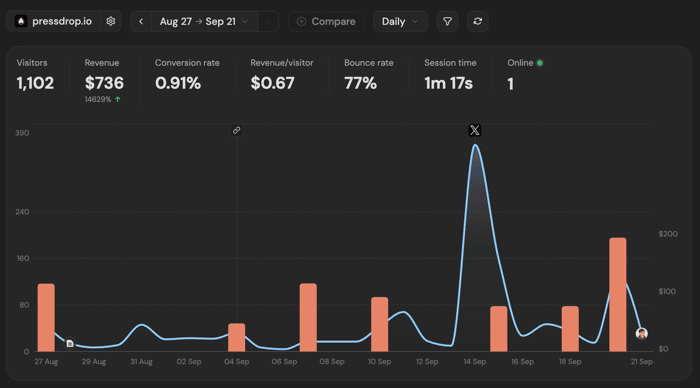
27th of August 2026. That's when I launched the idea of PressDrop.io.
My initial launch was on a bunch of .lol sites. Still remember those?
As you can see in the graph, I got my first sales on the FIRST DAY! As a matter of fact, my second visitor became my first customer https://x.com/isjackback/status/2093202733603963006 so crazy!!
Then came silence (see graph). One week of miserable silence.
I tried everything:
- Posted on X
- Launched on PH and other platforms
- Posted on Reddit
Nothing worked. Until.
I got another SALE, and then another, and they kept coming in.
I think this tweet was a turning point https://x.com/isjackback/status/2096932995076657467.
I started SHOWING what PressDrop can do. Showing does more than telling.
Along the way I kept raising prices, I started out really cheap with negative margins on the product. I did it just to see if anyone would even pay anything for my product.
Turns out, they will!
I'm still running early bird discounted prices, currently at $99. In my opinion the retail of PressDrop is somewhere around or north of $199, but the market will be the judge of that!
What is PressDrop?
PressDrop takes your startup to the news. No PR skills needed, just paste your URL, get a press release, pay and we distribute it to 500+ news outlets, including high authority sites with 80+ DR. PressDrop exists, so that you can tell the internet about your startup.

Nice job!
thanks roel!
The number that decides this business is not the price, it is whether anybody buys a second time. Press distribution is a one-shot purchase for most founders unless something visibly comes back from it, so I would track which customers got a real result and build the product around making that result obvious. On positioning, 500+ outlets is what every competitor in this category claims and buyers have been burned by syndication that produced nothing, so publishing the actual live links one real customer earned will sell harder than any outlet count.
Absolutely!
We have some public reports already! https://pressdrop.io/reports
Congratulations. Those first sales are really important.
thanks mate, they really are!
Really relatable. How much time do you put into this each week?
Really interesting launch story. The “showing instead of telling” part stood out to me because it seems like that was the point where people could actually understand the value of the product. I also like the approach of starting with a low price to validate whether people would pay, then gradually increasing it as you got real sales data. Congrats on the first $700, and I’d be curious to see how repeat purchases develop over the next few months.
The second visitor becoming the first customer is a meaningful signal. It means the product description was clear enough that someone who found it through any channel could understand what it does and decide to buy without a long conversion journey. That's a positioning win, even if it didn't feel like one at the time.
The showing versus telling shift is the right call for this kind of product. A press release distribution service has no natural trust shortcut. There's no obvious metric to anchor on except examples of what the output looks like and which outlets it actually reaches. Once you showed that, the buyer's question changed from "does this work?" to "does this work for me?" That's a shorter conversation.
The pricing escalation approach is interesting. Starting below your cost to find a real buyer is a specific form of validation. It answers the harder question than "will someone take it for free?" and it separates the early adopters from the people who will pay retail once the proof exists.
What does repeat purchase look like so far? Are buyers coming back for follow-up releases or is it mostly one-time right now?
Great breakdown. What feedback have you had from early users?
The website has a very well design.
Thank you kind stranger!
This pricing arc rings true. I sell tiny one-time-purchase web tools (free demo + $19 lifetime Pro on Gumroad and itch.io), and I've had the same realization from the other direction: start low to learn, but don't stay low.
The thing that surprised me most was that raising the price didn't just change revenue per sale — it changed who bought. At the low end you get tire-kickers who need hand-holding for everything; the people paying a bit more self-select as serious. Your 'negative margins' phase did the same job mine did: it bought you real purchase data to price against instead of guessing in a vacuum.
One thing I'd add: for a one-time purchase, the demo matters more than the price page. With a subscription people buy the promise; with one-time they buy what they just touched. It sounds like your 'showing what PressDrop can do' moment was exactly that — the product demo became the sales page. Congrats on the $700, that's real money.
Makes sense. Are you planning to charge for it, or keep it free for now?
$700 and multiple sales make the pricing test real. What changed in the buyers who converted after you started showing the product, and did they tolerate the higher price?
The pricing thread running through this is more interesting than the seven hundred. Starting at negative margins tells you people will click when the risk is near zero, which is not the same as willingness to pay. What actually proved something is that sales kept coming while you raised prices. The number I would watch from here is whether conversion holds through each increase. If it does not move, you are still under the real price and the increases are free money. When it finally drops you have found the edge, and that is far more useful to know than the revenue total.