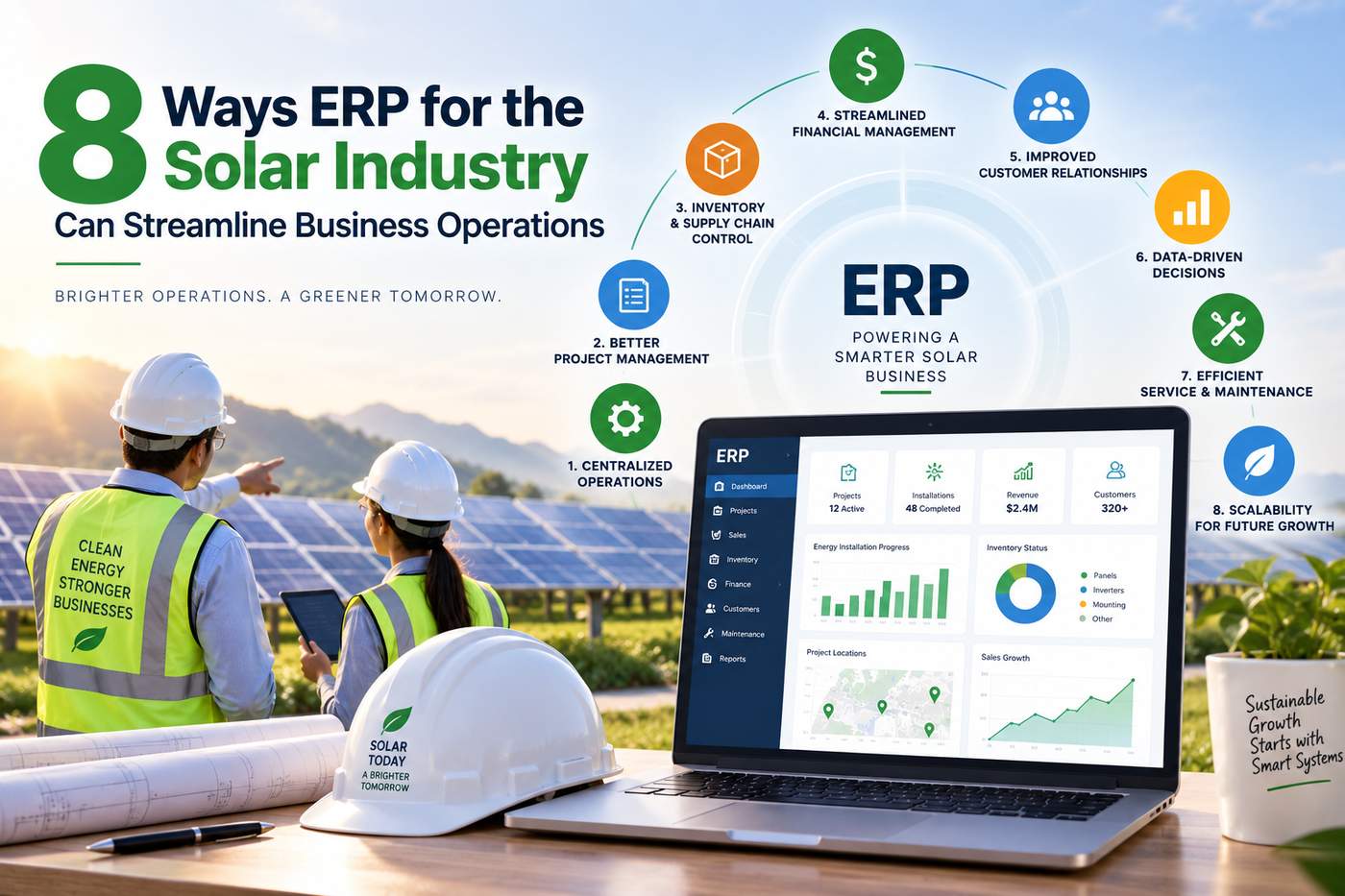
8 Ways ERP for the Solar Industry Can Streamline Business Operations
The solar industry is expanding rapidly, but growth also brings operational complexity. Solar companies often need to manage leads, quotations, site surveys, procurement, inventory, installation teams, project timelines, payments, and after-sales services at the same time.
When these activities are managed through disconnected spreadsheets and applications, teams can struggle with duplicated data, communication gaps, delayed updates, and limited visibility into projects.
This is where ERP for Solar Industry businesses can make a difference. An integrated ERP system brings important business processes into one centralized environment, helping solar companies coordinate their operations and make better use of their data.
For companies looking for greater control and flexibility, a white-label ERP approach can also provide a customizable foundation that can be adapted to their specific workflows and branding.
What Is ERP for the Solar Industry?
ERP, or Enterprise Resource Planning, is software designed to connect different business functions through a centralized system.
For a solar company, an ERP for solar industry platform can bring together areas such as:
Sales and lead management
Customer relationship management
Project management
Procurement
Inventory management
Installation operations
Workforce management
Accounting and billing
Maintenance and after-sales service
Business reporting
Instead of maintaining separate systems for each department, employees can work with connected information across the organization.
The result can be better coordination, improved visibility, and more efficient workflows.
8 Ways ERP for the Solar Industry Can Streamline Business Operations
1. Centralizes Solar Sales and Lead Management
Managing leads effectively is important for solar companies because a potential customer may go through several stages before becoming a client.
An ERP system can help teams organize lead information, track follow-ups, manage customer communication, create quotations, and monitor sales progress.
Sales teams can also have better visibility into customer requirements and previous interactions. This reduces the need to search through multiple spreadsheets, emails, or disconnected applications.
A centralized system can make it easier to move leads from initial inquiry to quotation and eventually to project execution.
2. Improves Solar Project Management
Solar projects involve multiple activities that must happen in the right sequence.
After a customer approves a project, teams may need to conduct site assessments, prepare designs, arrange materials, schedule installation, assign workers, and track completion.
ERP software can provide a centralized view of these activities.
Project managers can monitor:
Project status
Milestones
Assigned employees
Required materials
Installation schedules
Project costs
Deadlines
Customer information
Having this information in one system can make project coordination easier and help managers identify potential delays earlier.
3. Makes Procurement and Inventory Management More Efficient
Solar companies depend on equipment and components such as panels, inverters, mounting structures, cables, batteries, and other installation materials.
Poor inventory management can result in unnecessary purchases, shortages, or project delays.
An ERP system can connect procurement and inventory activities. Businesses can monitor stock levels, track purchases, manage suppliers, and determine which materials are being allocated to particular projects.
This can help companies maintain appropriate inventory levels while reducing unnecessary manual work.
4. Helps Coordinate Installation Teams
Solar installation requires coordination between project managers, technicians, contractors, and other field employees.
An integrated ERP platform can help businesses organize workforce assignments and installation schedules.
Managers may be able to view:
Available technicians
Assigned projects
Installation dates
Task status
Workforce requirements
Project locations
Completed work
Better coordination can reduce scheduling conflicts and help companies use their field workforce more effectively.
5. Connects Financial Operations With Projects
Financial management becomes increasingly complex as a solar company takes on more projects.
Businesses need to track quotations, invoices, payments, expenses, project costs, and profitability.
By connecting financial information with operational data, ERP software can give management a clearer picture of project performance.
For example, managers can compare project expenses against expected revenue and identify areas where costs are increasing.
This type of visibility can support more informed financial decisions.
6. Simplifies After-Sales Service and Maintenance
The relationship with a customer does not necessarily end after solar installation.
Solar systems may require inspections, maintenance, repairs, upgrades, and ongoing support.
ERP software can help companies maintain service records and track customer requests after installation.
A centralized system can provide information about:
Installation history
Equipment details
Service requests
Maintenance schedules
Technician assignments
Warranty information
Customer communication
This can help businesses build stronger long-term customer relationships while making service operations more organized.
7. Provides Better Business Reporting and Decision-Making
Solar companies generate significant amounts of operational data.
Without centralized reporting, management may find it difficult to understand which projects are profitable, which products are moving quickly, or where operational bottlenecks exist.
ERP systems can bring data from multiple departments into dashboards and reports.
Businesses can analyze areas such as:
Sales performance
Project progress
Inventory levels
Procurement expenses
Workforce productivity
Revenue
Customer service
Project profitability
Better access to business information allows decision-makers to move beyond assumptions and use data to guide operational improvements.
8. Supports Business Growth and Scalability
A growing solar company typically adds more customers, employees, projects, suppliers, and inventory.
Processes that work for a small business may become difficult to manage as operations expand.
This is one reason companies may consider a white label ERP for solar companies. Instead of creating an ERP platform entirely from scratch, businesses can start with an existing foundation and customize it according to their processes, branding, and operational requirements.
A scalable ERP solution can help businesses add users, modules, integrations, and workflows as their requirements evolve.
Why Consider a White Label ERP Solution?
A white-label ERP approach can be useful for businesses that want a branded and customizable business management platform without starting the entire development process from zero.
A suitable solution may allow businesses to customize:
Branding
User interface
Business workflows
Modules
User roles
Integrations
Reporting
Customer-facing elements
However, businesses should evaluate customization capabilities carefully before selecting a provider.
The objective should not simply be to obtain an ERP system quickly. The solution should be capable of supporting the company's actual solar business processes.
What Should Solar Companies Look for in an ERP?
Before choosing an ERP platform, businesses should consider several factors.
Industry-Relevant Functionality
The system should support the workflows that are important to solar businesses, including project management, inventory, procurement, installation, sales, and service management.
Scalability
The platform should be capable of handling increasing users, customers, projects, and transactions.
Integration Capabilities
Integration with accounting software, payment gateways, CRM systems, communication tools, and other business applications can reduce data duplication.
Security
Because ERP platforms store important business and customer information, security, access controls, authentication, and data protection should be carefully evaluated.
Customization
Businesses should determine whether they can modify workflows and features as their operational requirements change.
Support and Maintenance
ERP implementation is an ongoing process. Technical support, updates, maintenance, and troubleshooting can be important factors when selecting a development partner.
How White Label Digital Solutions Fit Into Business Growth
The concept of white label digital marketing demonstrates a similar business principle: companies can use established solutions and services under their own brand instead of building every capability internally.
The same general approach can apply to business software. A white-label ERP solution can provide a foundation that organizations customize around their operational requirements.
For technology providers and businesses entering specialized markets, this can create opportunities to launch branded solutions while focusing internal resources on customers, operations, and growth.
Choosing the Right ERP Development Partner
Selecting a technology partner requires more than comparing development costs.
Businesses should examine the provider's technical expertise, customization capabilities, scalability approach, security practices, integration experience, and post-launch support.
For example, Triple Minds offers white-label software solutions that can be considered by businesses looking to develop customized platforms for specialized industries.
Before moving forward, companies should clearly define their requirements and discuss them with potential providers. A detailed requirements document can help determine which modules are necessary for the initial implementation and which features can be introduced later.
Final Thoughts
Solar companies have to coordinate many interconnected processes, from acquiring customers and managing projects to procuring equipment, organizing installations, handling finances, and providing after-sales support.
Implementing ERP for Solar Industry operations can bring these activities into a centralized system and provide businesses with better visibility across their operations.
For companies seeking greater flexibility, a white-label approach can provide a customizable foundation that can be adapted to specific workflows and business requirements.
The most effective ERP strategy is not necessarily the one with the largest number of features. It is the one that connects the processes that matter most to the business, supports employees, provides useful data, and remains flexible enough to grow with the organization.

