AI Is Moving Into Real Estate Operations, What Should Brokerages Automate First?
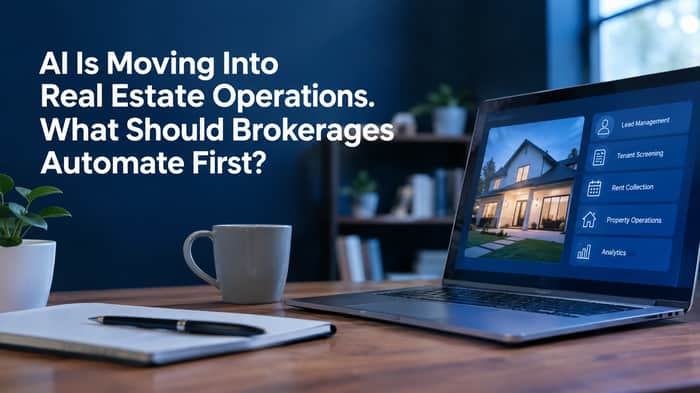
For a while, using AI in real estate mostly meant generating listing descriptions, writing social posts, creating emails, or summarizing information.
That is changing.
A recent analysis of Delta Media's 2024 to 2026 brokerage surveys found that brokerage leaders now rate AI's current importance at 7.12 out of 10, compared with 5.45 in 2024. The share of leaders using or planning to use AI for administrative support also increased from 23% to 53%. More than half are looking at workflow and back-office automation, while other areas include CRM, analytics, recruiting, training, and agentic AI.
So, what should a brokerage actually automate first?
What changed in the way brokerages use AI?
The interesting part isn't simply that more real estate companies are using AI.
It is where they are using it.
Marketing was an obvious starting point because the output is easy to see. Generate a listing description, rewrite an email, create a social post, and move on.
Operational workflows are different.
AI now has the potential to sit inside processes that happen every day, such as lead management, leasing, tenant communication, CRM updates, administrative tasks, and data analysis.
That creates a more important question:
Where can AI remove the most repetitive work without removing the human decision-making that still matters?
What should a brokerage automate first?
A simple way to identify the right starting point is to look for tasks that are:
Repeated frequently
Time-consuming for employees or agents
Based on predictable steps
Dependent on information that already exists in business systems
Easy to measure before and after automation
You don't need to automate an entire department on day one.
Start with one workflow where the problem is obvious.
Can AI improve lead management?
Lead management is one of the easiest places to see the operational value of AI.
A brokerage may receive inquiries through websites, listing portals, forms, email, phone calls, and other channels. Someone still has to organize those leads, determine what they need, follow up, update the CRM, and decide which opportunities require immediate attention.
AI can support parts of that process by:
Capturing and organizing incoming leads
Asking initial qualification questions
Prioritizing leads based on defined criteria
Triggering follow-up workflows
Updating CRM information
Flagging leads that need human attention
The goal isn't to replace the agent.
It is to reduce the amount of manual coordination required before the agent can actually do their job.
What about leasing and tenant workflows?
Leasing creates another set of repetitive interactions.
Prospects may ask similar questions about availability, property details, applications, scheduling, and next steps. Property teams can spend significant time responding to those requests and moving information between systems.
AI can help structure this workflow around the customer journey.
For example:
Inquiry → qualification → property information → follow-up → application → human review
The same approach can extend to tenant communication and routine property management tasks.
This is where real estate-focused AI products become interesting. Instead of using a general-purpose AI tool for every individual task, businesses can use products designed around specific operational workflows.
Platforms such as Svermo take this product-focused approach across areas such as leasing, tenant screening, rent collection, lead management, and property operations.
Can AI handle administrative work?
This may be less exciting than an AI agent, but it can be one of the most practical places to start.
Think about the small tasks that happen hundreds of times:
Updating records
Sending reminders
Sorting information
Routing requests
Summarizing documents
Collecting information
Generating routine reports
Triggering the next step in a workflow
Individually, these tasks may not seem significant.
Collectively, they can consume a lot of operational time.
This is also where integration matters. An AI system that works in isolation may create another place for employees to check. An AI workflow connected to the systems a business already uses can actually remove steps.
Where does AI help with real estate data?
Not every AI use case is about automation.
Brokerages also deal with large amounts of property, market, customer, and operational data.
The 2026 Delta Media findings show that brokerage leaders are looking at AI for business intelligence, predictive analytics, market analysis, and property valuations.
So the question becomes:
Can AI turn existing data into something a team can act on?
That might mean identifying patterns across properties, surfacing unusual changes, preparing reports, supporting forecasts, or helping teams find relevant information faster.
The important distinction is that AI should support the decision process rather than automatically turn every prediction into a business decision.
Should brokerages jump straight to agentic AI?
This is probably the most interesting part of the current shift.
The latest survey found that about half of brokerage leaders planned to adopt or expand agentic AI, particularly for areas such as business intelligence, forecasting, and contract review.
But does every workflow need an autonomous AI agent?
Probably not.
A more practical progression is:
-
Assist
AI helps a person complete a task. -
Automate
AI handles a defined, repeatable workflow. -
Act
AI can take predefined actions when specific conditions are met. -
Escalate
The system sends exceptions or higher-impact decisions to a human.
That last step matters.
The more independently an AI system can act, the more important it becomes to define permissions, review points, data access, and escalation rules. Recent reporting on the same Delta Media research also highlights ongoing concerns around data security, system integration, regulatory compliance, and AI guardrails.
What should an AI-powered real estate workflow look like?
A useful mental model is:
Data → AI → Workflow → Human Review → Action
For example:
A new property inquiry comes in.
The system captures the inquiry, identifies what the prospect is looking for, checks available information, triggers an appropriate follow-up, and updates the CRM.
If something falls outside the predefined workflow, it goes to a person.
That is different from simply giving employees another chatbot and asking them to figure out how to use it.
The real value comes from connecting AI to an actual business process.
How do you know whether the automation is working?
This is where many AI experiments become difficult to evaluate.
Before automating a workflow, establish a baseline.
Then measure things such as:
Response time
Follow-up completion
Lead conversion
Administrative hours saved
Leasing cycle time
Number of manually handled tasks
Error or exception rates
Time spent searching for information
If the numbers don't improve, adding more AI probably isn't the answer.
Fix the workflow first.
So, where should a brokerage start?
The answer doesn't have to be complicated.
Find one repetitive workflow that creates a measurable operational bottleneck.
Automate that workflow.
Connect it to the systems and data the team already uses.
Keep human review where the consequences of an incorrect action are significant.
Then measure the result before expanding into another area.
AI is clearly moving deeper into real estate operations. The more interesting question now isn't whether brokerages will use AI. It is whether they can identify the right workflows, integrate AI properly, and make automation useful without making their operations harder to manage.
That is probably where the next phase of real estate AI gets interesting.

I’d add reversibility to the criteria for choosing the first workflow.
A task can be repetitive, measurable and still be a poor first automation if one wrong output affects a tenant, applicant, contract or financial decision. I’d start with coordination work that is easy to inspect and undo: collecting missing information, scheduling, routing requests, reconciling CRM fields or preparing a case for human review.
The measurement should include more than hours saved. Exception rate, manual corrections and incorrect escalations show whether the automation actually removed work or merely moved it downstream.
Has Svermo run one workflow with before-and-after numbers yet? That would reveal more than the survey about where brokerages should genuinely start.