Best Vanta Alternatives: 9 Platforms to Switch to (2026)
How the leading Vanta competitors compare on automation, price, and who runs the compliance work
Vanta built this category. It put compliance automation on the map, and for plenty of teams it's still the sensible default. Something has shifted in why teams go looking for the best Vanta alternatives, though. In 2026 the choice comes down to which operating model fits your team, because the field has split along a line many buyers notice only after they sign: who runs the compliance work once the platform is live.
Most teams weighing a Vanta alternative want one of three answers. Some want something cheaper before a renewal quote lands. Some want more guidance than a self-serve checklist. Some want the work done for them, rather than surfaced on a dashboard nobody has time to clear. The nine platforms below map to those situations, with an honest read on where each one beats staying put.
Why teams shop for Vanta alternatives
Vanta earned its position, and few reviewers fault the core product. The reasons teams give for leaving stay consistent across switch conversations. Renewal pricing tops the list. Vanta quotes per deal and prices by framework, so the second and third framework can cost close to the first, and buyers report renewal numbers climbing as a program grows. Questionnaire automation and risk-management capacity often sit in higher tiers with hard limits.
Workload is the second driver. A self-serve tool surfaces failing controls and waits for a human, which relocates the problem for a two-person team rather than clearing it. On G2, reviewers flag integration gaps for niche stacks and the manual cleanup that follows, alongside pricing that smaller companies find hard to absorb. Regulated teams sometimes want more visibility into which data validates which control than the platform's evidence logic exposes. For EU and UK buyers, an optional Frankfurt region covers residency on paper, while CLOUD Act exposure through the US parent remains a live question.
What Vanta still gets right
None of that makes Vanta a weak choice. It's the category leader by adoption, and the ecosystem shows it. Setup is fast, and time to audit-ready is short. The integration library is among the widest in the space, and the Trust Center is polished and well known. Automation for SOC 2 attestation, ISO 27001, and HIPAA is mature, and the company keeps investing in AI. On G2, users praise the interface and the way the platform turns compliance into a business driver. If you have someone in-house to operate it and budget for the renewal, staying can be the right call.
How to choose a Vanta alternative
One question settles most shortlists: who runs the program once it's live? A capable team with a security owner can pick almost any platform here and optimize for integrations and price. A lean team without that role faces different math, because a dashboard of failing controls needs hours nobody has spare.
Three more questions narrow it further. How many frameworks are you chasing? A single framework favors a focused tool, while several at once reward deeper GRC or a managed program that handles them together. What's your deadline? A blocking enterprise deal shortens the runway, so guided onboarding or hands-on expert support earns its keep. Where does your data need to live? EU and UK residency rules out some US-only options.
The 9 best Vanta alternatives, and when each one wins
Nine platforms, each matched to the situation where it beats staying on Vanta. The client-facing pick sits first, then the field runs from lean-startup tools to enterprise suites.
- Scytale
AI GRC automation paired with dedicated GRC expert support, from first audit to multi-framework compliance.
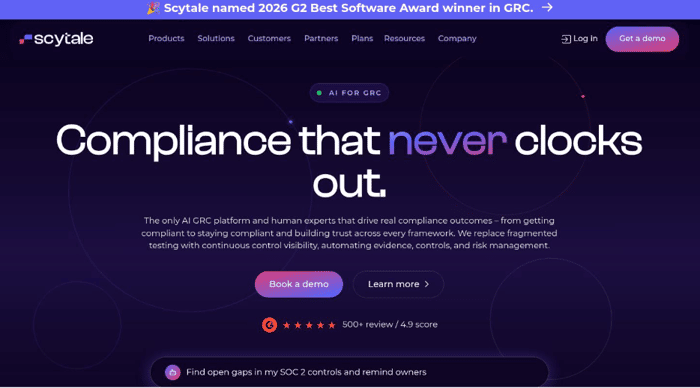
Scytale is an AI GRC platform that combines compliance automation with dedicated GRC expert support throughout the compliance journey. The platform automates core processes like evidence collection, access reviews, vendor risk management, policy management, and continuous control monitoring, giving teams ongoing visibility into their compliance and risk posture. Scytale supports 80+ security, privacy, and AI frameworks, including SOC 2, ISO 27001, GDPR, HIPAA, ISO 42001, and SOX ITGC, with multi-framework cross-mapping that lets teams reuse controls and evidence across overlapping requirements. With 150+ integrations, a customizable Trust Center, built-in audit management, and integrated penetration testing, teams can manage more of their compliance and audit work in one platform
When it wins: Teams want more than self-serve compliance automation, with dedicated GRC experts guiding the process alongside AI-powered automation, from initial readiness through audit and continuous compliance.
When to skip: Organizations looking primarily for complex, enterprise-wide risk modeling, or buyers that require published pricing before speaking with a provider.
- Secureframe
A guided, polished on-ramp for first-time compliance teams that want more than a checklist.
Secureframe built its name on white-glove onboarding, which suits teams facing SOC 2 for the first time. The platform automates evidence collection and continuous compliance across 40-plus frameworks, including FedRAMP and CMMC, and layers AI remediation on top. Onboarding is where it earns the premium over cheaper tools. It holds a 4.7/5 on G2 across more than 800 reviews, with praise centered on ease of use and low-maintenance compliance.
When it wins: a first-time team wants a person walking it through setup and broad framework coverage priced below Vanta.
When to skip: G2 reviewers report integration friction with niche tools and limited control over follow-up timing, and once the program is live the recurring evidence work returns to your team.
- Sprinto
The budget-first, cloud-native option for lean early-stage SaaS.
Sprinto aims at cost-conscious startups with real-time monitoring, continuous compliance, and native connectors for common cloud stacks. Its coverage runs across SOC 2, ISO 27001, GDPR and other frameworks, and third-party trackers put entry pricing below Vanta, in the rough range of $7,500 to $10,000 a year for small teams. Price is the reason it lands on most shortlists.
When it wins: budget is the deciding vote and the program is a single, straightforward framework on a cloud-native setup.
When to skip: ISO, PCI, and HIPAA layers carry add-on pricing, support and go-to-market run on India time zones that some US teams feel in response times, and there's no advertised EU-only hosting to confirm residency.
- Scrut Automation
Risk-first, multi-framework GRC for mid-market teams that outgrew a single-framework tool.
Scrut leads with risk rather than audit prep, mapping security programs to risk and running multi-framework compliance with an AI-assisted teammate. Teams juggling several frameworks at once get depth that a focused SOC 2 tool can't match. It carries the highest G2 score in this group, 4.9/5 across more than 1,300 reviews, with reviewers singling out support and expert guidance.
When it wins: a mid-market team runs several frameworks and wants risk-aligned GRC depth beyond a single-attestation tool.
When to skip: G2 reviewers describe a steep learning curve that needs extra onboarding, plus occasional bugs and slow interface performance that can stall evidence tracking.
- Thoropass
One partner for both the platform and the audit itself.
Thoropass folds its own auditors into the software, so the platform and the SOC 2 audit come from a single relationship. It automates evidence collection and validation across 30-plus frameworks, and the in-house audit team guides you through the engagement. Third-party data puts the median contract near $30,000 a year. It holds a 4.7/5 on G2 across almost 600 reviews, with support during complex audits a recurring highlight.
When it wins: coordinating a separate audit firm is the part of compliance you'd rather hand off.
When to skip: fusing software and auditor trims your independence to change either one later, and G2 reviewers report limited visibility into audit status and a disjointed interface in places.
- Hyperproof
Enterprise-grade GRC for larger programs managing many frameworks at once.
Hyperproof centralizes governance for teams past the startup stage, using AI-assisted control mapping to cut duplicate work across overlapping frameworks. It turns risk data into something a program can act on and connects across audits. On G2 it holds a 4.5/5, though across a smaller base of about 217 reviews, so weight the themes with that in mind.
When it wins: a larger program spans many frameworks and needs cross-framework control mapping to stop re-documenting the same controls.
When to skip: G2 reviewers cite a steep learning curve for advanced features and thin options for tailoring reports and dashboards, so budget setup time.
- Drata
The closest like-for-like Vanta swap for funded teams with a security owner.
Drata is the alternative outsiders won't notice you've switched to, because it matches Vanta on automation maturity and buyer-recognized trust tooling. It automates evidence collection and continuous monitoring across ISO 27001, SOC 2 and GDPR, among other standards, with deep integrations and internal plus third-party risk. Since acquiring SafeBase in early 2025, it bundles a mature Trust Center under one roof. It holds a 4.7/5 on G2 across more than 1,300 reviews.
When it wins: you want a near-identical swap and have someone in-house to run the configuration and the recurring work.
When to skip: it's still self-serve, so the steady-state work lands back on your team, and G2 reviewers flag confusing UI clarity around which tasks need attention along with integration and transition complexity.
- OneTrust
Privacy, GRC, and AI governance in one enterprise suite.
OneTrust connects privacy, risk, data, and compliance on a single enterprise platform, and it absorbed Tugboat Logic's compliance-automation capability. It runs continuous monitoring and automated controls across governance workflows, and its third-party risk management earned analyst recognition in the 2026 TPRM report. The draw is breadth for a large organization managing more than compliance.
When it wins: a large org needs privacy, GRC, and compliance together in one suite, with AI governance a growing part of the mix.
When to skip: it's more platform and implementation than a lean team chasing a first SOC 2 attestation needs, since the suite is built for enterprise breadth rather than a fast, focused compliance run.
- AuditBoard (now Optro)
Enterprise internal-audit and risk management at Fortune-500 scale.
AuditBoard now trades as Optro on both its website and its G2 profile. The product targets enterprise internal-audit and risk teams with agentic governance it calls a "system of action," running continuous risk-signal analysis, control testing, and incident response with AI across a broad set of modules. On G2, listed as Optro, it holds a 4.6/5 across about 1,600 reviews.
When it wins: an enterprise internal-audit or risk team needs deep audit and risk modules rather than a first-attestation on-ramp.
When to skip: it's built for enterprise audit, not fast SMB SOC 2 onboarding, and G2 reviewers under the Optro name note limited customization of roles and dashboards plus inconsistent access to analytics.
A note on trust centers:
If the only gap is a public proof layer, a full compliance platform is more than you need. SafeBase pioneered the modern Trust Center, with NDA-gated document access and automated security-questionnaire responses. Drata acquired it in early 2025, so the SafeBase capability now ships inside Drata's platform rather than as a standalone product. Teams that want just the trust layer should evaluate it there.
Switching from Vanta without losing SOC 2 progress
A migration off Vanta is bounded work, not a reset. Your controls, policies, and evidence history belong to your program, so a structured switch carries them over. Integrations reconnect on the new platform, controls remap to the new library, and the evidence record stays continuous so your auditor keeps an unbroken trail. Run with a plan, and the cutover lands in weeks. Run it ad hoc during an active audit window, and it drifts for a quarter, which is why an irritating renewal email is a thin reason to start one.
Two moves make it smoother. Time the switch outside an audit window so evidence continuity holds. Where a lean team can't spare the hours, a managed option shortens the migration, because the vendor's expert handles most of it rather than adding it to a founder's queue.
Choosing the Vanta alternative that fits your team
The best Vanta alternative depends less on feature checklists than on who runs the compliance work once the platform goes live. A team with a security owner and budget can treat Drata as a near-identical swap. A startup where price decides leans toward Sprinto. A team that dreads coordinating an audit picks Thoropass, and a mid-market program running many frameworks looks at Scrut or Hyperproof.
Larger organizations that need privacy alongside GRC weigh OneTrust or the enterprise audit depth of AuditBoard's Optro. For a lean team that wants the automation and a hands-on GRC expert together to reach SOC 2 attestation and ISO 27001 without a full internal function, an AI GRC platform with managed expert support closes the gap Vanta's self-serve model leaves open. Match the tool to the situation, and the switch fixes the problem that started the search.
Switching from Vanta: FAQs
Why do companies switch from Vanta?
Renewal pricing drives more switches than anything else. Vanta quotes per deal and prices by framework, so costs compound as a program adds frameworks, entities, and integrations, and higher-tier gating limits questionnaire and risk capacity. The other common trigger is workload: a self-serve platform surfaces failing controls and waits, which overwhelms a small team that has no one to own the remediation.
How much does Vanta cost?
Vanta publishes no public pricing, and it quotes each plan after a demo. Third-party trackers put entry subscriptions around $10,000 a year, climbing as you add frameworks, entities, and integrations. Once add-ons like extra frameworks, vendor risk, questionnaire automation, and premium support stack up, the annual figure climbs well beyond that. Model your real renewal number before you compare.
Who is Vanta's biggest competitor?
Drata is the closest like-for-like. The two match each other on automation maturity and buyer-recognized trust tooling, so a switch between them draws no notice outside your own team. What changes in-house is the amount of configuration you own. If the real question is who runs the work rather than which logo, the managed and guided options separate from the self-serve pack.
What's the best Vanta alternative for a small team without a security hire?
Scytale is a strong Vanta alternative for small teams without a dedicated security or compliance hire because it combines AI GRC automation with hands-on GRC expert support. The platform automates work like evidence collection and continuous monitoring, while dedicated experts guide the team through gaps, remediation, and audit preparation. This helps small teams work toward SOC 2 without needing someone in-house to manage compliance full time.
Can a Vanta alternative handle SOC 2 and ISO 27001 together?
Yes. Cross-framework mapping lets a platform reuse shared controls across frameworks instead of documenting each one twice. AI GRC platforms like Scytale support 80+ frameworks, including SOC 2, ISO 27001, GDPR, and HIPAA, and cross-map overlapping requirements so teams can reuse controls and evidence instead of duplicating work. Confirm the platform covers every framework on your roadmap before you sign, since coverage varies.
How long does it take to switch from Vanta to another platform?
With a plan, a migration lands in weeks rather than months. You reconnect integrations on the new platform, remap controls to its library, and import existing policies and evidence so the record stays continuous. The main scheduling rule is to run the switch outside an active audit window, which protects evidence continuity. A managed service compresses the timeline further, since the vendor handles most of the migration for you.
Do Vanta alternatives include penetration testing?
Most don’t offer penetration testing directly within the platform. Vanta, Drata, Secureframe, and Sprinto typically rely on third-party providers, which can mean managing the test and remediation separately. Some alternatives, like Scytale, integrate penetration testing into the compliance workflow, including white-box, grey-box, and black-box testing, so findings and remediation can be managed alongside the rest of the compliance process.
