Built a personal finance tracker because I was sick of Google Sheets breaking on me
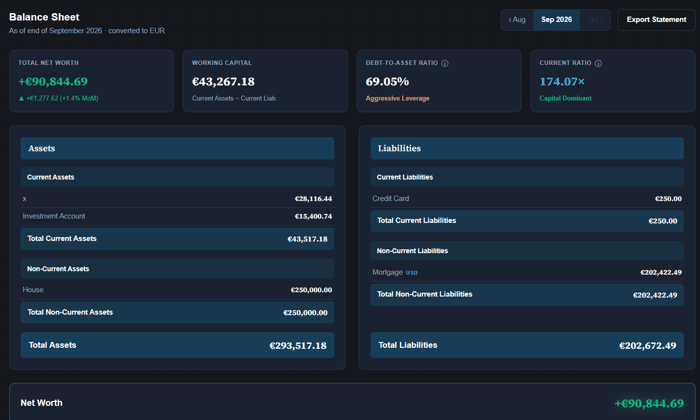
Solo dev, based in the Netherlands. Personal finance is a bit of a hobby for me, and I got fed up maintaining my own tracking in Google Sheets — formulas breaking, no real dashboard, just a wall of numbers I never fully trusted. So I built FiscoTrail.
It covers budgets, transactions, investments, and net worth. Works great with one currency (most people), also handles multiple if you need it — I didn't want to build it around any one country. There's a FIRE planner too, one that actually factors in things like loan payoff timing rather than just a flat withdrawal rule.
It's live now at fiscotrail.com. Core stuff is free and staying that way — planning paid features later for people who want more, but not rushing that until I actually understand what people find valuable.
Right now I'm just trying to get real usage and feedback before I think about pricing at all. If you've got multiple accounts or currencies to juggle, or you're just tired of your own spreadsheet, I'd love for you to try it and tell me what's confusing or missing. No bank connection needed, users are in full control of the data they enter.

Builders with ADHD (or just feast-famine revenue): a full P&L rarely gets opened.
What does: a weekly cash-in vs near-term bills view + one review question (“what do I need to know before next week?”). Cap it at 15 minutes. Move tax/reserve the day money hits so available cash is honest.
I shipped a small digital weekly cashflow + review for ADHD freelancers (Notion + PDF) after using the ritual myself: https://www.etsy.com/listing/4579570887/adhd-freelancer-weekly-cashflow-review
If you already have a system, curious what your “one weekly number” is.
Thanks for writing this up. Bookmarking it for later.
Nice work shipping it. What has been the biggest challenge since launch?
Getting users for sure. Still learning the marketing part...
Appreciate the honesty here, most people only share the wins.
Makes sense. Are you planning to charge for it, or keep it free for now?
I think there are already in many more in market. What's new to yours?
Fair question, and honestly, no argument there — there's no shortage of personal finance apps, and I'm well aware of what else is out there. My actual goal isn't to be "one more option in the list" though, it's to genuinely be best-in-class — not cutting corners on the parts that matter, so people don't have to compromise between, say, good investment tracking and good multi-currency support and good privacy. That's exactly why feedback like this thread matters so much to me right now, it's how I actually get there instead of just assuming I have.
A few things I'd point to as genuinely different, not just "we have it too":
The FIRE planner isn't a flat 25x/4% calculator — it actually runs a survival simulation that accounts for loans stepping down over time, plus a Monte Carlo layer for sequence-of-returns risk after retirement, not just one deterministic line. Most tools either skip this or oversimplify it.
The manual-entry, no-bank-connection choice is deliberate too, not a missing feature — the trust angle a few people here have already picked up on. No Plaid, no bank credentials shared, ever.
And multi-currency without assuming one home country, plus genuinely free at the core, not a trial dressed up as free.
None of that makes it "done" though — this is exactly the kind of conversation that tells me where it's still falling short of that bar.
Makes sense. Are you planning to charge for it, or keep it free for now?
Part of the platform will always be free. Honestly my mail purpose was to help people being clear with their personal finances. It helped me a lot in my own life. There will be also a paid tier, which would support additional functions, API costs etc. and also would allow me to harvest some fruits from my own work. At this phase everything is free, and I am planning to keep everything free forever for early testers.
Hi Tombal83, QA engineer here, I test web apps before launch. Since your pitch is privacy, I read the homepage next to the Privacy Policy the way a careful user would. The homepage says "no third parties involved", while the policy (clear and well written) lists Supabase, Vercel, an email provider and a market-price source as processors. A privacy-minded user will spot that gap first; something like "no bank credentials, only the processors listed in our policy" would read true. Small one: the date shows as "Last updated: [16 September 2026]" with the template brackets still in. What happens inside the app after signup I can't judge from outside. Thanks for keeping it EU-hosted.
This is exactly the kind of feedback I was hoping for, genuinely — both real bugs. You're completely right that "no third parties involved" didn't hold up next to my own policy. Already fixed it. Bracket thing's fixed too.
Appreciate you actually reading the policy against the homepage instead of just skimming — that's a level of scrutiny I clearly needed. Thanks for the EU-hosted nod too; I wanted to apply the highest standards.
Since there’s no bank connection, I’d treat edit history as part of the product, not just a safety feature. A manual number can look wrong three months later and the user won’t remember where it came from. Showing the old value and a small note when it changes might be what keeps the tracker trustworthy once the novelty wears off.
Good catch, and honestly something I don't have yet — right now if someone edits a transaction or balance, the old value's just gone. Your framing of it as trust infrastructure rather than a "nice to have" audit log is the right way to think about it, especially since manual entry is already asking people to trust their own accuracy over time.
The "show the old value and a small note on why it changed" idea is a nice middle ground too — full version-history UI would be overkill for most edits, but a lightweight "changed from X to Y" trail keeps the trust intact without turning every edit into a big production. Might be one of those things that's cheap to build now and painful to retrofit later once there's real history piled up — good nudge to get to it sooner rather than later.
The free core gives you room to learn before pricing. What are early users actually using repeatedly that you could see becoming the paid layer?
The thing people come back to daily is basic transaction entry — that's free forever, no friction on the daily habit. I might cap free tier at a smaller number of categories though, and gate convenience stuff like CSV upload behind paid (free tier stays manual-entry only).
Beyond that, the stuff people use less often but clearly value — FIRE planner, financial health check, live price updates — is where I'm expecting the real paid tier to land. Not daily-use, but high-value, and some of it costs real money to run.
This is useful. How are you finding your first users so far?
Mostly the same channels I mentioned earlier: Reddit and Indie Hackers so far, plus reaching out directly to people in my own network who deal with the kind of stuff FiscoTrail solves (multi-currency accounts, tired of spreadsheets, that sort of thing).
Solid lesson. Which channel has worked best for you so far?
Honestly, still early days so take this as a small sample — but Indie Hackers has been the standout so far. This post alone has gotten more real, thoughtful discussion than anywhere else I've tried. I also posted on Reddit (AlphaandBetaUsers, SideProject) — one got removed by Reddit's spam filter, the other's gotten views but basically no engagement. Not sure yet if that's the channel or just the specific posts, still figuring that out. But this thread is genuinely the best feedback I've gotten anywhere since launching.
Great site with valuable content!
Really relatable. How much time do you put into this each week?
You mean to build the platform or enter ongoing financial data? Building the platform did not take that much time to be honest, at least to get it to a version that does the basics. Doing fine tuning, adding additional functions, regression testing the changes was (and still is) the most time consuming part. But I feel I am close to a point when it is getting ready and I am genuinely happy with it.If your question is about time spent on enterring the data, the initial setup might take some time, but recording transactions is a routing task. Not more than a few minutes per day, or max 15 minutes per week. It also has a CSV upload function which makes things really fast.
Nice
Running the spreadsheet and the new app in parallel is interesting because it probably exposes exactly what users are afraid of losing when they move years of personal data. I’d watch not only what they use in week one, but what starts feeling more useful after a month of data has accumulated. That seems like the point where the app has to beat the spreadsheet.
That's a really good way to frame it, and I'm actually living exactly that transition right now, still running both in parallel. Month one was mostly about trust — just checking the numbers matched what the spreadsheet said. Entering data in FiscoTrail is noticeably faster too, which helped, but the bigger shift is that after a few months of validation, I've started actually trusting the system — at least for the scenarios that apply to my own situation — rather than needing to double check everything against the sheet.
What's made the app feel genuinely better, not just faster, is stuff a spreadsheet was never good at: net worth as a real trend over time instead of a row I'd have to build myself, budgets carrying forward automatically instead of me copy-pasting last month's formulas. I'm at the point now where I think I can actually scrap the spreadsheet for good soon — which is a good sign, honestly, since I'm about as hard a critic of this as any user's going to be.
Sheets breaking is real. For solopreneur month close I keep two free formula-only workbooks (Excel/Sheets) so the formulas stay boring and trustworthy: monthly P&L + quarterly tax set-aside, with a Close sheet + Confidence Check for ‘am I done yet?’ — https://solopreneurpl.com — not tax advice / not a filing tool.
Nice, clean scope on that — good reminder that not everything needs to be a full app.
This is a good example of a product starting from a repeated personal frustration rather than a feature idea. I’d be curious to know which specific spreadsheet failure finally pushed you to build it—manual categorization, broken formulas, or the difficulty of using it on mobile?
Honestly the biggest one was the manual setup every month — I had to do a bunch of prep work just to be ready to start entering data, before I'd even logged a single transaction. But the real breaking point was adding a new account or expense category. Every time, I had to go through and make sure every formula that touched that category actually picked it up correctly — miss one and a number would just quietly be wrong somewhere, and you wouldn't necessarily notice for a while.
Funny enough, I'm actually still running FiscoTrail and the old Google Sheet in parallel right now, just to double check I'm not missing anything the spreadsheet used to catch. So far it's holding up — planning to finally retire the spreadsheet for good soon.
Waiting on pricing until you understand what people value sounds careful, but free users of a finance tool will never teach you what someone is willing to pay. Put a price on the FIRE planner now, even a wrong one, because the fastest signal you can get is who reaches for a card. Personal finance is one of the few categories where people already pay for spreadsheets, so charging early is less risky than it feels.
Fair challenge, and I think you're right that free usage alone won't tell me what people are willing to pay — that's a real gap in my thinking. Two reasons I'm still holding off though: first, this handles real financial data, so I want the legal/compliance side solid before money changes hands, not just before signups. Second, and maybe the bigger one — I'm still very early, trying to get to the first 100 real, recurring users. A price signal from 15-20 early adopters wouldn't tell me much; I'd rather know there's genuine interest in the free product first, then introduce pricing once there's an actual base to read signal from.
That said, your point still stands that free users alone won't teach me willingness to pay — so I could put a price on the FIRE planner now as a "coming soon" with a waitlist, just to start collecting that signal without needing full billing built yet. Might do that in parallel. Appreciate the pushback, this is exactly the kind of comment I was hoping this post would get.
Solid first version — especially the ratios in the balance sheet, with debt-to-asset and current ratio front and center instead of buried in a report somewhere. Bookmarking to try with my own accounts.
I would really appreciate if you try it out, and looking forward for your feedback. I am testing this with my own numbers for a longer time, but everyone's financial setup is a bit different, so those kind of feedbacks are highly valued.
The manual-entry constraint is interesting because it makes trust a feature rather than a missing integration. I’ve found the first useful question is not “what should the dashboard show?” but “what decision do I want to make this week?” A small weekly review with one or two changes surfaced might be more habit-forming than another dense overview. How are you thinking about helping users get from the numbers to that decision?
Honestly, right now it's more numbers-dump than decision-support — you've put your finger on a real gap. I like the "one or two changes surfaced" framing a lot more than a full weekly report, since a wall of stats doesn't actually tell someone what to do differently. Might end up being the natural home for some of the paid-tier stuff too — e.g. "your portfolio drifted X this week, here's what that does to your retirement timeline" ties the decision directly to something concrete. Still figuring out the shape of it though.
The trust angle seems like the strongest wedge, especially with manual entry and no bank connection. I’d consider a weekly “what changed?” digest that turns transactions into a few plain-language observations, while keeping the detailed ledger available for users who want it. That could make the habit feel rewarding without adding automation users may not trust.
This lines up with something someone else in the thread suggested too, so clearly a real gap, not a one-off idea. The part I'd want to be careful about is making sure "plain-language observation" doesn't turn into guessing.
The three paid ideas you listed are not the same kind of thing, and I think that matters a lot for pricing. A retirement planner and a financial health analysis are both things somebody opens once or twice a year, which is hard to hold a subscription against, because people cancel in the gap between uses. Automatic price updates on portfolio holdings is the opposite: it costs you money every month and it quietly delivers value every month even when the user never logs in. If I had to guess which of the three can carry a recurring price without churning, it is that one, and the planners end up being the reason people upgrade rather than the reason they stay.
This is a genuinely useful reframe, thank you — I hadn't split it that cleanly before. You're right that a retirement planner and a health check are things people open occasionally and then forget exist, which is a rough fit for "pay every month." Automatic price updates running quietly in the background regardless of login is a much more natural subscription shape. Might end up structuring it closer to what you said — planners as the reason someone tries the paid tier, live pricing as the reason they keep paying for it. Curious if you've seen that acquisition-feature / retention-feature split work elsewhere.
Manual entry is a good constraint if it keeps trust high. I’d measure where users stop entering data—after a few days, at month-end, or during reconciliation—and use that point to prioritize friction reduction. A small import/export path or templates could help without turning this into another fragile sync system. What retention pattern are you seeing after the first week?
Honest answer: I don't have solid data on this yet, still early days user-count-wise. But this is exactly the kind of thing I should be instrumenting now rather than later, so appreciate the nudge.
The no-bank-connection choice makes the “wall of numbers” problem more important because the user is already doing the input work. A weekly review that asks only for changed balances and then explains the movement could make that tradeoff feel worthwhile. Which part of the dashboard do early users understand least: budgets, investments, or the FIRE planner?
If I had to guess before I have real data: FIRE planner, by a fair margin. It's got the most going on under the hood (two different target dates, a Monte Carlo simulation, loan payoff timing feeding into it) so there's more surface area for something to be confusing on first look. Budgets is probably the most immediately graspable since it maps to something people already have a mental model for. Investments sits in the middle. Haven't measured this properly yet though, so take it as a builder's hunch more than data.
Simple transaction entry being the repeat behavior is a good sign. Since that's what people come back for, I'd make each entry cheaper over time with "fix it once" rules: rename or categorize a merchant one time and have it apply to every past and future transaction from it. I think that kind of automation is what keeps people in a finance app, and it would fit well in your paid layer next to the retirement planner.
Really like this one specifically. Where I'm torn is whether it belongs in the paid tier at all — it's making the already-free core loop (transaction entry) less annoying rather than adding new value on top, which feels closer to "the free tier should just be good" than "pay for more."
The free core gives you room to learn before pricing. What are early users actually using repeatedly that you could see becoming the paid layer?
The repeated usage is mainly about simple transaction entries. I'm planning to keep this free forever. In my thought the paid tier will relate to the real value added stuff like retirement planner, financial health analysis, automatic price updates of portfolio holdings etc.
That makes sense. I’d be curious to dig a bit more into how you’re thinking about that paid layer — would email be easier? What’s the best address?
I'd only introduce any type of paid layer after a month or two of completely free beta testing. This would also mimic a few monthly finance cycles. Without that sort of data, I'd only be guessing blindly.
Got it — the usage patterns will probably tell you more than the initial interest. Would email be easier? What’s the best address?
I like the approach of keeping pricing secondary and focusing on real usage first. Especially with a finance product, seeing what people actually use repeatedly seems much more valuable than guessing which features they’d pay for upfront.
Yes indeed. This is also my hobby and I would genuinely like to help people getting that aha moment about their own finances, so I would not be bothered that much if most people would only use the basic free stuff. In my mind if they find it useful, they would not mind paying a small monthly fee for additional functions that would help them achieve their goals even faster.
The “wall of numbers I never fully trusted” line is very relatable.
One thing I’d be curious to see is a simple explanation layer on top of the dashboard: not just current net worth or budget status, but “what changed since last time and why.” For example: contributions, withdrawals, investment movement, debt payoff, FX changes, or manual adjustments.
That kind of bridge can make a manual finance tool feel less like data entry and more like a review habit. Especially since you’re avoiding bank connections, the user needs to feel that the extra manual control gives them clearer understanding, not just more typing.
Really like this — the "what changed and why" framing is exactly right, and it's a gap in what I've built so far. I do have a net-worth-over-time comparison already, but it's just "here's the number, here's last month's number" — it doesn't break down why it moved. Separating out contributions vs. market movement vs. FX vs. debt payoff is a genuinely different (and better) thing than what I have.
Curious how granular you'd want that to be by default. Like would you want that breakdown visible every time you check in, or more of an on-demand "explain this" you'd click into only when a number surprised you? I could see the first one getting noisy fast if someone's got a lot of accounts.
I’d probably keep the default view fairly calm: show the top 2–3 drivers of change, not every possible category.
Something like:
“Net worth changed by +$4,200 since last month”
Then let people click into “explain this” when a number feels surprising.
The default job is reassurance: “nothing weird happened, I understand the movement.” The detailed job is investigation: “why did this account or currency move so much?”
If the breakdown is visible every time at full depth, I agree it could get noisy fast, especially with lots of accounts. But a short bridge by default plus drill-down feels like a good middle ground.
This comment was deleted a day ago