Built a tool that notifies your family automatically if you go quiet. Zero customers so far — here's the idea, and what I think I'm missing
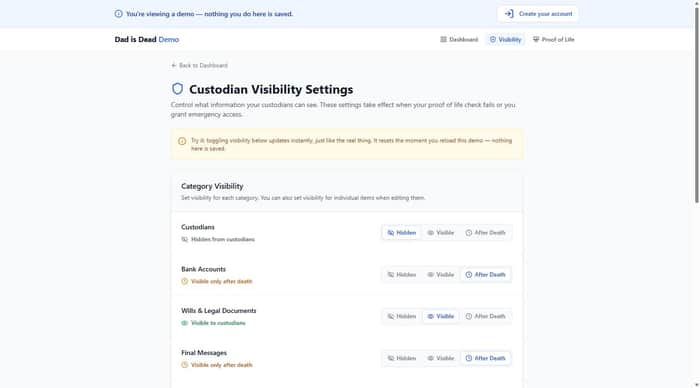
I've spent the last few months building Dad Is Dead — a digital legacy tool that stores your important documents, passwords, and final wishes, then automatically notifies the people you trust the moment they actually need access.
The idea came from a problem I kept running into thinking about my own family: everyone agrees they should "get their affairs in order," and almost nobody does. Partly it's avoidance. But partly it's a real design gap — even people who do write everything down never solve the actual trigger problem: who decides when it's time for someone else to get access, and how do they know?
So the whole product is built around one mechanism — a proof-of-life escalation, in four steps:
- Reminder — periodic check-ins (weekly, or whatever cadence you set)
- Miss enough of them — after several missed reminders, custodians get a heads-up notification
- Grace window — a final warning goes to you directly; if you confirm you're fine, everything resets immediately, no matter how far the escalation got
- Access granted — only if the grace window also passes unanswered do custodians get into the vault
Access isn't all-or-nothing, either. You choose per item whether it's visible now, visible only once access is actually granted, or hidden — and you can restrict any of that to specific custodians instead of everyone on the list. So a spouse can see the whole vault, while an adult child only ever sees the one letter addressed to them, nothing else. That took more of the design time than the escalation logic did, honestly — "who sees what, and when" turned out to be a much harder problem than "who gets notified."
Everything sits in one AES-256 encrypted place: legal documents, financial accounts, digital credentials, funeral wishes, photos, and recorded final messages.
It's live, it works, it's $9/mo to start with a 30-day money-back guarantee — and it has zero real customers. That's the part I'm actually here about.
My theory: most people don't feel this problem while they're the one being asked to plan for their own death — they feel it while they're the one cleaning up after someone else, with no plan in place. Which means "everyone should have this" is true but useless as a marketing thesis; the sharper audience is probably people who just went through that mess for a parent or spouse and are now paranoid about leaving the same one behind.
If that's you, or you've been putting off your own version of this — I'd genuinely like to know: was the hard part finding the accounts, getting into them, or not knowing what they actually wanted done? Trying to figure out if any of the mechanisms above are solving the real problem, or ones I made up in my head.
(This is one of four small Azure-native tools I run solo — the rest are on my IH profile if you're curious what else I'm building.)

Clear and practical, thanks. Did anything surprise you along the way?
Clear and practical, thanks. Did anything surprise you along the way?
Clear and practical, thanks. Did anything surprise you along the way?
Clear and practical, thanks. Did anything surprise you along the way?
Clear and practical, thanks. Did anything surprise you along the way?
Clear and practical, thanks. Did anything surprise you along the way?
Clear and practical, thanks. Did anything surprise you along the way?
Good point. Did you test that with users before committing to it?
Thanks for sharing the numbers, that makes it much easier to follow.
Makes sense. Are you planning to charge for it, or keep it free for now?
How did you decide this was worth building in the first place?
Interesting. How are you measuring whether it is working?
Thanks for sharing the numbers, that makes it much easier to follow.
Solid lesson. Which channel has worked best for you so far?
Really relatable. How much time do you put into this each week?
Clear and practical, thanks. Did anything surprise you along the way?
Clear and practical, thanks. Did anything surprise you along the way?
How did you decide this was worth building in the first place?
Thanks for writing this up. Bookmarking it for later.
Helpful post. How did you get your first bit of traction?
Thanks for writing this up. Bookmarking it for later.
Interesting approach. What was the hardest part to get right?
Clear and practical, thanks. Did anything surprise you along the way?
This is useful. How are you finding your first users so far?
Great breakdown. What feedback have you had from early users?
Good point. Did you test that with users before committing to it?
Really solid approach — curious how you're thinking about this, what's been the hardest part to figure out so far?
Good point. Did you test that with users before committing to it?
Good point. Did you test that with users before committing to it?
Good point. Did you test that with users before committing to it?
Have conversations with people who recently managed a relative’s affairs revealed willingness to entrust a paid service with sensitive access, or mainly confirmed that the problem feels important?
Good question — I haven't done structured interviews, just anecdotal conversations with people who've already been through it. What I've heard leans more toward "yes, I'd pay for this" than I expected, but it's a small, self-selected sample (people who already talk to me about what I'm building), so I don't want to overstate it. Honestly part of why I posted this here — trying to get a less biased read before I lean too hard on my own conversations.
That trust-to-payment gap is probably the next thing worth unpacking. Could be useful to continue by email sometime, if you’re open to it.
Happy to continue over email — probably faster than a comment thread. There's a contact form here that reaches me directly: https://ageebgeesolutions.com/?utm_source=indiehackers&utm_medium=referral&utm_campaign=launch&utm_content=comment-followup#contact (has a "Dad Is Dead" option in the product dropdown). Feel free to use that, or keep going here if that's easier for you.
Thanks! I’ve just sent it over.
Looking forward to hearing your thoughts whenever you have a chance.
Good point. Did you test that with users before committing to it?
Good point. Did you test that with users before committing to it?
Really good writeup, thanks for sharing it. What's the next thing you're planning to try here?
Thanks! Next up is talking to more people who've actually been through this, rather than building more features blind. The most surprising part so far: the visibility/permissions piece (who sees what, and when) ate way more design time than the notification logic — I expected the proof-of-life mechanism to be the hard part, and it wasn't.
Good point. Did you test that with users before committing to it?
Nice, this makes a lot of sense. What's been the most surprising part of it so far?