Can a free SEO proposal tool bring the right customers to my SaaS? I built one to find out
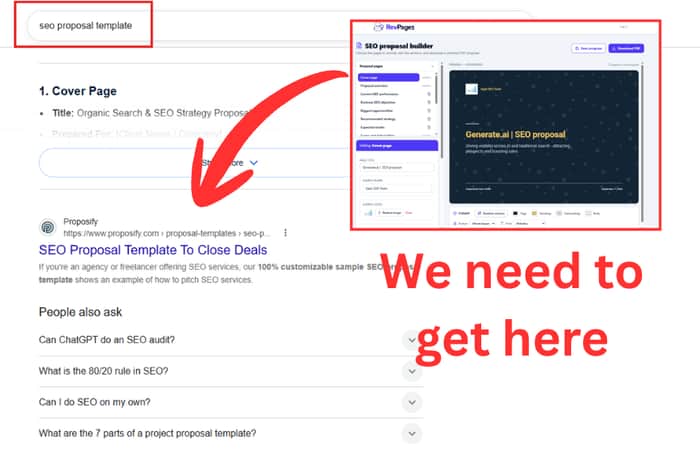
Can a free tool attract users to my paid tool?
For context, I’m building RevPages, a tool that helps SaaS companies find revenue-generating SEO opportunities.
But the biggest challenge with building a new product is getting the right people to discover it.
Yes I could publish articles about SEO (And I have) but there’s already a huge amount of SEO content online, and getting traffic from another advice post is becoming harder in the world of AI search.
So I’ve been looking for useful tools I can build around problems my potential customers already have - and trying to rank them.
Free tools and templates can attract users (and backlinks) on autopilot for years - I created lots of them for StandOut CV before selling earlier this year.
Some initial brainstorming led me to “SEO proposal template”.
The keyword gets around 1,300 searches a month globally. More interestingly, the people searching for it are likely to include SEO freelancers and agencies putting together pitches for clients. Those are exactly the sort of people who might also use RevPages to find and forecast opportunities for those clients.
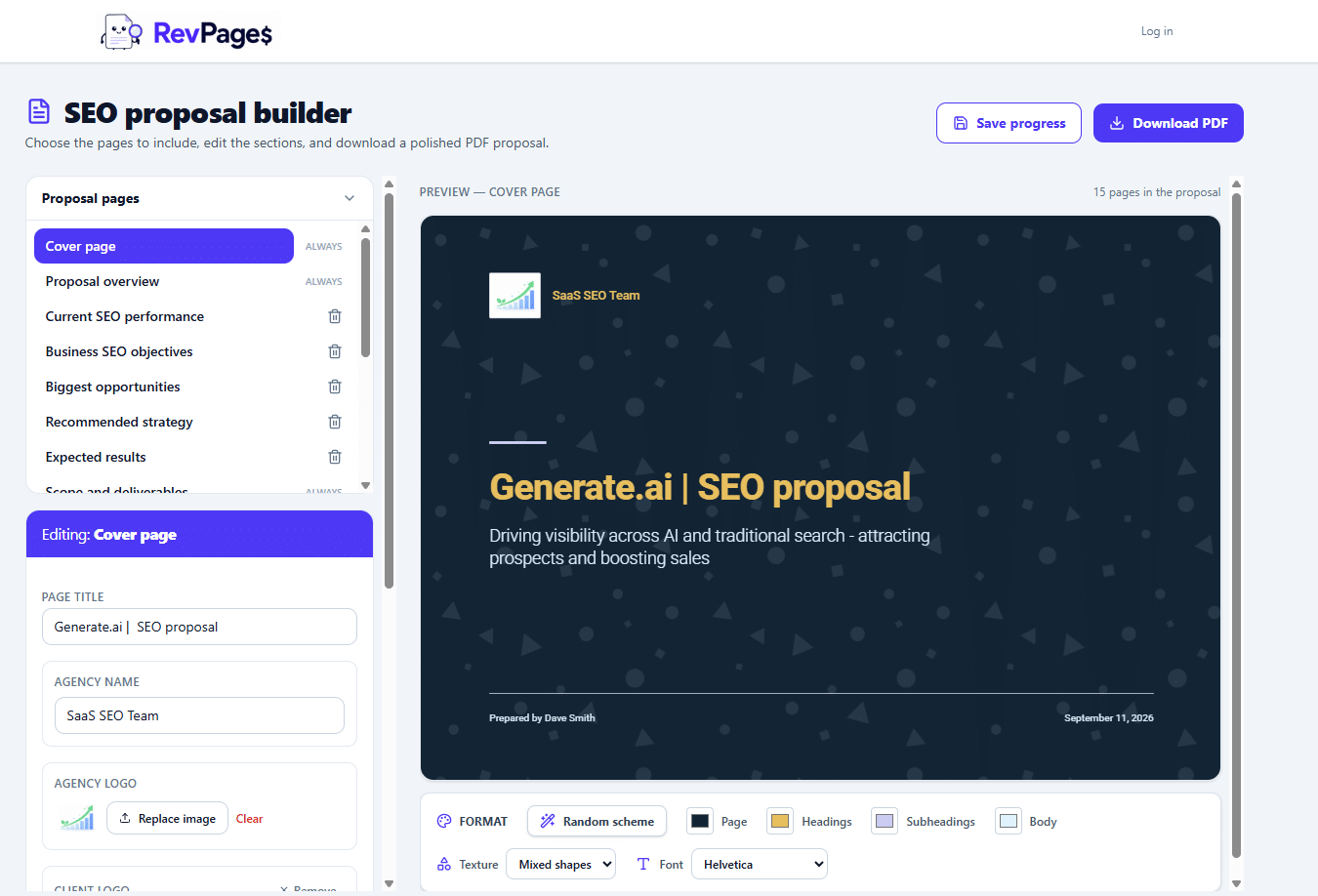
So, I decided to build a free SEO proposal builder. You can open it, edit the proposal immediately and download a PDF without creating an account.
I built it in Lovable in less than a week, although there was a lot more thinking, testing and fixing involved than the phrase “vibe coding” suggests.
The vibes alone were not enough to get this over the line.
Evaluating the search results for competition
Before building anything, I looked at the search results for “SEO proposal template” and “free SEO proposal template”.
I was hoping to see weak results and tools that I could realistically improve on using Lovable.
There were some very strong domains ranking. At first glance, that made the keyword look difficult. But many of the results didn’t seem to deliver what I would want as a user.
Some were from the big proposal software companies - their templates looked good, but you had to sign up before you could even use the editor - and their content is generic proposal material as opposed to SEO-specific. Others were articles explaining what an SEO proposal should contain, without giving you an actual proposal you could edit.
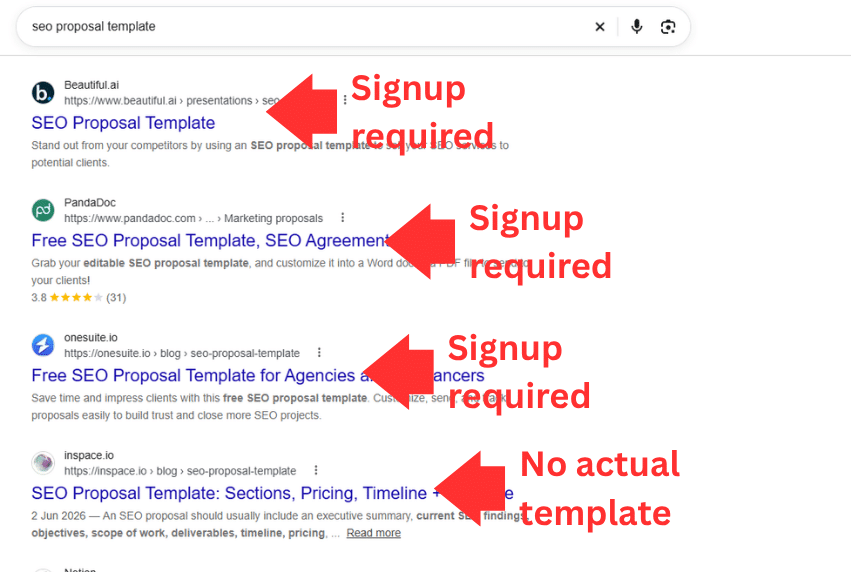
This was good news for me. A page with a genuinely useful, immediately accessible builder would serve the search better than any of those options.
I don’t know whether Google will agree yet, but I’m fairly confident. The established sites have a big advantage, and a useful tool doesn’t automatically earn a ranking. But I felt there was enough of a gap to make it worth trying.
Ultimately it’s a high-volume keyword that attracts the kind of people I want to reach, and I think I can make something more useful than what’s currently ranking.
That makes it a worthwhile opportunity in my eyes.
I started by researching what users need, not writing a prompt
It would have been tempting to open Lovable and ask it to “build an SEO proposal generator”. and have this done in an hour.
But that would not have given me the quality I want for this tool.
I did use Lovable to build the product, but first I reviewed other proposal tools and real example proposals. I wanted to understand what was useful, what felt frustrating and what an SEO-specific proposal needed that a general sales proposal didn’t.
Then I listed the pages the builder should include. The finished template has 15:
- Cover page - Add your branding, the client’s name and the proposal title.
- Proposal overview - Summarise what you’re recommending and why.
- Current SEO performance - Show how the client’s website is performing today.
- Business SEO objectives - Set out the commercial goals the SEO work should support.
- Biggest opportunities - Highlight the pages and keywords with the most potential.
- Recommended strategy - Explain what you’d prioritise and how you’d approach the work.
- Expected results - Show what the work could achieve, with forecasts clearly labelled as estimates.
- Scope and deliverables - Spell out exactly what’s included.
- Timeline - Show when each stage of the work will happen.
- Reporting and measurement - Explain what you’ll track and how you’ll report progress.
- About us - Introduce yourself or your agency.
- Case studies - Share relevant examples of previous work and results.
- Testimonials and reviews - Add feedback from past clients.
- Pricing - Break down your fees, with totals calculated automatically.
- Next Steps - Tell the client how to get started.
That’s more than a blank document with a few suggested headings.
Each page needed a purpose, editable content and sensible example copy that someone could replace without having to rebuild the layout.
I also made detailed tables describing how individual features should work.
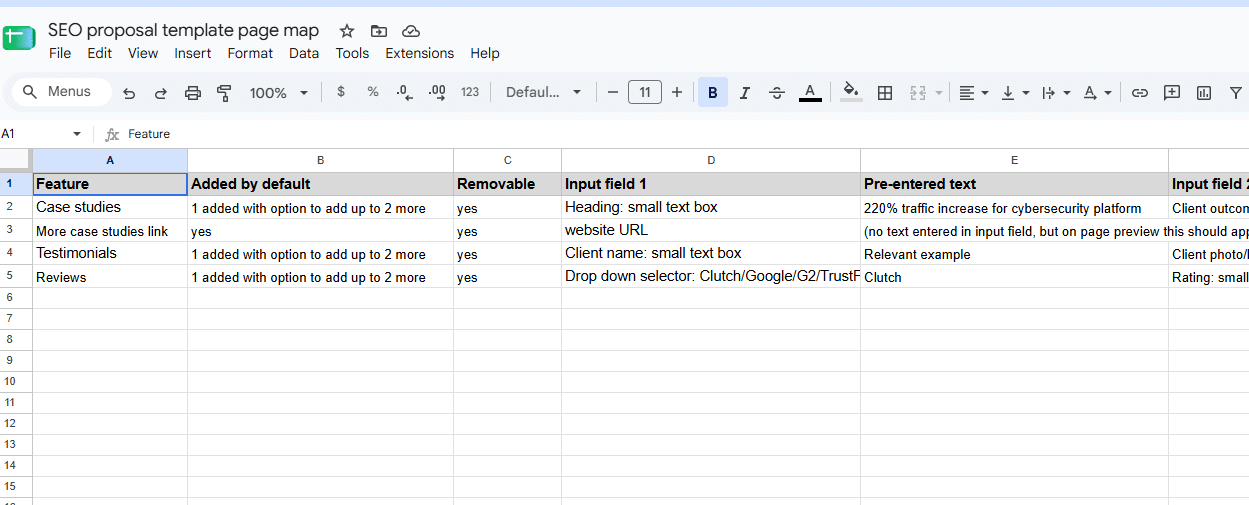
What happens when somebody changes a performance rating?
Which parts of a pricing table are editable, and which figures should calculate themselves?
What pre-written options would save someone time without forcing them into my way of pitching SEO?
Working those details out before asking Lovable to implement them made the build much harder - but the end result was a much better product
Here are some of the tool’s best features
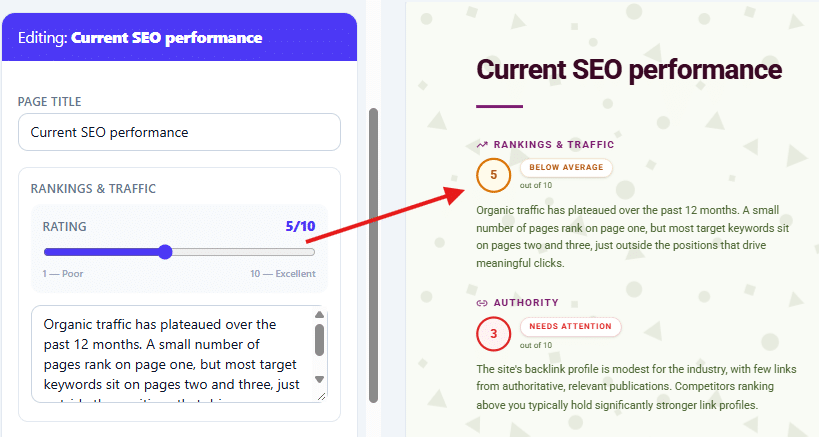
I was impressed by how easily Lovable handled features I’d expected to be much harder to build. Once I’d worked out exactly how I wanted them to behave, I could describe them, test the result and make changes quickly.
- Interactive performance ratings: Rate different areas of a client’s SEO performance, and the numbers and colours update on the page from red to green.
- Automatic pricing totals: Add or change services and fees, and the pricing tables calculate the total for you.
- Editable design: Change the proposal’s colours and layout to suit your own brand.
- Image uploads: Add your logo and supporting images to make the proposal feel like yours.
- SEO-specific pages: Show a client their current performance, biggest opportunities, recommended strategy and expected results, rather than trying to adapt a generic sales proposal.
- Instant PDF download: Start editing straight away and download the finished proposal without signing up or paying.
- Optional account: Log in if you want to save your work and create multiple proposals.
“Built in under a week” doesn’t mean “one prompt and done”
Lovable made it possible for me to build this much faster than I could have otherwise. I could describe a feature, see it working, spot what didn’t work and change it.
But a good part of the week went into reviewing what it produced.
I created several test proposals from start to finish, fixing bugs and tweaking features along the way.
I wanted the tool to feel straightforward to someone who has a client pitch to create quickly, not like a product they need to learn.
That’s been my main lesson from building with AI tools: the implementation can be quick, but you still have to make the product decisions and do testing. Researching users’ alternatives, specifying the details and testing the result took more thought than the initial build prompt.
The tool needs a page that can compete in search
I couldn’t publish the builder on an empty landing page and hope that the tool alone would rank.
I’ve been doing SEO long enough that it doesn’t work like that.
I’ve built an in-depth page around it that explains what’s included, how to use it, what makes a good SEO proposal and answers the questions someone might have before starting. It also offers a downloadable example, so visitors can see the quality of the finished PDF.
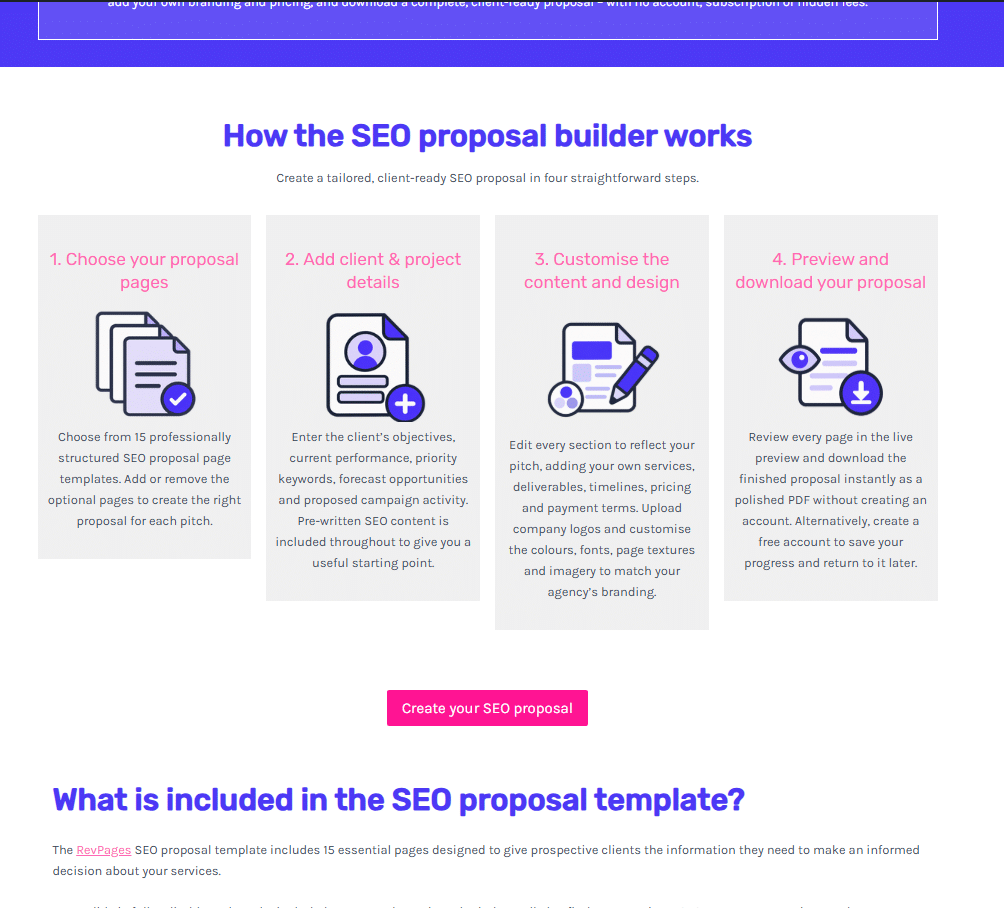
The aim is to make the page useful whether someone wants to build a proposal right now or is still figuring out what their proposal should contain.
Next comes promotion. I’ll write posts like this one, share the build and reach out to relevant sites that might find the template useful for their readers, to build links and attract some early users.
I don’t expect it to rank for such a valuable keyword overnight, but I’m confident that it will be driving organic clicks within a few weeks
Why I’m building more tools
This project has made me more interested in free tools as a way to market software.
Articles are still useful, but AI can answer a lot of the questions that used to bring people to a website. And when readers do land on an article, they may be less inclined to trust another piece of advice that looks like it could have been generated in seconds.
A tool gives people a different reason to visit. They need to do something. In this case, they can arrive needing an SEO proposal, spend time putting one together and leave with a PDF they can send to a client.
If they come back to create proposals for other clients, they’ll spend more time with RevPages and get to know the brand through something that has helped them. That feels more valuable than a single visit to an article.
I’m still writing content, including the detailed page around the builder and posts like this one. The tool gives that content something useful to lead people towards.
Whether it brings in customers remains to be seen. But I’ve built something for the audience I want to reach, and I can now see whether they use it, return to it and eventually try RevPages.
Follow me on Indie Hackers, X or Linkedin to find out where this marketing experiment leads.

The useful distinction here is the spec-and-test loop, not the generation speed. For a tool aimed at agencies, I’d keep a tiny acceptance checklist from one real proposal: editable inputs, recalculated fields, export fidelity, and a blank-state path. Re-run it after every feature; that protects the quick build from becoming a support queue.
Clear and practical, thanks. Did anything surprise you along the way?
Thanks for sharing the numbers, that makes it much easier to follow.
Good write-up. What would you do differently if you started again?
This is really close to what I'm trying right now, so it was great to read the thinking behind it.
I'm testing the same idea in a different niche: a free 12-week cash flow template for contractors, to find out if people would pay for an app version. Before spending on ads, I checked Keyword Planner. "Cash flow forecasting software" had top-of-page bids around $30 to $115 per click in the US, while "cash flow forecast template" was far cheaper. That's what pushed me toward a free template instead of ads. I also skipped the signup for a similar reason.
One question from your StandOut CV days: roughly what share of free-tool users ended up paying, and was there anything that made the jump from free tool to paid product work better?
Which section of the proposal is hardest for users to complete? If it’s forecasting results or finding opportunities, that seems like a natural place to introduce RevPages.
Nice build. The keyword pick is the smart part — agencies hunting for a proposal template are way closer to “I’ll pay for opportunity research” than people reading another SEO how-to.
One thing I’d watch early: downloads vs people who actually come back and make a second proposal. First PDF is curiosity. Second one is the agency you actually want. If that number stays tiny, the tool is a traffic play, not a funnel yet.
Free tool as distribution is a strong bet, but watch the shape of the demand here: a proposal builder is naturally a one-and-done tool. Most freelancers will build the one proposal they need, download the PDF, and have no reason to ever come back. That is great for traffic and backlinks, but it is not a funnel until a subset has a recurring need.
The one number I would watch first: what fraction of users create a second proposal within a couple of weeks, and whether those second-proposal users are the ones who take the optional account. That segment is your actual RevPages audience — agencies pitching regularly, not one-off freelancers. If repeat usage is near zero, the tool needs a revisit reason before it can feed the paid product — something like a saved proposal you can revise when the pitch changes, or a prompt to come back when it is time to report results to the client.
And on the measurement question others raised: I would not bundle downloads with intent. Split the funnel into three numbers — proposals created, proposals that led to a saved account, and any movement toward RevPages content. Only the third one tells you the free tool is marketing. The first two just tell you it is useful.
Smart choice of keyword, since people searching "SEO proposal template" are exactly the freelancers and agencies who'd pay for RevPages. One idea to close the loop: after the PDF download, ask one optional question like "what's the site you're pitching?" and offer a free opportunity scan for it. That turns an anonymous download into a warm lead with context, without adding a signup wall.
That’s exactly the kind of problem I’ve been thinking about from the AI-search side.
I recently built a stateless AI visibility tool where you enter your brand + competitors, run the generated prompts through AI tools, then paste the responses back in. It analyzes whether your brand and competitors are actually appearing in those answers.
I’m curious whether this “measure first, then optimize” approach will become as important for AI visibility as it has been for traditional SEO.
Love this angle. Building Xstream4K right now so this hits close to home — what made you look into it in the first place?
I think returning behavior would be a particularly interesting signal.
For my own AI visibility tool, I’m looking at a slightly different version of this problem: whether someone keeps testing their brand and competitors across AI-generated responses.
The tool is intentionally stateless for now — users enter their brand + competitors, get prompts, run them in AI tools, paste the responses back, and get an analysis of brand visibility.
I’m still figuring out which signals actually indicate that someone has a recurring problem worth solving rather than just curiosity.
Once the tool gets usage, what behavior will tell you you've attracted a RevPages prospect rather than just a useful free-tool visitor—returning proposals, creating an account, or exploring the paid product?
The “tool vs content” distinction is really interesting. I’m experimenting with a similar idea around AI visibility.
I built a stateless platform where users enter a brand and competitors, get prompts to run in AI tools, then paste the responses back for analysis. The goal is to make the invisible part of AI search visibility measurable.
I deliberately kept it frictionless rather than forcing signup, so I’m also curious whether that creates better engagement or just more anonymous usage. Still early, but it’s an interesting distribution experiment.
The anonymous usage vs qualified engagement question is the interesting part. Could be useful to compare notes on that beyond the thread sometime, if you’re open to it.
Yeah, absolutely — I’d be interested in comparing notes. I think there’s a lot to learn from seeing whether removing signup friction actually leads to more meaningful usage, rather than just more usage on paper.
I’m especially curious about what behaviours end up being the strongest signal that someone actually has a problem your paid product can solve. Happy to chat sometime.
Email might be easiest for this — happy to continue there.
This is a really smart distribution play. The framing around "users need to do something" vs just reading content is key - there's actual friction and value exchange happening. Quick question though: how are you measuring whether these proposal-builders actually convert to RevPages users? Are you adding some kind of signup prompt, or tracking which accounts created multiple proposals? Curious if you'll see a lag before conversion, or if some creators will just use the free tool and bounce.