Can AI and White Label SEO Change Agency Scalability?
AI and white-label SEO are changing how agencies manage growing workloads. Learn how the right combination of automation, specialist support, and scalable
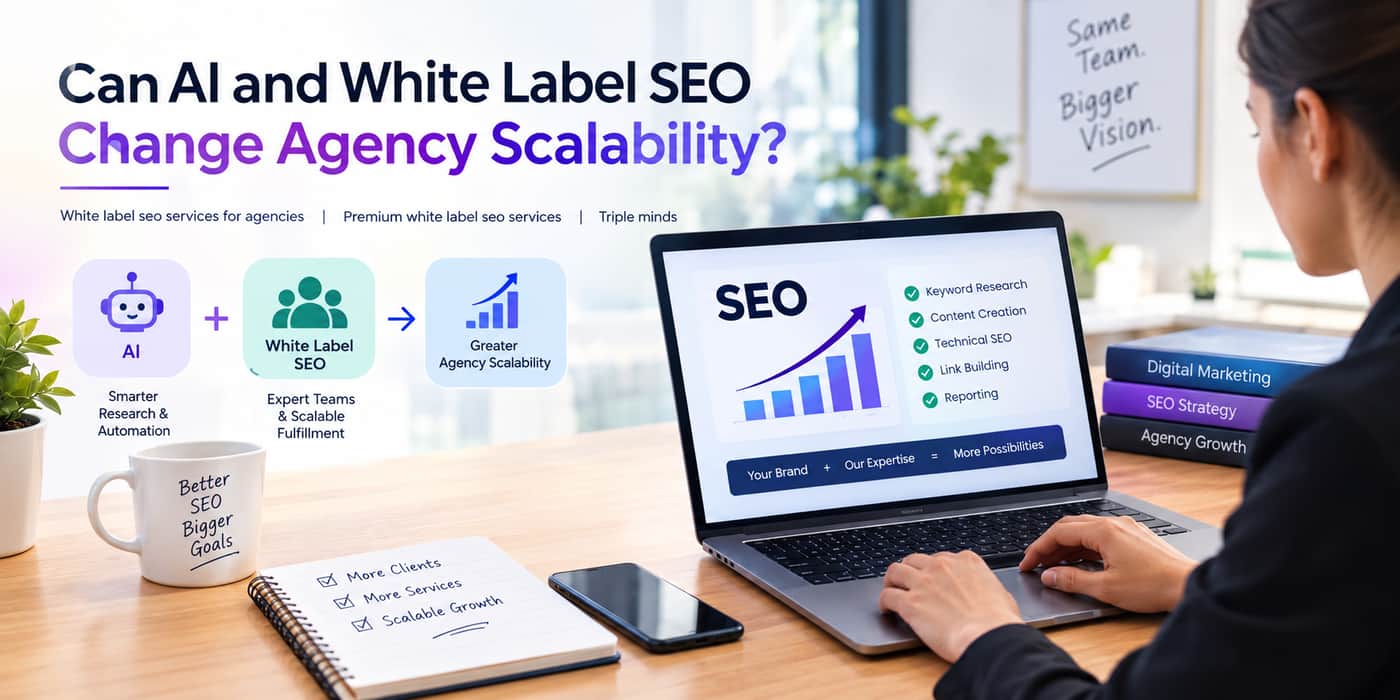
Running a digital agency often means trying to balance two very different sides of the business. On one side, there is sales, client acquisition, and business development. On the other, there is the day-to-day work required to actually deliver what has been promised.
SEO can make that balance even harder. A single client campaign can involve keyword research, technical audits, content, competitor research, link building, reporting, and continuous optimization. As the number of clients increases, the workload can quickly become difficult for a small internal team to manage.
At the same time, artificial intelligence is changing how SEO professionals approach research, content analysis, automation, and reporting. This raises an interesting question: Can AI combined with white-label SEO create a more scalable model for agencies?
What Are White Label SEO Services?
White label SEO services for agencies allow a digital marketing agency to offer SEO to its clients while an external SEO team handles some or all of the fulfillment behind the scenes.
The agency remains responsible for the client relationship, strategy, communication, and branding, while the fulfillment partner works on agreed SEO tasks.
This model can be useful when an agency wants to expand its SEO offering without immediately building a large internal department.
For example, an agency specializing in web design might start receiving requests for SEO. Instead of hiring SEO specialists, content writers, technical experts, and link-building professionals immediately, it can work with a white-label partner to provide those services under its own brand.
Where AI Enters the Picture
AI does not automatically make an SEO operation scalable. It becomes useful when it supports well-defined processes.
Modern SEO teams can use AI-assisted workflows for tasks such as:
Keyword research and clustering
Content topic discovery
Competitor analysis
Content briefs
Technical data analysis
Metadata suggestions
Internal-linking opportunities
Reporting and data summaries
Identifying content gaps
The important distinction is between using AI as a support tool and expecting AI to replace SEO expertise.
Human review is still important because SEO decisions often depend on context, search intent, business goals, competition, and the quality of the information being analyzed.
Why Agencies Struggle to Scale SEO
The biggest challenge is not always getting new clients. It can be fulfilling the work consistently after those clients sign.
Imagine an agency starts with five SEO clients. Its existing team may be able to manage the workload comfortably.
Then the agency signs another ten clients.
Suddenly, the team needs to produce significantly more content, audits, optimization recommendations, reports, and strategy updates. If the agency responds by hiring every time workload increases, operating costs can rise quickly.
This is where a flexible fulfillment model can become useful.
Can White Label SEO Reduce the Capacity Problem?
White-label SEO can give agencies access to additional fulfillment capacity without requiring them to build every role internally.
Instead of maintaining separate specialists for every SEO function, an agency can work with an external team for specific services.
This could include:
Technical SEO
Technical specialists can help identify issues related to crawling, indexing, redirects, structured data, page performance, and site architecture.
Content Production
A white-label team can support keyword mapping, content briefs, writing, editing, and optimization.
Link Building
Agencies can outsource outreach and link acquisition while retaining control over the overall SEO strategy.
Reporting
Branded reports can allow agencies to present campaign progress to clients under their own identity.
This type of arrangement can give an agency more flexibility when client volume changes. Current white-label SEO providers describe similar models in which agencies retain client relationships while fulfillment is handled behind the scenes.
AI and White Label SEO Can Work Together
The more interesting possibility is not AI or white-label SEO.
It is AI plus a structured fulfillment system.
Consider a simplified workflow.
An agency receives a new SEO client.
The SEO team uses AI-assisted tools to organize keyword data and identify content opportunities. A specialist reviews those findings and creates the campaign strategy. The white-label fulfillment team then handles agreed production tasks.
The agency reviews the deliverables before sending them to the client.
In this model, AI helps with efficiency while human specialists remain responsible for decisions and quality control.
Watch: How AI Is Changing Digital Workflows
AI is becoming part of many digital workflows, and understanding how the technology is being applied can help agency owners think more realistically about its role in SEO.
You can explore the topic further in this video:
https://youtu.be/rmKEGhYxLTM?si=tUymVAdHKuIL8WwD
The important takeaway for agencies is that AI should support a repeatable process rather than become a replacement for the process itself.
What Premium White Label SEO Services Should Include
Not every white-label provider offers the same level of support.
Agencies considering premium white label SEO services should look beyond a basic list of deliverables.
Consistent Quality
Client-facing SEO work represents the agency's reputation. Poor-quality content, rushed audits, or generic recommendations can eventually affect client trust.
A good fulfillment process should therefore include quality checks before deliverables reach the agency.
Flexible Capacity
An agency's workload can change from month to month.
A flexible partner should make it possible to increase or reduce the volume of work based on client requirements.
Transparent Reporting
Agencies need enough information to understand what has been completed and why particular recommendations were made.
Clear reporting also makes client communication easier.
Human Oversight
AI can speed up repetitive tasks, but human review remains important.
A useful workflow might look like:
AI assistance → specialist review → optimization → quality control → agency approval
This provides efficiency without removing accountability.
Scalability Is More Than Handling More Clients
It is tempting to define scalability simply as the ability to take on more customers.
But sustainable scalability involves more than client numbers.
An agency also needs to consider:
Delivery costs
Team workload
Turnaround times
Quality control
Client communication
Reporting
Process documentation
Profit margins
Service consistency
If an agency doubles its client count but also doubles its operational problems, it has not necessarily created a better business model.
The objective should be to increase capacity while keeping processes manageable.
How AI Can Improve the White Label Workflow
AI can potentially make several parts of a white-label workflow more efficient.
Faster Research
Large amounts of keyword or competitor data can take considerable time to organize manually. AI-assisted analysis can help teams identify patterns and potential opportunities more quickly.
Content Planning
AI can help generate topic ideas, group related queries, and identify potential content gaps.
However, those suggestions still need to be checked against search intent and the client's actual business objectives.
Reporting Assistance
Monthly SEO reporting can involve collecting and summarizing large amounts of data.
AI can help turn raw information into preliminary summaries, which SEO professionals can then review and refine.
Process Automation
Repetitive tasks are another area where AI and automation can help.
The less time specialists spend on repetitive administrative work, the more time they can dedicate to strategy and quality control.
What AI Cannot Solve by Itself
AI is not a shortcut around good SEO.
It cannot automatically understand every client's business, competitive environment, target audience, or commercial priorities.
There are also risks in relying too heavily on automatically generated content or recommendations.
For example, an AI-generated article might technically include the target keyword but still fail to answer the user's actual question.
Likewise, an AI-generated SEO recommendation may appear reasonable but overlook an important technical limitation on the website.
This is why human expertise remains an important part of a scalable SEO system.
The Agency Still Owns the Client Relationship
One of the main reasons agencies consider white-label services is that they do not necessarily want to give up ownership of the client relationship.
The agency can remain the primary point of contact while the fulfillment partner operates in the background.
This creates a division of responsibilities:
Agency:
Client strategy, communication, positioning, pricing, and relationship management.
White-label partner:
SEO execution, research, content, technical work, reporting support, or other agreed deliverables.
AI tools:
Automation, analysis, research assistance, and workflow support.
When these roles are clearly defined, the model can be easier to manage.
When Should an Agency Consider White Label SEO?
There is no single point at which every agency should adopt white-label SEO.
However, certain situations may indicate that it is worth exploring.
An agency might consider it when:
SEO requests are increasing faster than internal capacity.
Hiring specialist SEO staff is becoming expensive.
Existing employees are overloaded.
The agency wants to introduce SEO as a new service.
Clients are requesting additional SEO capabilities.
The agency needs temporary fulfillment support.
The agency wants to test a new service before building an internal team.
The key is to evaluate whether the model fits the agency's workflow rather than adopting it simply because it is popular.
How Triple Minds Fits Into This Model
Triple Minds is one example of a company positioned around digital solutions and SEO services that agencies can consider when looking at scalable delivery models.
For an agency exploring white-label SEO, the important consideration is not simply the number of services available. It is whether the provider can fit into the agency's existing processes while maintaining consistent quality and communication.
A useful partnership should feel like an extension of the agency's delivery team rather than an entirely separate operation that creates additional management work.
The Future May Be a Hybrid SEO Model
The traditional choice between an entirely in-house SEO team and complete outsourcing may become less important.
A hybrid model can combine:
In-house strategy + AI-assisted workflows + specialist white-label fulfillment
An agency could keep strategic decisions and client relationships internally while using external specialists for production-heavy or highly technical tasks.
This gives agencies more flexibility without requiring them to build every capability from scratch.
Final Thoughts
AI is changing how SEO work is researched, produced, analyzed, and reported. At the same time, white-label fulfillment gives agencies another way to manage increasing client workloads.
Neither approach is a magic solution.
AI still needs human direction, and white-label SEO still requires careful partner selection and quality control.
But when the two are combined thoughtfully, they can create a more flexible delivery structure. Agencies can potentially use AI to make workflows faster while relying on specialist teams to handle the areas that require experience and execution.
Ultimately, scalability is not about doing everything faster. It is about building a system that allows an agency to grow while keeping its service quality, client relationships, and internal workload under control.

