Cold Chain Monitoring Mistakes That Trigger Failed Audits
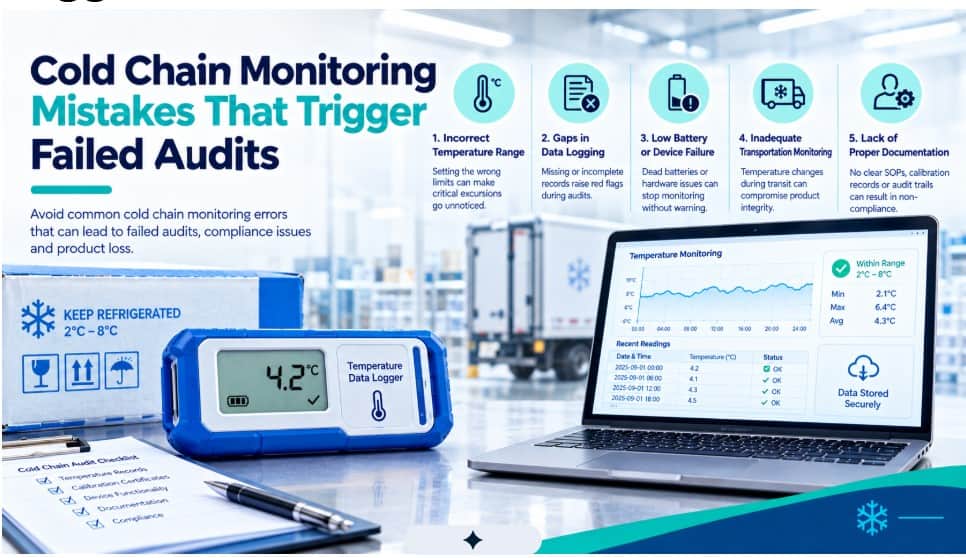
A failed cold chain audit rarely comes down to one dramatic error. More often, it's an accumulation of small, avoidable gaps in monitoring, documentation, or process that individually seem minor but collectively convince an auditor the system can't be trusted. Here are the mistakes that show up most often.
Incomplete Temperature Records Across the Full Journey
Auditors expect a continuous, unbroken temperature record from the point a product leaves controlled storage to the point it arrives at its destination. Gaps — even short ones during a handoff between carriers or a warehouse transfer — are one of the most common findings in a failed audit, because they make it impossible to confirm the product remained within acceptable conditions throughout.
Calibration Certificates That Have Lapsed or Gone Missing
Every logger and sensor used for compliance monitoring needs a current, traceable calibration certificate, and auditors will typically ask to see these directly rather than accepting a general assurance that equipment is "regularly calibrated." Missing certificates, or certificates that have lapsed without a documented recalibration, are treated as a serious finding because they undermine confidence in every piece of data the equipment has produced since the lapse.
Inconsistent Monitoring Methods Across Different Routes
Using one monitoring approach for domestic shipments and a completely different, less rigorous approach for international ones creates an inconsistency that auditors notice quickly. If your regulated product ships both domestically and internationally, the monitoring standard applied should be consistent regardless of route, rather than varying based on which logistics partner happens to be handling a particular leg.
No Documented Response to Recorded Excursions
It's not enough to simply record that a temperature excursion occurred — auditors expect to see a documented response: an investigation into the cause, a decision about whether the affected product was still fit for use, and a record of what corrective action was taken. Companies that record excursions but have no formal process for responding to them are effectively demonstrating that their monitoring data isn't actually being acted on, which raises the obvious question of why it's being collected at all.
Data That Can't Be Reproduced or Verified
If temperature data is stored in a format that's difficult to export, verify, or reproduce on request — proprietary software no longer supported, data trapped on a single device with no backup — this becomes a significant liability during an audit. Auditors need to be able to independently verify the data trail, and anything that obstructs that process, even unintentionally, reflects poorly on the overall system.
Poor Sensor Placement That Doesn't Reflect Real Conditions
Placing a single sensor in a convenient but unrepresentative location — the easiest spot to access on a pallet rather than the location most likely to experience temperature extremes — produces data that technically exists but doesn't actually validate product safety. Auditors familiar with proper thermal mapping practices will often ask specifically how sensor placement was determined, and "wherever was easiest" is not an answer that holds up.
Staff Who Can't Explain the Monitoring Process
A surprisingly common audit failure point isn't the equipment or the data at all — it's staff being unable to explain how the monitoring system works, what triggers an excursion alert, or what the escalation process is when one occurs. Documentation and technology only satisfy an audit if the people responsible for the process actually understand and can articulate it.
Treating Monitoring as a Checkbox Rather Than a System
A subtler mistake, but one auditors are increasingly trained to spot, is a monitoring program that technically exists but was clearly implemented to satisfy a requirement rather than to genuinely manage risk. This often shows up as identical, unchanging procedures across very different product types and routes, minimal evidence that anyone reviews the data unless prompted, and a general sense that the paperwork was built backward from what an audit checklist demands rather than forward from an actual risk assessment. Auditors who've seen enough genuine systems can usually tell the difference fairly quickly.
Third-Party Logistics Partners Who Aren't Held to the Same Standard
When part of a shipment's journey is handled by a third-party logistics provider, it's common for that leg to be monitored less rigorously than the legs a company controls directly — sometimes because the contract with the 3PL never specified a monitoring standard at all. Auditors increasingly expect to see that monitoring requirements extend contractually to every party handling the product, not just the sections of the journey managed in-house, and a gap here is treated as seriously as a gap in internal process.
No Clear Ownership of the Monitoring Program
A less obvious but frequent finding is the absence of a clearly designated person or team responsible for the cold chain monitoring program as a whole. When responsibility is diffused across multiple departments with no single owner, tasks like calibration renewal, software updates, and periodic process review tend to fall through the cracks simply because everyone assumes someone else is handling it. Auditors often ask directly who owns the program, and a vague or hesitant answer is itself a red flag.
Failing to Update the Process After a Previous Finding
If a previous audit flagged an issue and the corrective action taken was narrow — fixing the specific instance rather than addressing the underlying process gap that caused it — the same category of finding tends to reappear in the next audit cycle. Auditors specifically look for evidence that previous findings led to systemic changes, not just one-off fixes, and repeat findings in the same area are treated more severely than a first-time issue.
Building an Audit-Ready System From the Start
Avoiding these mistakes largely comes down to designing a monitoring and calibration process that's continuous, well-documented, and consistently applied, rather than trying to reconstruct a defensible record after an audit has already been scheduled. Providers such as TempNote offer Cold Chain Monitoring solutions built around this kind of continuous coverage, and their ISO 17025 calibration lab services provide the kind of traceable, audit-ready calibration documentation that closes one of the most common gaps auditors find.
Most failed audits are preventable well before the auditor ever arrives — the mistakes above tend to be visible internally long before they become a finding on paper.

