First paying customer for my resume builder, after months of building and no marketing
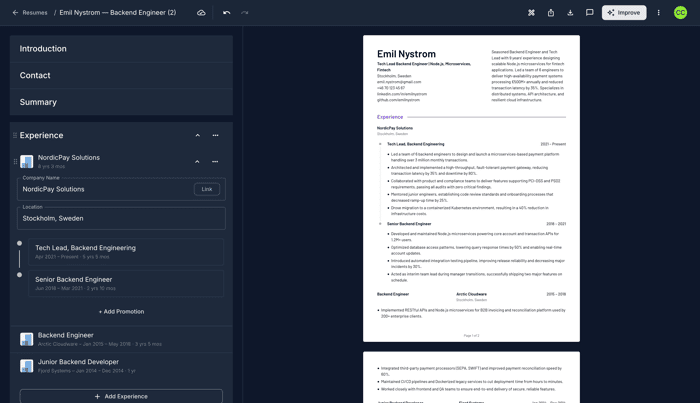
I'm a front-end developer in London. I've been building Filiz (https://filiz.app) in my spare time: a resume builder for software engineers. Structured sections for technical roles, live preview, and an AI mode that flags weak sections and drafts rewrites without applying them. You approve each one.
You can build a full resume without signing up if you want to poke at it.
I've done no marketing. I posted to one subreddit early on, got removed for self-promotion, and never tried again
Last week someone paid for the monthly plan. A friend of a friend, so not a stranger, but they looked at it and decided it was worth $19
Free to build and preview. $9 one-time for unlimited clean downloads, $19/mo for unlimited resumes and tailoring against a job description.
Feedback welcome on the landing page and where the paywall sits.
What did your first customer change for you?

Congrats, that's a real milestone, not a vanity one.
For me it was 2017, first year running my own company. The first paying was really what drove everything for me.
That mattered more than anything. Up to that point everything was theoretical. Once someone who trusted me signed up, the wind was in the sail.
Congrats, but I'd separate what this actually proves. A friend-of-a-friend referral tells you the product is good enough to vouch for, which is real, but it's a trust signal for you, not a demand signal for the product. Someone with zero reason to trust you, landing cold and paying $9 or $19 anyway, is a different test, and you haven't run it yet. I'm saying this because I'm about to face the same gap myself. Alisio has no paying users, and I already know my first one is more likely to come through someone who already trusts me than a stranger who found the page cold. That'll feel like validation. It'll actually just mean I still don't know if the product sells itself. Worth tracking the two separately once volume picks up, not lumping them together as 'a customer'.
"you approve each one" on the AI rewrites is the same bet I'm making with something I'm building, confirm-before-apply instead of auto-apply. curious if that was a deliberate trust decision from the start or something you added after seeing people hesitate to trust AI-rewritten resume content unsupervised
also the one-subreddit-then-never-again thing stood out, I'm actively doing the "answer real questions, don't link unless asked" version of Reddit right now and it's been fine so far, but I'm curious what specifically got the post removed, an obvious self-promo framing, subreddit-specific rules, or just being too new an account at the time. trying to learn from other people's Reddit mistakes before I make my own
The signal here is clean: someone paid because they saw value, not because you convinced them. That's why organic first customers are valuable - there's no marketing measurement noise clouding the real insight.
Most founders measure "we got a customer" (observational). You can actually measure "why did they decide $19 was worth it" (signal). The friend-of-a-friend wasn't a random acquisition channel - they saw the product, not your pitch. What problem made the difference between "neat tool" and "worth $19 to me"?
That measurement shift is when building changes from "I think this could work" to "here's what customers actually need."
Congratulations on getting that first paying customer! It’s the hardest milestone to cross, especially when doing zero marketing. What’s your next growth move to scale up?
cool
Congratulations on securing your first paying user—it shows that the value of your product is being recognized.
I’d also like to ask: what distinguishes your product from general-purpose AI tools like ChatGPT or Claude Code? If your product holds a significant advantage over them, you should highlight this on your website; doing so could help boost your paid conversion rate.
First customer changes the feeling from “I think this could work” to “someone actually valued this enough to pay.”
For me, that’s when feedback becomes much more useful too. You stop optimizing around assumptions and start asking what made them buy, what almost stopped them, and what would make them come back.
Also like the $9 one-time option here. It gives people a lower-friction way to pay before they’re ready for a subscription.
The first payment after months of building is a meaningful signal, even with the customer being a friend-of-a-friend. Curious whether the $19 decision changed how you think about the value users are actually paying for.