From 10 Employees to 100: The IT Decisions Founders Should Make Before Growth Creates Problems
Growth Creates Problems
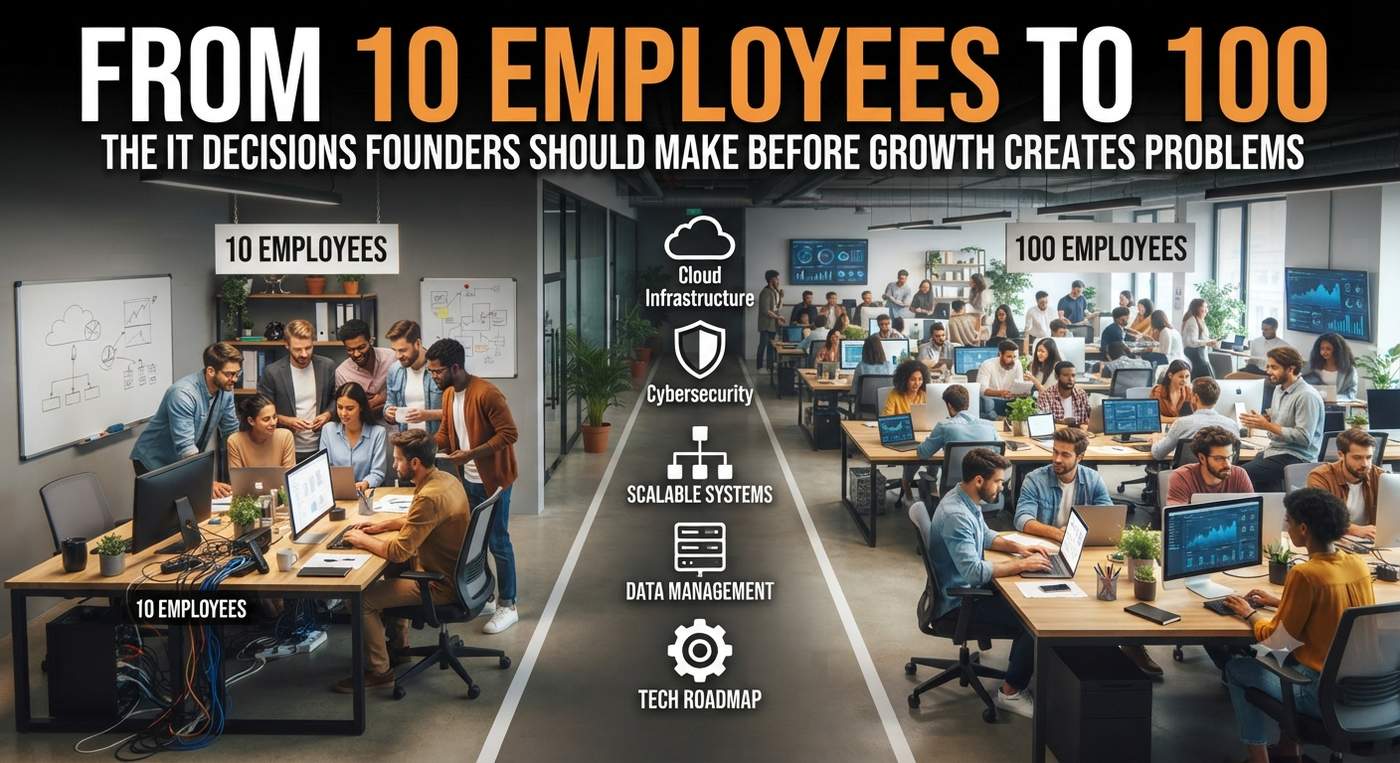
When you have ten employees, technology can feel pretty straightforward. Someone needs a laptop, you order one. The team needs a new application, you sign up. A new employee starts Monday, so someone spends Friday afternoon figuring out which accounts they will need.
For a while, that works. Then ten employees become 25, then 50, and eventually you are approaching 100 people. The little technology decisions made along the way start adding up, and suddenly the business has dozens of applications, different devices, inconsistent permissions, growing cybersecurity concerns, and technology costs that seem to appear without warning.
That is usually when founders realize something important: the technology that helped you get started is not necessarily the technology foundation that will help you keep growing.
Stop Solving IT One Problem at a Time
Early in a company's growth, being reactive is almost unavoidable. There are customers to win, people to hire, and a hundred other priorities competing for attention. If an IT problem comes up, you fix it and move on.
As the company gets bigger, however, that approach gets expensive. A quick software purchase can turn into another annual subscription that nobody reviews. A temporary file sharing process can become the way an entire department stores information. The laptop bought for employee number twelve can establish an unofficial standard that follows the business for years.
This is where IT roadmapping starts to matter. Instead of waiting for technology needs to appear, you begin looking at where the business is going and what technology will be needed to support it. A roadmap connects upcoming technology projects, costs, replacements, risks, and business priorities so leadership can make decisions before they become urgent. Convergence Networks recommends treating the roadmap as an evolving plan that considers future business objectives alongside technology investments.
The conversation changes from "What do we need right now?" to "What will this business need next?"
Think About the Company You Are Building
Imagine you currently have 30 employees but expect to reach 60 within the next two years. That growth affects much more than the number of laptops you will need.
You may need additional software licenses, more cloud capacity, stronger security controls, better onboarding processes, more structured access management, new collaboration tools, and perhaps an entirely different approach to IT support. If another office is part of the growth plan, networking, connectivity, equipment, security, and support all need to enter the conversation well before opening day.
An IT roadmap gives those decisions a timeline. It allows leadership to look at the business plan and ask what technology has to happen first, what can wait, what needs to be budgeted for, and which decisions being made today could become difficult to undo later.
That is especially important because technology decisions often have a longer life than expected. The software you select at 20 employees could still be central to the company when you have 100.
Standardize Before Everything Becomes Harder to Manage
Small teams can get away with a lot of variation. One employee prefers one laptop. Other downloads a different application. Someone keeps files in one place while another team stores them somewhere completely different.
At 100 employees, that flexibility can become friction. IT has more device configurations to support, employees have different software setups, information becomes harder to locate, and troubleshooting takes longer because there is no consistent environment.
Standardizing devices, applications, security settings, file storage, and onboarding processes while the company is still growing can prevent much of that complexity. New employees should have a clear experience from the beginning, with the right equipment, the right applications, and the right access waiting for them.
The same thinking applies when someone leaves. Access should not depend on someone remembering every application the employee happened to use. As the company grows, identity and access management need to become processes rather than memory.
Security Has to Grow with the Headcount
Adding employees does not simply mean adding users. It means adding accounts, devices, permissions, applications, data, and more opportunities for something to be misconfigured or overlooked.
That makes security decisions increasingly important as the organization grows. Multi factor authentication, device management, account permissions, backups, security awareness, and processes for adding and removing access should become part of the normal way the business operates.
Requirements may also change as the company begins working with larger clients or entering industries with stricter expectations. A growing business may find that IT compliance and security are no longer simply internal technology concerns. They can start affecting contracts, insurance requirements, vendor relationships, and opportunities to work with certain customers.
Security therefore needs a place in the growth plan and the budget. It should not become a priority only after an incident occurs.
Budget for Growth Before Growth Sends You the Bill
One of the easiest mistakes to make is assuming IT costs will rise neatly alongside employee count. They rarely do.
You might hire 15 people and suddenly discover that hardware needs replacing at the same time, a business application requires a more expensive subscription tier, additional cybersecurity measures are needed, and your current infrastructure no longer supports the company comfortably.
None of those expenses should be completely surprising if technology planning and budgeting are happening together. A good IT budget considers routine costs, future projects, aging equipment, business continuity, security improvements, and the systems the organization will need as it changes.
That does not mean predicting every dollar year in advance. It means knowing that major technology investments are coming and planning for them before they compete with every other unexpected expense.
Be Careful How Many Tools You Collect Along the Way
Growth has a habit of creating software. Sales finds a tool it likes. Marketing purchases another. Finance adopts its own platform. Operations need something more specialized. Before long, the organization has a growing collection of applications, overlapping functionality, multiple sources of information, and subscriptions that nobody is quite sure who owns.
Before adding another application, ask whether the business already something has capable of doing the job. Consider where the application will store company information, who will manage access, whether it works with existing systems, and what happens to the data if the company stops using it.
This becomes particularly important with AI. It is incredibly easy to start buying AI tools because they promise faster work or automation, but the technology should come after the business problem. The organization first needs to understand the process it wants to improve, the information involved, how that information is protected, and what a successful outcome would actually look like.
Sometimes getting ready for AI means cleaning up years of technology decisions first.
Someone Eventually Needs to Own the Bigger Picture
At ten employees, the founder might still be involved in choosing laptops, approving software, and calling support when something breaks. At 100 employees, that is no longer a good use of leadership's time.
Someone needs to be looking across the entire technology environment and connecting IT decisions to the direction of the business. That includes budgeting, cybersecurity, lifecycle planning, software, vendors, projects, employee needs, and future growth.
For some companies, that responsibility sits with internal IT leadership. Others use external IT Consulting Services to bring additional technical and strategic expertise into the planning process. The structure can vary, but ownership should be clear.
Otherwise, technology slowly becomes a collection of individual decisions made by different people at different times, rather than something the business is deliberately managing.
Build for 100 While You Can Still See 10
Growing from ten employees to 100 is a good problem to have. The goal is not to introduce layers of complexity before the business needs them. It is to avoid creating problems that become much harder to fix once another 50 people depend on the systems you chose.
Create standards while changing them is still relatively easy. Build security into the way people work before hundreds of accounts need to be cleaned up. Understand where your data lives before information is spread across dozens of platforms. Connect your IT budget to your growth plan before major investments become emergencies.
Most importantly, create an IT roadmap based on where the business is heading, not just where it is today. Technology should not be the thing that catches up after every stage of growth.
If you are building a company for 100 people, some of the most important IT decisions will be the ones you make long before employee number 100 walks through the door.

