From weekend project to $1M MRR in two years

After ten failures, Jure Sotošek had a win with a hardware product. That win gave him the distribution chops he needed to turn his next project, ParakeetAI, into a $1M MRR product within two years.
Here's Jure on how he did it. 👇
Combining software, AI, and distribution
I’m a software engineer turned entrepreneur from Slovenia. I studied Computer Science at King’s College London and then worked as a software engineer at Microsoft on Teams. I’d always wanted to build my own companies, though, and before finding something that really worked, I launched more than ten different products.
My first real breakthrough was WrumerSound, a hardware product for car enthusiasts, where I learned a lot about both building products and using organic short-form content as a distribution channel.
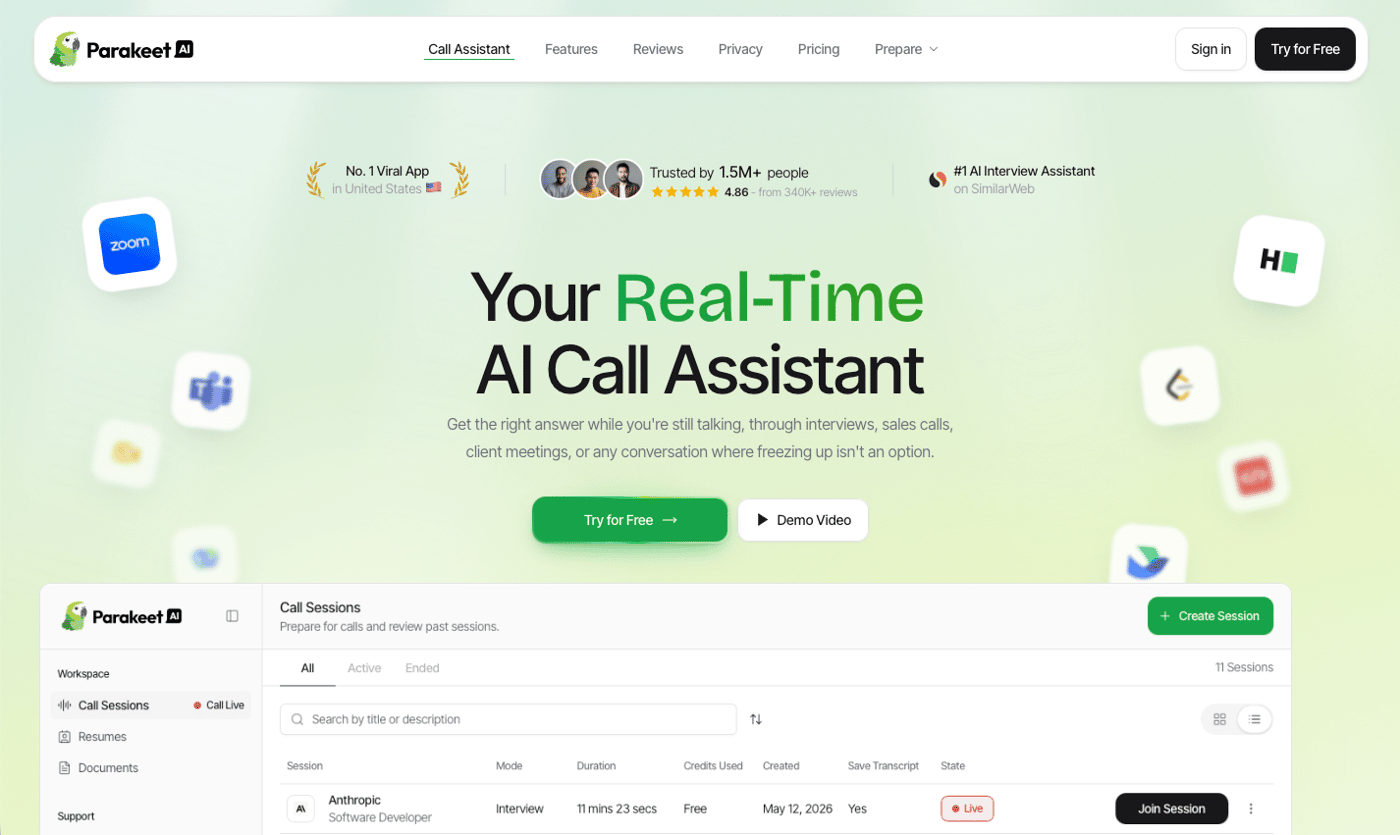
Today, I’m the founder and CEO of ParakeetAI. We started it in 2024 as a real-time AI interview assistant, and it has since evolved into a broader real-time AI call assistant. It listens to a conversation and gives you relevant answers while you’re still talking, whether that’s during a job interview, a sales call, or another high-stakes conversation.
We’ve bootstrapped ParakeetAI from zero to more than $1 million in monthly revenue in under two years, with over 1.5 million users. At the same time, we’ve built an organic distribution engine that generates roughly a billion views per month. I'm most proud that we achieved this with a very small team. It’s been a good example of how much leverage you can get today by combining software, AI, and distribution really well.
Building the idea
The idea for ParakeetAI arose from observing how quickly real-time AI was improving. I realized that if an AI could listen to a conversation, understand the context, and give you a useful answer almost instantly, it could become a completely new type of interface — not something you use before or after a conversation, but something that helps you while the conversation is happening.
Interviews were an obvious first use case because they’re high-stakes, people already spend a lot of time preparing for them, and the value of getting the right answer at the right moment is clear.
The first version of ParakeetAI was lean. I built the MVP myself over a weekend, so the initial investment was my time and a small amount of money for APIs and infrastructure. Because I’m a software engineer, I didn’t need to hire an engineering team or raise money to find out if the idea worked — it was bootstrapped from the beginning, and that combination of fast product development and organic distribution ultimately allowed us to grow it from a weekend project into the business it is today.
A simple stack
We built the original product in Next.js. For the AI pipeline, we used Speechmatics for real-time transcription and OpenAI models for generating answers; Stripe handled payments. We initially built the marketing site in Webflow. We deliberately kept the stack simple because speed was the priority at the beginning; I wanted to get from an idea to something people could pay for as quickly as possible.
The biggest challenge was getting the latency low enough that the product felt useful during a live conversation. We had to combine speech-to-text, an LLM, and text-to-speech to understand what was happening and respond quickly enough to feel almost real-time. We relied heavily on existing AI models and APIs rather than trying to build everything from scratch.
As the product has grown, the stack and infrastructure have become more sophisticated, but my philosophy around technology hasn’t changed. I’m not interested in using complicated technology for its own sake. We try to use proven tools, keep the system as simple as possible, and optimize heavily around the things customers notice: speed, reliability, and answer quality.
Charging early
ParakeetAI is a subscription software business. Customers pay for product access, and our revenue grows primarily by acquiring more users, converting them to paid plans, and increasing the value we provide over time. As software, the marginal cost to serve an additional customer is relatively low compared to a physical product, although AI inference, transcription, and infrastructure are meaningful variable costs we must manage carefully.
We started charging very early. I’ve always preferred validating a product with revenue rather than just sign-ups or positive feedback, so once the first version became usable, we charged for it. That gave us a much clearer signal: people saying a product is cool is one thing, but entering a credit card is much stronger validation. From there, we grew mostly by improving the product and dramatically increasing distribution through organic content.
Broadening the product beyond the original interview use case has been our biggest revenue expansion opportunity. Interviews were a great wedge because the problem is obvious and urgent, but the underlying technology is useful in many live conversations, sales calls, recruiting, meetings, and other situations where real-time contextual AI assistance is valuable. This allows us to expand both the number of customers we serve and the value each customer gets from the product.
My advice to other founders is to charge as early as possible. Don’t spend six months optimizing a product based on people telling you they would use it. Build the smallest version that solves the core problem, ask people to pay, and then use that revenue signal to decide what deserves more of your time.
Organic short-form content
Organic short-form content generated almost all our growth. This was intentional from the start. Before ParakeetAI, we had already generated close to 200 million views for WrumerSound across TikTok, Instagram Reels, YouTube Shorts, and Facebook Reels. When we started ParakeetAI, we specifically looked for a product naturally interesting enough to spread on those platforms. We didn't have a traditional launch. We made the product available, started posting videos, and got our first sale within the first week.
Initially, our strategy was simple: study what worked, create product demonstrations, post consistently, and iterate based on viral formats. Early on, we produced around two videos per day. Once we saw the channel worked, instead of immediately moving to paid ads, we scaled our existing successful efforts. We built a much larger UGC operation with creators producing content across many accounts, countries, and platforms. Today, that system includes more than 100 creators and produces hundreds of videos per day.
Our biggest lesson was treating organic content almost like performance marketing. We don’t just tell creators to “make something viral.” We systematically test hooks, formats, scripts, angles, and creators, observe performance, and then create many variations of the winners. This volume provides a huge number of experiments, and occasionally one format generates millions of views. We then scale that pattern across the network. At our current scale, our organic marketing machine generates more than 1 billion views per month, and at one point we generated around 2 billion organic views in three months.
We tested other channels. Reddit generated some sales, and Google Ads showed promise, suggesting SEO could eventually become meaningful. But we kept most of our focus on organic short-form because it produced the best results. One advantage is cost; another is that the content often feels more native and authentic than a traditional ad.
Good timing
Timing was a huge advantage, and completely outside my control. I started ParakeetAI during a period when speech recognition and large language models were improving incredibly quickly. A product like this would have been much harder, more expensive, or simply not good enough a few years earlier.
We were fortunate to enter the market at a point where the underlying technology was becoming capable enough while consumer awareness of AI was exploding.
Killing bad ideas
One of the biggest challenges I've faced was my experiences before ParakeetAI. I built more than ten products that either failed or never gained meaningful traction. That was frustrating, but it forced me to identify working solutions much faster. I stopped getting emotionally attached to individual ideas, becoming much more willing to ship quickly, look at the data, and move on without a strong signal.
If I were starting over, I would do fewer things and kill bad ideas even faster. Earlier in my career, I sometimes spent too much time building before proving distribution. Now I would start with two questions:
Can I build a useful version of this quickly?
Do I have a realistic way to get it in front of many people?
I’d launch the smallest possible version, charge from day one, and let customer behavior decide whether it deserves more investment.
Four pieces of advice
My biggest advice is to optimize for speed of learning, not for how impressive the product looks. Most of my early projects failed. The useful part wasn't the failure itself, but learning to find out much faster whether an idea had real demand. Build the smallest version that solves the core problem, put it in front of people immediately, and ideally charge from day one. A payment is a much stronger signal than someone telling you they like the idea.
I’d also think about distribution before writing too much code. One of the biggest mistakes technical founders make is spending six months building something and only then asking, “How do I get users?” Before starting, you should have at least one plausible answer for where the first thousand customers could come from. That could be short-form content, SEO, communities, outbound, an existing audience, or something else, but it should be part of the idea, not an afterthought.
Another non-obvious point is the value of developing complementary skills. Coding is great, but learning marketing and distribution was probably just as important for me. You don’t need to become world-class at everything, but if you can build, sell, and understand what users actually want, you can stay very lean and move much faster than teams that need a different person for every function.
Finally, don’t get too attached to any individual idea. Be persistent about becoming an entrepreneur, but flexible about the specific product. I went through more than ten projects before finding things that really worked. If something has no traction after a fair test, shutting it down isn’t failure; it gives you back your most valuable resource: your time. The goal is to run enough high-quality experiments that eventually you find something where the product, timing, and distribution all line up.
What's next?
My main goal is to expand ParakeetAI beyond interviews, transforming it into a much broader real-time AI assistant for conversations. Interviews offered a strong starting point due to their immediate value proposition, but the underlying product is useful anywhere someone needs context, information, or guidance during a conversation. I see a much bigger opportunity in sales calls, recruiting, meetings, customer conversations, and eventually other professional workflows.
I also want to improve the product until it feels almost invisible. Ideally, you don’t feel like you’re operating another piece of software; you’re simply having a conversation, and the right information appears at the right moment. This means continuously improving latency, accuracy, context awareness, and how naturally the product fits into a live call.
On the business side, I want to grow while staying very lean. AI companies today demonstrate how much a small team can accomplish with strong product, automation, and distribution. I’d rather build a highly efficient company with a small group of exceptional people than add headcount just because the company is growing.
Longer term, I’m interested in building multiple products and companies. ParakeetAI is my focus today, but my broader goal is to improve at identifying opportunities, building quickly, finding distribution, and scaling what works. I still feel we’re very early in what AI makes possible, and I want to build throughout that transition.
You can learn more about ParakeetAI at parakeet-ai.com, where you can try the product and see what we’re building.
I also share updates about ParakeetAI, growth, and what I’m learning as a founder on LinkedIn and X.

Leave a Comment