Galaxy Z Fold 8: A Look at Samsung’s Future Foldable Technology
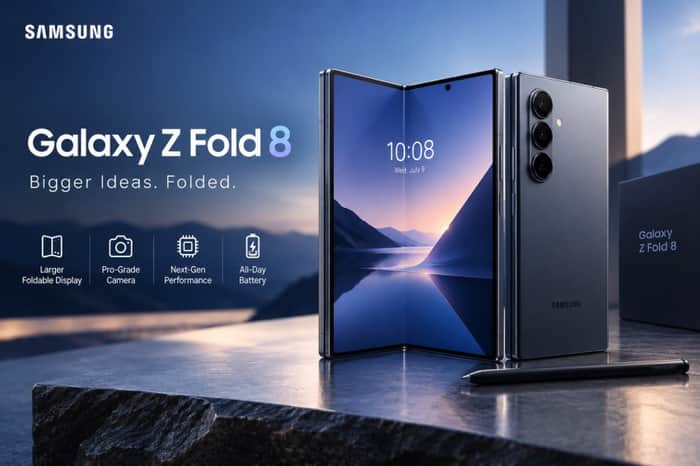
Samsung continues to push the boundaries of foldable smartphones with the Galaxy Z Fold8, the eighth-generation model in its Galaxy Z lineup. Officially unveiled at Galaxy Unpacked in July 2026, the Galaxy Z Fold8 introduces a redesigned form factor, wider display proportions, a lighter build, powerful hardware, and new AI-focused features.
Rather than simply making the traditional Galaxy Z Fold thinner or faster, Samsung has taken a different approach with the Fold8. The company has redesigned the proportions of the device to create a wider, more versatile experience for reading, browsing, entertainment, gaming, and multitasking.
Samsung has also introduced the Galaxy Z Fold8 Ultra, its first Ultra-branded foldable, giving customers another option at the premium end of the foldable market.
A Completely Redesigned Foldable Experience
One of the biggest changes in the Galaxy Z Fold8 is its new shape. Samsung has moved toward a wider, more passport-like design instead of the taller proportions associated with previous Galaxy Z Fold models.
The Galaxy Z Fold8 features a 5.5-inch cover display and a 7.6-inch main foldable display. When opened, the internal screen uses a 4:3 aspect ratio, which is particularly suited to web browsing, reading documents, watching videos, and running multiple applications side by side.
Samsung also says the display can be rotated to provide a 3:4 viewing orientation, while the cover screen uses a 10:16 ratio that feels more familiar for everyday smartphone activities.
This redesign shows that Samsung is focusing not only on screen size but also on how people interact with a foldable device in different situations.
Lighter and More Portable Design
Weight has been one of the major challenges facing foldable smartphones. Samsung has addressed this with the Galaxy Z Fold8, which weighs 201 grams, making it the lightest Galaxy Z Fold model to date.
The device measures approximately 123.9 × 81.9 × 9.7 mm when folded and 123.9 × 161.4 × 4.5 mm when unfolded.
The thinner and lighter construction makes the Fold8 easier to carry while maintaining the large-screen experience that defines the Galaxy Z Fold series.
Powerful Snapdragon Performance
The Galaxy Z Fold8 is powered by the Snapdragon 8 Elite Gen 5 for Galaxy processor. This puts the device in Samsung's highest-performance smartphone category and gives it enough processing power for demanding multitasking, gaming, productivity applications, and AI-powered features.
Depending on configuration, the phone offers 12GB or 16GB of RAM and storage options of 256GB, 512GB, and 1TB.
This combination makes the Fold8 particularly interesting for users who want a smartphone that can also function as a compact productivity device.
AI Becomes a Bigger Part of the Foldable Experience
Artificial intelligence is another major part of Samsung's latest foldable strategy.
The Galaxy Z Fold8 introduces new AI capabilities designed to take advantage of its larger display. Samsung describes the new generation as being built around more advanced, agentic AI experiences, allowing the device to provide more context-aware assistance and interact with users in more useful ways.
The larger screen also gives AI-powered tools more room to work alongside other applications. For example, users can potentially combine productivity tools, web browsing, communication, and content creation without constantly switching between screens.
Samsung's new foldable lineup is therefore not simply about having a larger display—it is increasingly about making that additional screen space useful for intelligent software experiences.
Display Technology for Entertainment and Productivity
The 7.6-inch internal display is one of the main attractions of the Galaxy Z Fold8.
With a 120Hz refresh rate and high-resolution AMOLED technology, the large display is designed to provide smooth scrolling, gaming, video playback, and productivity. The new 4:3 ratio can also reduce some of the limitations associated with watching content on the taller displays used by earlier foldables.
The wider layout is particularly useful for reading documents and websites because more horizontal content can fit on the screen.
For users who regularly work with multiple applications, the larger display can also provide a more comfortable workspace than a conventional smartphone.
Camera Improvements
The Galaxy Z Fold8 features a dual-camera system on the rear with 50MP main and 50MP ultrawide cameras, while the device also includes 10MP selfie cameras.
Samsung is placing greater emphasis on AI-assisted photography and video features alongside the hardware improvements.
However, the camera system remains an area where the Fold8 differs from some conventional flagship smartphones. Some reviews have pointed out that the device does not include a dedicated telephoto camera, which may matter to users who prioritize long-range photography.
Battery and Charging
Samsung has equipped the Galaxy Z Fold8 with a 4,800mAh battery. The company says the device can deliver more than 26 hours of video playback under its testing conditions.
The phone also uses silicon-carbon battery technology, which can provide higher energy density while helping Samsung maintain a relatively slim design.
The Fold8 supports 45W wired charging, while Samsung has focused heavily on battery safety and thermal management as it introduces the newer battery technology into its foldable lineup.
Durability Remains Important
Foldable phones have historically faced questions about durability because their displays and hinges contain more moving and flexible components than conventional smartphones.
The Galaxy Z Fold8 carries an IP48 rating, offering protection against water exposure and larger solid particles. Samsung has also redesigned elements of the internal structure and hinge system to improve the overall durability of the device.
However, the IP48 rating does not provide the same level of dust protection as some IP68-rated conventional smartphones and competing foldables. As a result, durability will remain an important consideration for buyers.
Galaxy Z Fold8 Price
The Galaxy Z Fold8 starts at approximately $1,899.99 in the United States and £1,699 in the UK, placing it firmly in the premium smartphone category.
Samsung is also offering the more expensive Galaxy Z Fold8 Ultra, which starts at approximately $2,099.99 in the United States and £1,899 in the UK.
The high pricing reflects the advanced foldable display technology, premium hardware, and engineering required to create a smartphone that can transform into a larger-screen device.
Galaxy Z Fold8 vs. the Growing Foldable Market
Samsung is no longer competing in an emerging market with only a handful of foldable manufacturers. Companies including Google, Xiaomi, Huawei, and others are developing increasingly sophisticated foldable devices.
In September 2026, Xiaomi introduced its Xiaomi 18 Fold, featuring a 7.58-inch internal display, a 6,000mAh silicon-carbon battery, and a triple Leica camera system. Huawei has also introduced new high-end foldables, including the Mate XT2 series.
These developments show how quickly competition in the foldable smartphone market is increasing. Samsung remains one of the global leaders, but competitors are continuing to experiment with larger batteries, different form factors, advanced cameras, and new multitasking experiences.
What the Galaxy Z Fold8 Means for the Future of Foldables
The Galaxy Z Fold8 represents an important step in Samsung's long-term foldable strategy.
Instead of treating foldables simply as smartphones that open into tablets, Samsung is experimenting with different screen proportions and form factors. The new 4:3 internal display suggests that Samsung wants the Fold series to become more useful for productivity and content consumption while remaining practical as a phone when closed.
The introduction of the Galaxy Z Fold8 Ultra also indicates that Samsung sees different types of customers within the premium foldable market. Some users may prefer the more compact Fold8, while others may want the largest possible workspace and maximum specifications from the Ultra model.
Conclusion
The Samsung Galaxy Z Fold8 represents a major evolution of Samsung's foldable smartphone technology. Its redesigned proportions, 7.6-inch internal display, 201-gram weight, Snapdragon 8 Elite Gen 5 for Galaxy processor, AI features, 4,800mAh battery, and improved structural design make it one of Samsung's most ambitious foldable devices yet.
The device is also entering a more competitive market than ever before. With companies such as Xiaomi, Huawei, Google, and potentially Apple pushing their own foldable technologies, Samsung will need to continue improving portability, durability, cameras, battery technology, software, and AI.
For now, the Galaxy Z Fold8 demonstrates that Samsung is moving beyond simply refining the original foldable-phone concept. The company's latest approach is about creating a device that can adapt between smartphone, entertainment, and productivity experiences—giving users a larger digital workspace without carrying a traditional tablet.
