GoldAI Insider: Data-Driven Market Intelligence (Gold & Stocks)
[The Insight: Data Doesn't Lie] As an indie hacker, I spend a lot of time analyzing search trends to find real market gaps. While everyone assumes "Diet" or "Big Tech" are the hottest topics, the data told a different story.
I compared the monthly search volumes:
Diet: 45,000 searches
NVIDIA: 680,000 searches
Gold Price: 1,460,000 searches
The interest in gold is more than twice that of NVIDIA and significantly higher than popular lifestyle keywords like "Diet." This massive demand—7 times higher than many other trending topics—convinced me that people are looking for a smarter way to understand the gold market.
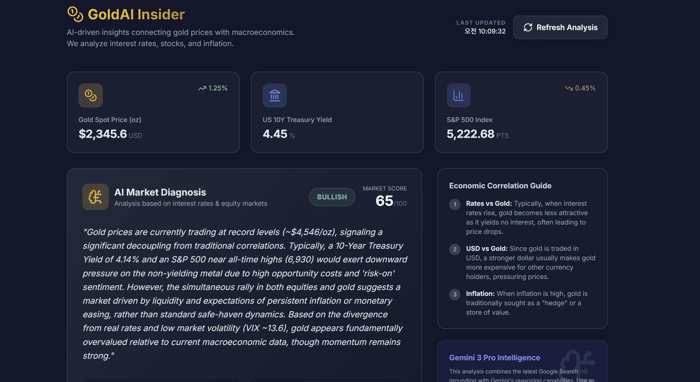
[What I Built: GoldAI Insider] I built GoldAI Insider to meet this demand. It’s a simple, AI-powered tool that analyzes gold prices alongside broader stock market trends. I wanted to provide clear insights without the noise of complex charts. It’s a practical tool built for efficiency, and I’m very satisfied with its performance.

The search volume comparison approach is smart validation. Most founders start with assumptions about what's "hot" - but 1.46M monthly searches for gold price vs 680K for NVIDIA is the kind of data that challenges intuition and reveals real demand.
One thing that stands out: people searching "gold price" are often in a specific mindset - they're either actively trading, hedging, or worried about macro conditions. That's different from someone searching "NVIDIA" who might just be curious about the company. The intent density is probably higher.
Curious about the AI analysis layer - are you summarizing news/sentiment, running technical analysis, or both? The "clear insights without noise" positioning resonates, but I'd imagine different users want different depths. Some want a quick "should I buy/sell" signal, others want the reasoning behind it.
Hi demogod_ai, thank you for the sharp and thoughtful feedback! You nailed exactly what we’re aiming for. As you mentioned, the "intent density" of gold price searchers is uniquely high. They aren't just curious; they are often managing risk or responding to macro shifts. Regarding the AI analysis layer, we are building it to provide both. We understand that "clear insights" mean different things to different people:For the "Signal" seekers: We’ll provide a high-level summary of market sentiment and key technical levels. For the "Reasoning" seekers: We’re designing a "Deep Dive" layer where users can see the underlying news summaries and technical data that drove the AI's conclusion. Our goal is to balance clarity with depth so that every user gets exactly what they need without the noise. Stay tuned for more updates!
The dual-layer approach makes a lot of sense. That's exactly how different user personas consume information - some want the headline, others want to audit the reasoning. The "Deep Dive" layer sounds like it could become a real differentiator, especially for users who've been burned by black-box recommendations before.
One thought: the transition between Signal and Reasoning modes could itself be valuable data. If you track when users drill down vs when they trust the summary, you'd learn a lot about which market conditions trigger "I need to understand why" behavior. That's probably when volatility or uncertainty is high - exactly when your tool matters most.
Looking forward to seeing how the Deep Dive feature shapes up. The "clarity with depth" balance is hard to nail but sounds like you're thinking about it the right way.