How I Used "L-Shaped" Kitchen Content to Rank for 50+ Long-Tail Keywords
Quick Introduction: Two months ago, my kitchen blog had zero visitors and zero organic traffic. Today, it ranks for over 50 long-tail keywords. Here is the exact blueprint I followed using one specific kitchen layout.
When I launched my site, I made a huge mistake that many beginners make. I wrote generic articles about "kitchen trends" and "modern kitchen designs." Nobody read them because I was competing against massive home improvement websites with decades of authority and thousands of backlinks. I had nothing. My fresh domain stood no chance against these giants.
So I changed my entire strategy completely and stopped targeting broad terms. Instead of fighting for high-volume keywords, I focused entirely on one specific layout that homeowners actually search for. That layout was the L-shaped kitchen, and it became my golden ticket to organic visibility.
People do not just search for "kitchen design" anymore. They search for exact problems and specific solutions. They type queries like "L-shaped kitchen for narrow spaces" or "how to fix dead corners in L-kitchens." These are long-tail keywords with lower search volume but much higher purchase intent. More importantly, almost nobody creates dedicated content for these exact questions, and that gap became my opportunity.
Why I Abandoned Broad Topics Forever
Broad keywords are impossible for new sites to rank for because the competition is just too intense. I was fighting against sites with hundreds of thousands of backlinks, professional design teams, and decades of accumulated authority. My fresh domain had zero chance of ranking for terms like "kitchen remodel" or "kitchen design ideas."
So I flipped my approach completely and asked what specific problems homeowners actually face on a daily basis. The answers were incredibly detailed and specific. Homeowners needed spatial solutions for their unique spaces, not generic inspiration that they could find anywhere. I decided to become the absolute expert on L-shaped kitchens, and this single focus changed everything for my site's growth.
To validate my research and understand technical search patterns, I started publishing data-driven content on platforms where professionals share their work. This helped me understand what technical questions people were asking about kitchen layouts.
Building the Pillar and Cluster Architecture
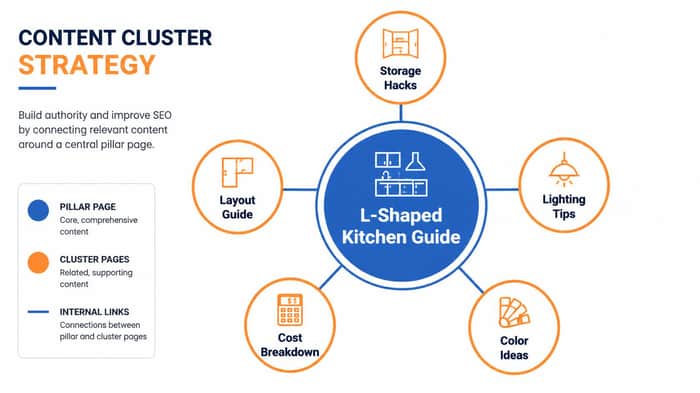
I did not write just one article about L-shaped kitchens. Instead, I built an entire content ecosystem around this single layout. I started with a comprehensive pillar page that covered every fundamental principle of L-shaped kitchen design. This pillar page discussed the kitchen work triangle in detail, explaining how the sink, stove, and refrigerator should be positioned for maximum cooking efficiency.
I covered corner cabinet solutions extensively, comparing lazy Susans, magic corners, and pull-out shelving options. I analyzed traffic flow patterns for daily cooking activities and included common design mistakes to avoid. That pillar page became my central content hub that everything else connected to.
Then I created many supporting cluster articles that addressed specific subtopics. I wrote about storage hacks for blind corners that plague L-shaped kitchens. I compared L-shaped layouts against U-shaped and galley layouts for different room dimensions. I covered lighting strategies for long countertops and broke down complete renovation costs for homeowners.
Every cluster article linked back to the main pillar page, and the pillar linked out to every cluster article. This internal linking created a strong content web that search engines could easily crawl. It signaled that my platform was the definitive resource on L-shaped kitchens.
Leveraging Data Through Unconventional Platforms
Content needs real evidence to be credible because opinions alone are not enough anymore. I published a detailed analysis notebook on Kaggle where I shared actual dimensions, workflow patterns, and spatial efficiency calculations for various L-shaped configurations. This wasn't just for backlinks—it became a citation source that designers and researchers started referencing.
Data scientists and design researchers started referencing my spatial calculations in their own work. This built powerful trust signals and proved that my content was research-backed rather than generic fluff. Kaggle notebooks get indexed just like regular web pages, and my notebook started ranking for technical queries about kitchen spatial planning.
This strengthened my E-E-A-T profile significantly because Google started viewing my site as an authoritative source backed by real data. Data professionals sharing my analysis drove high-authority referral traffic that traditional backlink building could never replicate.
Validating Intent Through Community Engagement
Data told me what people searched for, but I needed to know why they searched in the first place. I joined educational community platforms actively where renovation enthusiasts gather to share their struggles. Conversations on Plexuss were incredibly eye-opening for me and helped me understand real homeowner frustrations.
Homeowners shared their real renovation frustrations openly. They complained about wasted corner spaces constantly and stressed about hiring bad contractors. They designed beautiful kitchens that turned out completely impractical. They wasted money on useless storage solutions that didn't solve their problems.
I took detailed notes from these discussions and rewrote my content to address these specific frustrations. I added troubleshooting guides for common problems and included real examples that readers had shared. This content resonated deeply with actual visitors, and engagement metrics improved almost immediately. Time on page increased significantly, and bounce rates dropped to much healthier levels.
You can explore my complete approach on my FlashyKitchen blog where I share all my renovation insights and design guides.
Optimizing for AI and Voice Search Engines
Traditional SEO is not enough in 2026 anymore because AI overviews are changing search completely. I optimized my content for Answer Engine Optimization and also focused on Generative Engine Optimization to stay ahead. I started articles with direct Q&A snippets that answered the main question in two clear lines.
I used bulleted comparison tables extensively to present information clearly. For example, I compared corner drawer systems against lazy Susan mechanisms side by side. I wrote in natural, conversational language that helps voice assistants read my content aloud to users.
I integrated semantic keywords naturally throughout my articles without keyword stuffing. I used terms like kitchen workflow, ergonomics, spatial efficiency, and traffic patterns. These NLP-friendly keywords provide full context to AI algorithms. AI chatbots now easily extract my information and often cite me as the source directly, giving me zero-click visibility in AI search results.
The Measurable Results After Two Months
After two months of consistent execution, I achieved remarkable measurable results. Over fifty long-tail keywords are now ranking on the first few pages of search results. Organic traffic has become a consistent daily channel that keeps growing week after week.
My bounce rate decreased significantly across all articles because visitors now click through multiple related posts. Referral authority increased from data professionals who share my Kaggle notebook regularly. Search engines trust my site as a legitimate resource for L-shaped kitchen planning.
I did not use black-hat techniques or shortcuts to achieve these results. I earned this authority through genuine value, real research, and solving actual problems. The biggest lesson I learned is that specificity beats volume every single time.
Key Takeaways for Indie Hackers and Creators
If you are building a content product, listen carefully to this advice. Specificity will always beat volume because publishing fifty random articles is completely useless while publishing ten deep articles is pure gold. Choose one cornerstone topic exclusively and become the absolute best resource for that topic.
Never underestimate the power of internal linking because your site must function like a connected web rather than a collection of isolated pages. Explore unconventional platforms for content distribution because Kaggle and educational sites are completely underrated for building authority.
Design your content specifically for AI engines because clear headings and direct answers win in today's search landscape. Actively engage with your actual target audience because the best content ideas come from conversations. Listen to frustrations and emotional pain points, then create content that directly addresses them. Be patient and trust the SEO process consistently because results take time but they do eventually arrive.
I consolidated all my research into the 2026 guide which covers every cabinet type and layout mistake in complete detail.
Explore My Complete Content Architecture
If you love visual color inspiration, explore Jaclyn Smith's kitchen which contrasts beautifully with structural planning concepts. This celebrity-inspired guide shows how color psychology intersects with spatial design in real homes.
My entire content strategy revolves around helping homeowners make better renovation decisions. Every article connects to others through strategic internal linking, creating a seamless learning experience for readers.
Now it is your turn to take action. What micro-niche are you targeting with your content? Share your strategy in the comments below and let us learn from each other's journeys. Drop your experiences and questions here, and I will personally respond to every comment. 👇
