How much time do you spend on your brand name, not only on your product?
Lately I see people coming to IvaBot by its name. Some of them asked ChatGPT, others read about it somewhere and then searched for the name. It made me realise how much it matters to have backlinks, citations, articles about you or your brand, comparison tables and so on.
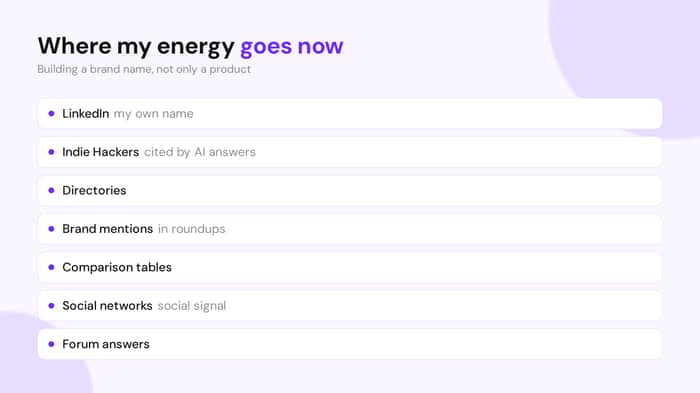
So I now put a big part of my energy into the brand name, and this is where it goes:
LinkedIn, because it is a recognisable platform tied to my own name.
Indie Hackers, because AI answers cite it well and it tells enough about the creator.
Directories.
Brand mentions with backlinks or in roundups.
Places in comparison tables.
Social networks, as a social signal.
Answers on forums.
A mention does not need a backlink every time. What matters is that your brand or company is named, and it works better when the description of the brand is always worded the same way, together with contact details, prices and everything else.
I do most of this by intuition rather than on the basis of solid data, so I am curious how others handle it. How much time do you spend on your brand name, is it a priority for you, and have you seen results from it?

The easy answer is "Probably not enough." The truth is, there will always be more to do than you have time for. Brand promotion is one of the hard ones, specifically, doing it right. It is also generally a long game. If you create something new and think to just jump out and start marketing with a completely new brand and product, it might be harder than you think.
The pattern you're noticing is that brand becomes a measurable signal for discovery. When people come directly by name instead of clicking a link, that's a different distribution channel than backlink-powered traffic - it means the brand has become memorable enough to survive a context switch. The fact that you're seeing consistent mentions across directories, forums, and comparison tables suggests you've found a scalable signal: consistent naming + consistent positioning = easier to verify + easier to reference. The key insight is that every channel has a different signal quality (a comparison table mention is stronger than a forum mention because it forces consistency across entries), so you can probably optimize by channel rather than treating all mentions equally.
One useful frame: you're not building backlinks, you're building an entity that search engines and AI systems can resolve — and that has a lag you should expect, often weeks between a mention appearing and branded searches moving. That lag is why most founders quit a channel too early; the measurement that keeps you honest is branded search impressions in Search Console month over month, not clicks on the mention itself. I also agree comparison tables are the highest-yield play — a "X vs Y" page catches someone mid-decision with the brand names already in their head, which is exactly the moment AI citations start to matter.
Interesting.
Names are always difficult to invent.
I just spent a lot of time defining my product brand named JPEGFORCE. For me, a name that clearly tells what the tool does is very important.
The way to measure this without fooling yourself: branded search has a lag. Mentions turn into branded queries and signups over roughly 30-90 days, so compare today's branded query volume against mentions from two months ago, not last week. Almost everyone over-attributes to whatever they did yesterday and declares the channel dead after ten days of a flat line.
Agreed, it needs time to settle. Some channels give results right away and keep working for a long time, others only show results after months, so the important thing is to track each of them correctly.
More than I expected. Between directories, demos and posts, marketing is turning into a second product 😅 I'm still figuring out which mentions bring people who actually use the tool, not just visits.
I agree. AI search is a new direction, and I am still feeling my way through it too. I am trying to find the pattern, and a lot of it comes down to intuition and practice.
This is a really interesting point. Brand mentions seem increasingly important as people discover products through AI answers and recommendations, not just traditional search.
Yes, and that is exactly why I started paying more attention to it. When people discover products through AI answers, the brand mentions around the web become the first thing they see, even before they reach the site.
We're pre-revenue and I already spend more time on the name than I expected.
The part about using the same description everywhere matches what I've seen. I keep one short line for our product and use it on LinkedIn, directories, IH and X. When AI tools pick up the same sentence from a few places, they describe you more clearly.
I'd add one thing to your list: answering questions in communities in your niche, without dropping a link. It's slow, but people start to know who you are.
Which source have you seen ChatGPT pick up fastest so far?
Agreed, commenting works, but very slowly, and you need good karma before your comments even count, on Reddit or Quora for example. Still, it is a necessary part of the work.
As for your question, I just asked ChatGPT about IvaBot, and all three sources it cited were directories: Software Advice, RightAIChoice and Toolify. So for a direct question about the brand, directories get picked up first, while for broader topic questions it tends to cite my posts here and on LinkedIn.
This observation about LLMs (ChatGPT, Claude, Perplexity) picking up brand names from consistent citations and directory mentions is spot on.
In 2026, brand consistency isn't just about human brand recall anymore — it's about "LLM retrieval integrity". When an AI engine evaluates software tools to recommend, it synthesizes knowledge across multiple authority anchors:
Canonical boilerplate consistency:
Having the exact same core definition, verified pricing structure, and technical specifications across directories (Product Hunt, AlternativeTo, SaaSHub, Indie Hackers) prevents LLMs from hallucinating or confusing the product with legacy competitors.
Neutral technical deep-dives over sales copy:
Publishing in-depth engineering breakdowns (on Hashnode, Dev.to, or engineering blogs) with canonical URLs pointing back to the main domain creates high-weight semantic signals. Search models weigh architecture explanations much higher than superficial marketing landing pages.
Structured data & syndication:
Maintaining machine-readable metadata (schema.org SoftwareApplication markup, PAD XML) allows specialized aggregators to ingest accurate specs automatically, creating an organic trail of backlinks and verified entity associations without manual outreach.
Investing in a consistent brand footprint across technical communities and verified directories pays compound interest over time — both for direct human trust and generative answer engines.
The Dev.to and Hashnode point is the one I have not tried, and it is the most interesting for me. I built IvaBot without being an engineer, so a breakdown of how the tracking works under the hood could be a good test of your idea that technical posts carry more weight than landing pages.
On schema, I added Organization markup for myself and do the same for clients, but I cannot say I have seen any difference from it. Ahrefs tracked 1,885 pages that added schema and found no real change in AI citations: https://ahrefs.com/blog/schema-ai-citations/. So I keep it as basic hygiene rather than a way to get cited.
Branding is not something you can build in a day. Whether you’re building an online or offline brand, as a founder, you always need to stay updated with the market, look for new opportunities, and keep trying and implementing better ideas.
If you’re running a small agency or business, it naturally takes time because you’re involved in almost everything. But when you’re building something at a bigger scale and have funding, things can move much faster. You can make the decisions while your team focuses on execution. In that way, you save a lot of your own time and can focus on the bigger picture.
At the end of the day, building a brand is a continuous process. It takes time, consistency, and constant effort.
Nobody said it was fast. Like everything else on the list, it takes organisation, a plan, a structure and a lot of time to act and test. Of course, paying an agency or having a team would bring results faster, but like many solo founders here, I am discussing what one person can do, usually without a big budget.
"A mention does not need a backlink every time" is the part most people get wrong, and you got it right by intuition. Worth making it explicit, because once it is explicit you can systematise it.
What you are actually building is an entity that a machine can resolve. A resolver does not care about one strong page. It cares about whether many independent sources say the same thing about the same name. So the thing to hold constant is the string, not the link: the same one sentence description, the same category words, the same pricing shape, the same founder name, everywhere. Two different descriptions of IvaBot in two directories is worse than one description in one directory, because it splits the evidence.
Three things that follow from that, and they are cheap:
Keep a canonical block in a text file: name, one line description, category, pricing, founder, URL. Paste it identically. Never improve the wording in one place only. If you do rewrite it, rewrite it everywhere in the same week.
Comparison and alternative pages are the highest yield of everything on your list, because "X vs Y" and "alternatives to X" are the exact questions assistants get asked, and those pages are what they quote. A roundup that names you next to a tool people already search for does more than a directory listing nobody reads.
Check the second index, not only Google. Answer engines do not all read the same crawl, and there is good reason to think ChatGPT's search leans on Bing rather than Google. I would treat that as a hypothesis worth testing rather than a fact, and the test is free: set up Bing Webmaster Tools and see whether your pages are even known there. Plenty of sites that look fine in Search Console are close to invisible in the other one.
On measuring it instead of guessing, since you said intuition: https://contentmation.com/score?utm_source=indiehackers&utm_medium=social&utm_campaign=brand_name_citations grades a domain across six channels including directory and citation presence, free and with no login. You can sanity check it before feeding it your own domain, since it has a public report for indiehackers.com itself.
Honest limit: it scores channel presence. It cannot tell you whether an assistant will cite you, because that depends on the index it reads and on nothing you control directly.
I like the line about two descriptions splitting the evidence. When we used to buy links, we deliberately spread the anchors: a keyword anchor here, a brand anchor there, a bare URL somewhere else. Now one description everywhere is the best solution, which surprised me a lot at first, but it has to be followed strictly. I already keep one agreed description, and your comment reminded me that one directory still shows an auto-generated text that describes IvaBot wrongly, so that is the first thing I will fix.
Comparison pages have worked best for me too: two of them brought signups, and AI assistants now cite one of those tables.
On Bing, I connected it from the start and submit every new page to both Bing and Google for crawling. I do the same for clients, because some of their sites were not in Bing's results at all. Then I use IvaBot to track whether appearing in Bing helps ChatGPT cite those pages. If it does not, I improve the page and add more of the sources that I think ChatGPT or the AI I need relies on.
I asked me this question, and I ended up looking at the actual HTML of the listing pages before signing up anywhere.
Two of the biggest software review sites don't link to your website at all. The "Visit website" button is a button without a link. Others do link, but with nofollow, so I stopped thinking of directories as backlinks. They are just brand mentions, a place where an AI answer can pick up a consistent description of what you do. That changed which ones I bother with.
One question, since people reach IvaBot by name after asking ChatGPT: have you checked which sources it cites when it mentions you? I'm curious whether it's the directories or something else entirely.
Many people say nofollow backlinks do not work. They may not pass weight to your site, but a mention of your page and your brand is still a plus. Also, when a comment is genuinely useful, people copy that nofollow link and visit your page, which already makes it valuable for you.
Yes, I checked. AI cites me from Indie Hackers, my Product Hunt launch and LinkedIn, because that is where most of my posts with detailed breakdowns, my thoughts and my comments are. For narrower questions it can cite my blog on IvaBot, a few articles on other sites where information about me spread, Reddit, directories and other sources. It depends on which AI and which question.
You said people are already coming to IvaBot by name now — that's actually a measurable thing, right? Direct/branded search traffic before you started this vs after. That would tell you if it's working way faster than intuition can, even without knowing which channel did it.
You are right, and it is the simplest check I have. Search Console shows the branded queries, so I can compare impressions and clicks for the name before and after I started this work. It will not tell me which channel did it, but it is a much faster signal than intuition, and I will compare the two periods properly.
Great insights, Galyna! I completely agree that building brand recognition through consistent descriptions—even without backlinks—creates a powerful virtuous cycle.
This made me wonder: When you launch a new product or service in the future, how do you plan to handle your existing brand accounts and profiles? Do you pivot the existing account, keep them separate, or shift focus to a personal/studio brand?
I’d love to hear how you and others handle this when scaling multiple projects. I'm still experimenting on my end, but I’ll be sure to share any interesting results or data as I go!
Good question, and I am still learning here, since IvaBot is my first SaaS. I built IvaBot for myself first, and as an SEO specialist I use it every day for my clients, especially to check how AI answers cite them for different prompts, so I would keep IvaBot and its accounts exactly as they are. For a new project I would first find potential users and test whether the idea works at all. My first testers and clients would support the brand name by using it and recommending it to others. I would also build in public and gather an audience before the launch.
I've been thinking about this more recently too.
I used to treat the brand name mostly as something you choose once, get the domain for, and then move on to the actual product. But I'm starting to think the information that accumulates around the name becomes an asset of its own.
One thing I'd add though is that mentions probably aren't equal. A directory page saying “X is an AI tool for Y” feels much less valuable than a discussion, comparison, tutorial, or experiment where the product is mentioned in a useful context.
Especially with AI search, it seems like having the same brand consistently associated with a clear use case across multiple independent sources matters more than just collecting backlinks.
So I'm spending more time on distribution now, but trying to make each mention contain some actual information rather than just placing the name everywhere.
Good point, Yes, I do the same. I start with one description that is identical everywhere, and then on each platform I add useful information that fits that particular place and its audience.
This resonates with distribution forcing functions. Your brand name becomes a signal only when it survives the filter of visibility - from Indie Hackers citations to comparison tables. The repetition and consistency you mention are load-bearing because they transform mentions into a coherent pattern that AI and humans alike recognize. The real leverage point isn't the activity, it's having a measurement system that tells you which surface area (LinkedIn vs forums vs directories) compounds over time. Most teams move on before the frequency reaches the threshold where it sticks.
Agree about the measurement. Right now I track it by observation plus UTM links, which shows me clicks from each platform but not how long a mention keeps working. The threshold point is fair too. The results I see came only after months of repeating the same description in many places, so I plan to keep going rather than switch channels.
Nice progress. What is the next thing you are focusing on?
Almost none until I had to say it out loud to someone, which is when spelling it twice started costing more than picking a better name would have.
That is a good test. IvaBot is easy to spell, but I still have to explain what it does every time, so a name that explains itself saves you a step I keep repeating.
I had to change my product name though when it comes to branding as the previous name conflicts with others
Nice progress. What is the next thing you are focusing on?
Interesting approach. What was the hardest part to get right?
Nice progress. What is the next thing you are focusing on?
Thanks for sharing the numbers, that makes it much easier to follow.
Good point. Did you test that with users before committing to it?
What made you pick this stack over the alternatives?
Interesting approach. What was the hardest part to get right?
Nice progress. What is the next thing you are focusing on?
Thanks for sharing the numbers, that makes it much easier to follow.
Good point. Did you test that with users before committing to it?
What made you pick this stack over the alternatives?
Interesting take. Would you still recommend this approach to someone starting today?
Nice progress. What is the next thing you are focusing on?
Agree that shipping is the easy part. I renamed my project before launch (from a made-up word to "The Sixth Man", a basketball term fans already know), and it made every post and DM easier: nobody asks what the name means, it explains the idea by itself.
The "describe it the same way everywhere" point is underrated. I use one line on every profile and it's already less confusing for people who see it twice.
I kept the name I started with as a working title, and after all the work on the brand I no longer want to change it, even though the "bot" part makes the project sound smaller than it is. So renaming before launch was a well-thought-out move at exactly the right time.
Love this angle. Building Xstream4K right now so this hits close to home — what made you look into it in the first place?
Interesting approach. What was the hardest part to get right?
Nice progress. What is the next thing you are focusing on?
Good point. Did you test that with users before committing to it?
Thanks for sharing the numbers, that makes it much easier to follow.
What made you pick this stack over the alternatives?
Interesting take. Would you still recommend this approach to someone starting today?
Interesting take. Would you still recommend this approach to someone starting today?
Yes, and I would start even earlier than I did. From the first day I would write one short description of the product and use exactly the same wording everywhere
We chose “UtilitySEO” because the domain was available and the name describes what it does in two words. Zero minutes on creative naming — but the trade-off is that a literal name competes with the generic phrase. Anyone searching “utility SEO” gets the category, not us.
Our brand numbers are small enough to be honest about: DA 3, ten referring domains and they’re all spam, four visits a month. What’s actually working is exactly what you describe — the IH posts and comments where we share real numbers get cited by AI assistants. We had someone run a five-engine AI visibility audit on our domain: GPT cited us 5/5, Perplexity 4/5, Qwen 1/5.
The pattern is that AI cites specificity. A post with “DA 3, four visits” gets referenced where “we’re early-stage” doesn’t. The brand name matters less than whether the content around it gives AI something concrete to cite.
Exactly, I see the same thing. Articles with fresh information get indexed and cited every time, especially when they include tests I ran myself, links to sources and an up-to-date review. AI seems to reward proof that someone actually did the work.
One thing I would add is consistency. When the brand is described in the same words everywhere, with the same prices and contact details, AI assistants stop mixing it up with other names. For a long time IvaBot was confused with a better-known brand with a similar name, and that changed quickly once the description became the same across all mentions.
Have you been able to trace which mentions actually lead to branded searches or qualified visits, or are you still treating all brand visibility signals as roughly equal?
I do not treat them as equal, but I trace the difference by watching what happens after each mention rather than with exact attribution.
The mentions that work best are the ones on large platforms within the topic. On LinkedIn, for example, I share my own experience, people see my photo, my work and probably mutual connections, and I can see that after posts without any link people search for IvaBot.
Two SEO-focused sites also worked well. They published the pros and cons of services like IvaBot, IvaBot caught people's interest there and brought signups. Now ChatGPT and Google's AI answers cite that comparison table, so it works as a long-term investment.
Posts here on Indie Hackers, where I share my project honestly, are also one of the main sources AI cites, because they show clearly who I am, what I do and why the project was built.
For quite a long time Google and AI assistants confused my SaaS with a better-known brand with a similar name. As soon as I started working on brand growth, that changed, and it changed very quickly.
I have probably forgotten some channels too, but these are the ones where I see a clear effect.
That distinction between visibility and downstream behavior is worth digging into. Could be useful to compare notes on that by email sometime, if you’re open to it.
Sure, happy to compare notes. I am more active on LinkedIn than on email, so let's connect there: https://www.linkedin.com/in/galyna-arikh/
**A bit of context I missed in the post: I work in SEO, and a few months ago I launched IvaBot, a pay-as-you-go tool that tracks Google positions, keywords and backlinks together with how often ChatGPT, Perplexity and Gemini mention a brand. I have not left SEO, but I now combine it with brand marketing, which is what this post is about.
Good point. Did you test that with users before committing to it?
Makes sense. Are you planning to charge for it, or keep it free for now?
How did you decide this was worth building in the first place?
I built it for my own SEO work first. I needed to track positions, backlinks and AI citations for clients in one place, and I did not want another monthly subscription for it.
Clear and practical, thanks. Did anything surprise you along the way?
Honestly, everything surprised me, because IvaBot is my first SaaS. It started with writing code, which I had never done before, and now it is promotion, where I work more like a marketer than an SEO specialist.
Nice work shipping it. What has been the biggest challenge since launch?
Thanks! The biggest challenge has been getting known, not building. Shipping the product turned out to be the easier part, and getting people and AI assistants to know the name takes much more time. That is actually why I wrote this post, because most of my energy now goes into the brand name rather than new features.