How Solo Founders Can Use AI to Build Faster and Work Smarter
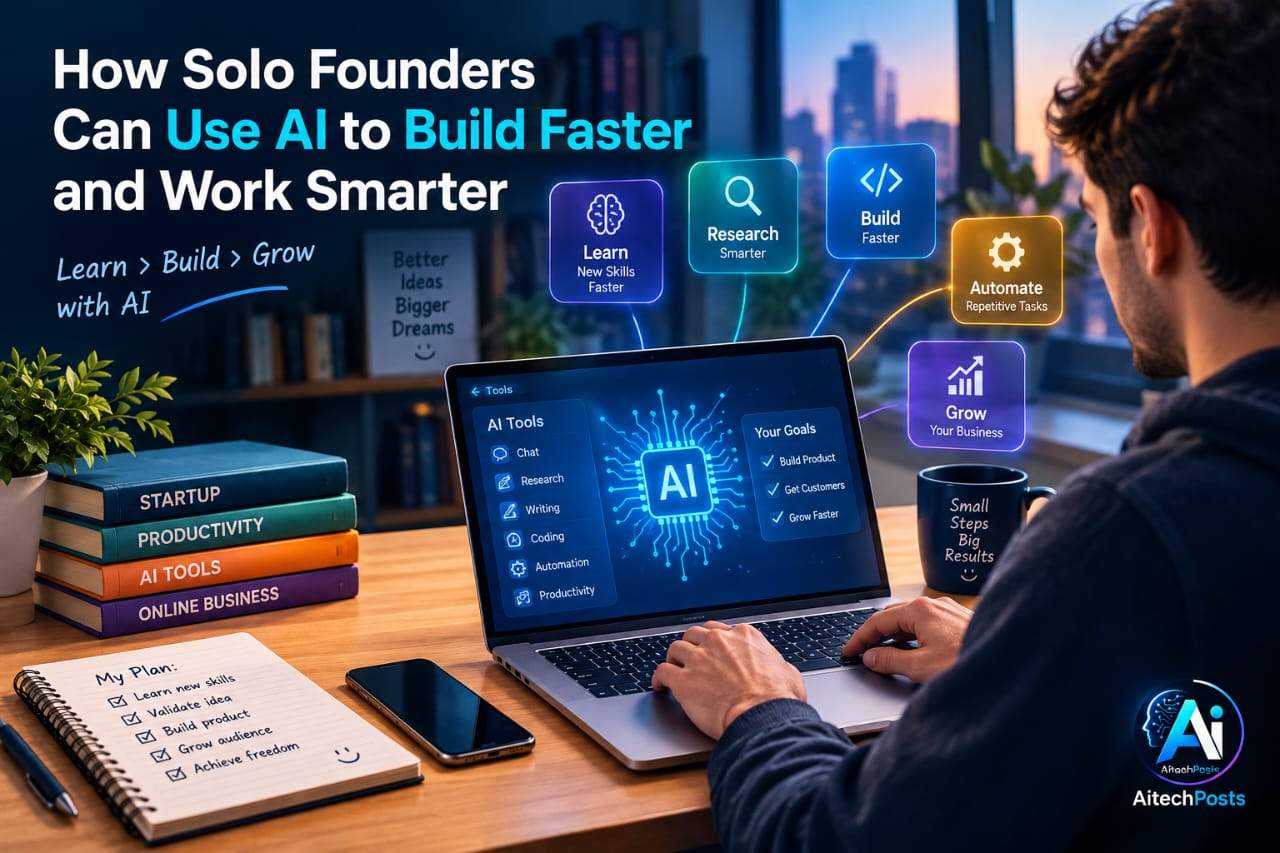
Building a business as a solo founder is exciting, but it also comes with a difficult reality: you are responsible for almost everything.
You may start the day working on your product, move to customer support, write content, analyze competitors, fix technical issues, and then spend the evening planning your next growth strategy.
The biggest problem is usually not a lack of ideas.
It is a lack of time.
This is one reason why artificial intelligence is becoming increasingly valuable for solo founders. AI can help individuals research faster, automate repetitive work, generate ideas, and complete tasks that previously required significantly more time.
However, AI does not automatically make someone a better founder.
The real advantage comes from understanding where AI should be used and where human judgment is still essential.
For solo founders, the best approach is not trying to automate an entire business overnight. Instead, AI should be used strategically to remove repetitive tasks and create more time for product development, customers, and important decisions.
AI Is Becoming a Powerful Tool for Solo Founders
A solo founder has limited resources.
Unlike a larger company, there may not be separate teams for marketing, development, customer support, research, and operations. One person may be handling all of these responsibilities.
AI can help reduce this pressure.
For example, founders can use AI to:
Research new markets.
Organize customer feedback.
Generate content ideas.
Write initial drafts.
Summarize information.
Assist with coding.
Create documentation.
Automate repetitive workflows.
The important thing is that AI should act as a force multiplier.
Instead of replacing the founder, it can help one person accomplish more with the same amount of time.
A founder who previously spent several hours organizing research may now be able to use AI to structure the information much faster. That additional time can then be spent talking to customers or improving the product.
This is where AI becomes genuinely valuable.
Use AI to Learn New Skills Faster
One of the most significant advantages of modern AI tools is their ability to make learning more accessible.
Solo founders constantly need to learn.
You may need to understand a new programming framework, learn about SEO, research a market, improve your marketing skills, or understand how a competitor approaches a particular problem.
Traditionally, this process could involve searching through dozens of articles, watching multiple videos, and spending significant time organizing information.
AI can speed up the initial learning process.
For example, instead of simply searching for a technical topic, a founder can ask an AI assistant to:
Explain a concept in simple terms.
Compare different approaches.
Identify the advantages and disadvantages.
Create a learning roadmap.
Suggest questions that should be researched further.
This does not mean AI-generated information should always be accepted without verification.
Instead, AI can provide a starting point.
Founders can then use their own research and judgment to develop a deeper understanding of the topic.
Research Business Ideas More Efficiently
A common mistake among founders is spending too much time building before properly understanding the problem.
AI cannot guarantee that an idea will succeed.
However, it can help founders organize their research before investing significant time and resources.
For example, AI can assist with:
Identifying potential customer problems.
Organizing competitor information.
Creating customer interview questions.
Summarizing research notes.
Finding recurring patterns in feedback.
Imagine speaking with ten potential customers.
Instead of manually organizing every note, a founder can use AI to identify recurring themes and questions.
Perhaps several people mention the same problem.
Perhaps they are using a particular competitor but are unhappy with one specific feature.
AI can help organize those signals.
However, the most important information still comes from real people.
The best workflow is:
Customer conversations → Research notes → AI organization → Pattern analysis → Founder decision
This keeps the founder involved in the most important part of the process.
AI helps organize information, but the founder decides what the information actually means.
Build Products Faster With AI Assistance
AI is also changing how solo founders approach product development.
Today, AI can assist with many technical tasks, including:
Explaining code.
Finding potential errors.
Generating repetitive code.
Creating documentation.
Helping with debugging.
Generating simple prototypes.
This can significantly reduce the time required to experiment with new ideas.
However, building software faster does not automatically mean building a successful product.
The most important product questions still require human judgment.
A founder still needs to decide:
What problem is worth solving?
Who is the target customer?
Which features are necessary?
Which features should be removed?
What should the first version of the product look like?
AI can make development faster.
It cannot automatically determine what customers actually want.
The best approach is to use AI for technical assistance while keeping product decisions focused on real customer feedback.
Automate Repetitive Tasks
One of the most practical uses of AI for solo founders is automation.
The question every founder should ask is:
Which tasks repeatedly consume time without requiring my full attention?
Those tasks are often good candidates for AI assistance.
Examples include:
Organizing emails.
Summarizing meetings.
Categorizing customer feedback.
Creating first drafts.
Preparing routine reports.
Managing internal documentation.
Generating content outlines.
Automation can create valuable time.
But founders should be careful not to automate important learning experiences.
For example, customer conversations should not be completely removed from the founder's workflow.
Speaking directly with customers provides valuable insights that may not appear in analytics or AI-generated summaries.
The same applies to major product and business decisions.
AI can provide suggestions.
The founder should still remain responsible for the final decision.
Don't Create a Workflow With Too Many AI Tools
The rapid growth of AI tools has created another challenge.
There are now tools for writing, research, coding, automation, design, productivity, and many other tasks.
This can lead to unnecessary complexity.
A founder may start using multiple AI platforms and eventually spend more time switching between tools than actually completing meaningful work.
A better approach is to build a simple workflow.
AI for Research
Use AI to organize information and identify questions that require further investigation.
AI for Development
Use AI for repetitive coding tasks, debugging, and technical explanations.
AI for Content
Use AI to brainstorm ideas and create initial structures.
AI for Operations
Use automation for repetitive administrative work.
Human Decision-Making
Keep strategy, product direction, and major decisions under direct human control.
The goal should not be to use the highest number of AI tools.
The goal should be to create the most efficient workflow.
For founders who are still exploring different tools and their practical applications, this guide to the best AI tools for students can also provide useful examples of how AI platforms can support research, learning, writing, and productivity.
Many of the same principles apply to founders who need to learn new skills while building their businesses.
Keep Human Judgment in the Workflow
AI can produce useful results quickly.
But it can also make mistakes.
Information may be inaccurate, outdated, incomplete, or missing important context.
This is why founders should avoid blindly trusting AI-generated output.
A simple process can prevent many problems:
AI generates → Founder reviews → Final action
This is particularly important when AI is used for:
Customer communication.
Public content.
Financial information.
Important business decisions.
Product documentation.
The more important the task, the more important human review becomes.
AI should reduce unnecessary work.
It should not eliminate responsibility.
Use AI to Reduce Context Switching
Context switching is one of the biggest productivity problems for solo founders.
You may begin working on a product feature and suddenly remember a customer email.
Then you check analytics.
After that, you research a competitor.
Eventually, you may forget what you originally intended to work on.
AI can help organize information and workflows so that less time is spent searching for notes, documents, and previous conversations.
For example, founders can create systems for organizing:
Customer feedback.
Product ideas.
Marketing ideas.
Research notes.
Competitor information.
Content plans.
The goal is not to create an overly complicated AI system.
The goal is simply to reduce unnecessary mental effort.
When information is easier to organize and retrieve, founders can spend more time focused on meaningful work.
Start Small and Measure the Results
The best AI workflow usually develops gradually.
Instead of attempting to automate everything, start with one repetitive task.
Ask yourself:
How much time does this task currently take?
Can AI help reduce that time?
Does the output require human review?
Is the new workflow actually better?
If the process works, continue.
If it creates more complexity, remove it.
This approach prevents founders from adopting AI simply because it is popular.
Technology should solve a real problem.
If a tool does not save time, improve quality, or help you make better decisions, it may not deserve a permanent place in your workflow.
Final Thoughts
AI is creating new opportunities for solo founders.
One person can now research faster, learn new skills, build products more efficiently, and automate repetitive tasks.
But the biggest advantage is not simply doing more work.
It is creating more time for the work that requires human judgment.
AI can help write a first draft.
It can organize information.
It can assist with coding.
It can automate repetitive processes.
However, it cannot fully replace the founder's understanding of customers, markets, and opportunities.
The most successful solo founders may not be those who automate everything.
They may be the ones who identify the tasks that consume unnecessary time and use AI strategically to remove those bottlenecks.
The key question is simple:
What part of your business repeatedly consumes time without requiring your full attention?
That is often the best place to start using AI.
For readers interested in discovering practical AI resources and technology insights, AITechPosts provides guides covering artificial intelligence and the changing technology landscape.
Frequently Asked Questions
1. How can solo founders use AI effectively?
Solo founders can use AI to research markets, learn new skills, organize customer feedback, create content drafts, assist with coding, and automate repetitive tasks. The most effective approach is to use AI as a productivity assistant while keeping important business and product decisions under human control.
2. Can AI help a solo founder build a startup faster?
Yes. AI can speed up tasks such as coding, debugging, documentation, research, content creation, and workflow automation. However, AI cannot replace customer research, product judgment, or strategic decision-making.
3. Should founders automate their entire business with AI?
Not necessarily. A better strategy is to automate repetitive tasks that do not require the founder's full attention. Important activities such as understanding customers, validating ideas, and making major business decisions should continue to involve direct human judgment.
4. What are the biggest benefits of AI for solo founders?
The biggest benefits include saving time, reducing repetitive work, learning faster, improving research, accelerating product development, and helping one person manage multiple business responsibilities more efficiently.
5. How should founders choose the right AI tools?
Founders should first identify the specific problem they want to solve. Instead of using many AI tools, it is usually better to select a small number of tools that fit clearly defined workflows for research, development, content, or operations.

