How to Launch an Online Business and Secure the Funding to Grow
Launching an online business has become more accessible, but turning an idea into a stable company still requires careful planning. A website, social media account, or product concept can be created quickly. Building a business that generates dependable revenue is more demanding.
Successful online businesses usually start with a clear understanding of what they sell, who needs it, and why customers should choose them instead of an alternative. Funding also matters. Even businesses with relatively low startup costs may eventually need money for inventory, technology, marketing, contractors, or other expenses.
Taking a structured approach can help entrepreneurs move from an early concept to a business that has room to grow.
Start With a Problem Worth Solving
A strong business idea should address a specific need rather than simply introduce another product into an already crowded market.
Before investing heavily in branding or technology, entrepreneurs should determine what problem their business will solve. That problem might involve saving customers time, lowering a cost, improving convenience, or providing access to something that is difficult to find elsewhere.
Research is useful at this stage. Look at existing competitors, customer reviews, search behavior, online communities, and common complaints. These sources can reveal gaps that established companies have overlooked.
The goal is not necessarily to invent an entirely new category. Many successful online companies enter existing markets but offer a better experience, clearer positioning, or a product designed for a more specific audience.
Test the Idea Before Making a Large Investment
Entrepreneurs do not always need a complete business infrastructure before determining whether people are interested in an idea.
A simple landing page, small product release, prototype, preorder campaign, or limited service package can provide useful information. Early testing gives potential customers an opportunity to respond while allowing the business owner to collect feedback without committing significant resources.
Pay particular attention to customer behavior. Positive comments are encouraging, but actual purchases, inquiries, subscriptions, or repeat visits usually provide stronger evidence of demand.
Testing also gives entrepreneurs the chance to improve pricing, messaging, and product features. Changing direction is considerably easier when the business is still small.
Build a Practical Business Model
Once there is evidence that customers want the product or service, the next step is determining how the business will make money consistently.
The business model should explain what customers will pay for, what it costs to deliver the product, and how much revenue may remain after expenses. An online retailer, for example, needs to consider inventory, shipping, returns, transaction fees, advertising, and website costs. A service business may have fewer physical expenses but could depend heavily on labor and customer acquisition.
Pricing should reflect more than what competitors charge. Entrepreneurs need enough margin to cover both expected costs and unexpected expenses.
This is also the point where a basic financial forecast becomes useful. Estimating monthly sales, operating costs, and cash needs can show whether the business model is realistic before the company begins expanding.
Create a Professional Online Foundation
An online company depends heavily on trust. Customers may never interact with the owner face to face, which means the website and overall digital presence often become the first evidence that the company is credible.
The website should make the business easy to understand. Visitors should quickly know what the company offers, who it serves, how much products or services cost when appropriate, and what they need to do next.
Technical reliability matters as well. Pages should load properly on mobile devices, payment systems should work smoothly, and customer information should be handled responsibly.
Business owners should also establish basic administrative systems early. These may include accounting software, separate business banking, customer records, inventory management, and documented operating processes. According to the U.S. Small Business Administration, preparing a business plan can help entrepreneurs think through areas such as market positioning, operations, financing needs, and growth.
A professional foundation does not need to be complicated. It simply needs to support the business without creating unnecessary friction.
Understand How Much Funding You Actually Need
Funding should solve a defined business problem rather than simply provide additional cash.
Before seeking financing, identify exactly where money would be used. A business might need $15,000 to purchase inventory before a busy season, $8,000 to build a stronger ecommerce platform, or additional working capital while waiting for customer payments.
Knowing the purpose of the funding makes it easier to evaluate financing options.
Entrepreneurs should also distinguish between one-time expenses and recurring cash needs. A fixed equipment purchase has a clear cost, while marketing, payroll, and inventory may require ongoing access to capital. In situations where expenses fluctuate, a business line of credit can provide access to funds when eligible businesses need working capital without requiring them to borrow the entire available amount at once.
The appropriate financing structure will depend on the company's financial position, credit history, revenue, and reason for borrowing.
Compare Different Sources of Business Funding
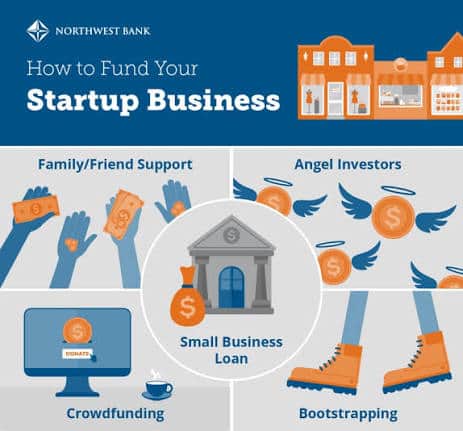
Not every online venture needs outside investors. In fact, giving up ownership too early can create unnecessary complications for a business that could have grown through revenue or traditional financing.
Self-funding is often the simplest starting point. Entrepreneurs may use personal savings or reinvest early profits into the company. This allows owners to maintain control but can limit the speed of expansion.
Loans and other forms of business financing may be appropriate when the company has a predictable way to repay borrowed money. Investors, meanwhile, can provide substantial capital and expertise, but they typically receive equity in exchange.
Crowdfunding is another possibility for businesses with products that appeal to a broad audience. It can also serve as a form of market testing because customers are financially supporting the concept before a larger launch.
The best choice depends on the business. Entrepreneurs should consider the cost of capital, repayment obligations, ownership dilution, and the amount of risk involved.
Use Funding to Strengthen Proven Areas
Receiving funding does not mean a company should suddenly increase spending everywhere.
Capital is often most effective when directed toward parts of the business that already show promising results. If a particular marketing channel consistently produces profitable customers, additional investment may help expand it. If demand is exceeding available inventory, funding could increase purchasing capacity and reduce missed sales.
The same principle applies to technology and hiring. Automation can make sense when repetitive work is limiting growth, while additional staff may be justified when customer demand has exceeded what the founder can reasonably manage.
Expansion should follow evidence. Spending heavily on untested strategies simply because money has become available can create additional financial pressure instead of solving it.
Turning an Idea Into a Real Business
A promising concept is only the beginning of an online venture. Building a sustainable company requires entrepreneurs to validate demand, understand their costs, create reliable systems, and make careful decisions about financing.
Funding can accelerate that process, but capital works best when the business already has a clear direction. Entrepreneurs who understand why they need money and where it can produce measurable value are in a stronger position to choose suitable financing.
By testing ideas early, tracking financial performance, and investing in areas that have demonstrated potential, an online business can move beyond the startup stage and develop a stronger foundation for long-term growth.


-
1One thing that often gets overlooked when talking about funding is that founders don’t always have a regular salary or payslip. This can be especially relevant for people who have just started a business, work freelance, or earn most of their income through self-employment. It’s also interesting to see how this is handled in different markets. In Azerbaijan, for example, there are financing options for people who may not have a traditional salary certificate: https://kredaqro.com/blog/maas-arayisi-olmadan-nagd-kredit/ I think this is a useful reminder that funding options can vary quite a bit depending on the market and the applicant’s income structure. Crowdfunding, investor capital, business loans, and personal financing can all make sense in different situations; what matters is matching the funding type to the actual need and repayment capacity.7 days ago Reply

-
1Funding can accelerate a business, but it cannot replace evidence that the business is working. For an online business, I would prioritize customer validation, repeatable acquisition, retention, and clear unit economics before deciding how much capital is actually needed. Once those fundamentals are visible, funding becomes a tool for scaling what works rather than a substitute for finding product-market fit.11 days ago Reply
