HVAC Repair in Plainfield, NJ | New Jersey HVAC Pros | 877-401-0454
Plainfield is a city of 54,586 people in Union County, and its housing stock is not like the rest of the county's. One clarification before anything else, because it causes real confusion with dispatchers and parts suppliers: North Plainfield is a separate borough in Somerset County and South Plainfield is a separate borough in Middlesex County, each with its own government and its own construction office. This page is about the city of Plainfield in Union County. We are New Jersey HVAC Pros, and we repair, service and replace heating, cooling and ventilation equipment across Plainfield's three delivery ZIP codes: 07060, 07062 and 07063.
The city was built early, and the mechanical problems follow from that
Look at the census record and you can see exactly when Plainfield filled in. The population was 5,095 in 1870. It hit 11,267 by 1890, 20,550 by 1910 and 34,422 by 1930. By 1950 it was 42,366, by 1960 it was 45,330, and it then sat in a narrow band around 46,000 for four decades before climbing again to 54,586 in 2020.
Read that curve as a construction timeline. Nearly two thirds of the population Plainfield has today was already here before 1930. The Central Railroad of New Jersey reached town in 1839, the current main station building went up in 1902, and the city grew as a commuter and resort destination for people working in Newark and New York. In 1886 a local newspaper publisher started marketing the town as the "Colorado of the East" on the theory that its air was good for respiratory trouble. That is where the Queen City reputation and a great many large Victorian houses came from.
Those houses are still standing. Plainfield packs 16,712 housing units and 15,907 households into 5.96 square miles, at 9,160 people per square mile, with 3.41 persons per household and an owner-occupancy rate of 44.8 percent. A lot of that is large single-family stock, often subdivided, sitting on lots that were platted for horse traffic.
What that means mechanically is consistent from block to block. High ceilings, so the volume of a room is 20 to 30 percent larger than its square footage suggests. Balloon framing, which turns exterior stud bays into unintended chimneys for conditioned air. Plaster and lath over rough openings that were never sealed. Chimneys sized and lined for coal, later converted to gas. Windows replaced in three different decades by three different owners. Load calculations done on square footage alone are wrong here more often than they are right. Call New Jersey HVAC Pros at 877-401-0454 to have a system sized against the actual building.
Four historic districts, and why that affects where your condenser goes
Plainfield designated four local historic districts in 1981: the Crescent Area, Hillside, North Avenue and Van Wyck Brooks districts. All four were later listed on the New Jersey and National Registers of Historic Places. Van Wyck Brooks alone covers more than 150 properties. The city maintains a Historic Preservation Commission and publishes district maps and design guidelines.
Article X of the city's ordinance, the historic preservation controls, requires a certificate of appropriateness for exterior alterations to contributing buildings that are visible from a public street, and for site modifications subject to public view. The ordinance names specific elements: windows, doors, shutters, railings, columns, cornices, molding, trim, stairs, porches, siding, gutters, signs and solar panels. Interior changes are exempt. So is anything not visible from a public way, and so is painting. Referrals to the commission carry a 45 day review window.
Here is the honest version for HVAC. The ordinance list does not name air conditioning condensers, line sets or through-wall vent terminations, so we will not tell you that a condenser definitively requires a certificate of appropriateness. What we will tell you is that a condenser in a street-facing side yard, a line set stapled up a front elevation, or a sidewall vent punched through a visible facade are the kind of change a commission looks at, and that the time to ask is before the pad is set. If you live in one of the four districts, call the city and confirm the requirement for your specific plan. Then let us route the equipment to the rear or a screened side yard, which is usually where it belongs anyway. Call New Jersey HVAC Pros at 877-401-0454 before you commit to a location.
What we repair, service and replace
Heating first, because that is what most of this city runs on. We work on gas furnaces, steam boilers, hot water boilers, circulators and zone valves, low water cutoffs, main and radiator vents, aquastats, gas valves, pressure switches, inducer motors, heat exchangers and venting. We also handle oil to gas conversions and the near-boiler piping that gets done wrong on half of them.
On the cooling side: central split systems, condensers and evaporator coils, air handlers, ductless mini-splits and multi-splits, and heat pumps in both heating and cooling. High-velocity small-duct systems come up more here than in most towns, because they were designed for exactly this kind of house.
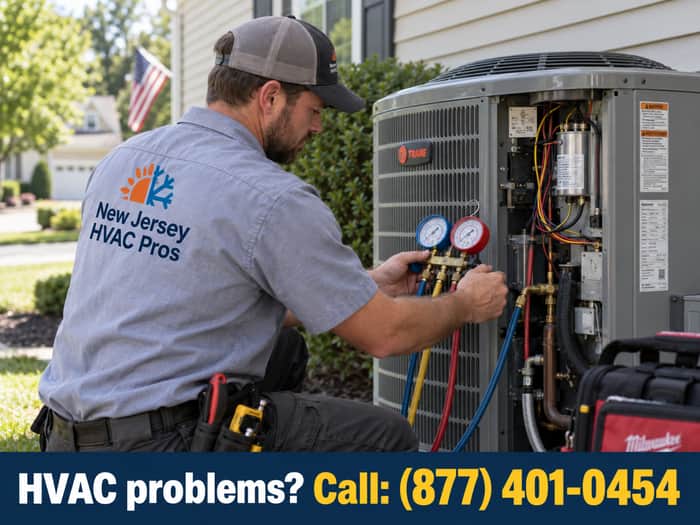
Then the quieter failures: thermostats and low voltage wiring, condensate pumps and drains, blower motors and ECM modules, capacitors and contactors, refrigerant leak diagnosis, duct sealing, and filtration. Any work that opens a sealed refrigerant circuit requires EPA Section 608 certification under federal rule. Ask any contractor for that, including us. Call New Jersey HVAC Pros at 877-401-0454 to get a specific piece of equipment looked at.
Steam and hot water heat is not a niche here
In a lot of New Jersey, hydronic heat is unusual enough that homeowners have trouble finding someone who knows it. In Plainfield it is ordinary. Plenty of the big pre-1930 houses still run one-pipe steam, two-pipe steam, or gravity-converted hot water, and the failure modes have nothing to do with forced air.
One-pipe steam banging is almost always a pitch problem or a water problem, not a boiler problem. A radiator that has settled away from its supply valve holds condensate, the returning water meets incoming steam, and the collapse makes the noise. Wet returns rot from the inside and go without warning. Main vents clog, and a system that cannot vent air cannot fill with steam, so the far end of the house stays cold no matter how long the burner runs. Low water cutoffs silt up and either stop protecting the boiler or short cycle it.
On hot water, the recurring items are air-bound zones, seized circulators, failed zone valve heads and expansion tanks that have lost their charge. None of that is exotic. It just needs someone who has seen it before. Call New Jersey HVAC Pros at 877-401-0454 if your radiators are banging or half your house is cold.
Cooling a house that never had ducts
Most of the older stock here was never built for central air. Owners have solved that three ways over the years, and each one leaves us a different job.
Some ran ductwork into an attic and dropped supplies through closets and old chases. Those systems tend to have long, poorly insulated trunk runs sitting in unconditioned attic space, which in July does about the opposite of what you want. Some installed high-velocity systems with small flexible tubing, which fit the architecture well but are unforgiving about static pressure. Many never went central at all and use ductless heads, window units or through-wall sleeves.
Ductless is often the right answer in a house like this, particularly one that has been divided into flats. It avoids cutting a chase through finished plaster, it lets you zone floor by floor, and it puts the outdoor unit wherever the wall lets you put it. The catch is line set routing, which in a historic district is a design question and not just a plumbing one. We will talk through where the tubing can run before we quote it. Call New Jersey HVAC Pros at 877-401-0454 to walk a house that has no ductwork.
Sections of the city and the ZIP codes
Plainfield's neighborhood names are locally understood rather than officially surveyed, so treat this as approximate. Names in regular use include Sleepy Hollow in the northeast, the West End and the Soulville area within it, and Netherwood on the east side around the station of the same name. The four historic districts, Crescent Area, Hillside, North Avenue and Van Wyck Brooks, also function as neighborhood names in everyday conversation.
The city has three USPS delivery ZIP codes: 07060, 07062 and 07063. There is a fourth, 07061, but it is a post office box ZIP with no residential delivery, so it is not a service area. You will also see 07069 and 07080 attached to a Plainfield mailing address in some databases; those belong to Watchung and South Plainfield, which are different municipalities. ZIP boundaries do not follow neighborhood lines anywhere in this state, so give us a street address rather than a neighborhood name and we will confirm coverage in a sentence. Call New Jersey HVAC Pros at 877-401-0454.
Bordering towns
Plainfield touches nine municipalities across three counties. In Union County it borders Scotch Plains to the north and east and Fanwood to the northeast. In Middlesex County it borders South Plainfield and Piscataway to the south, Dunellen to the southwest and Edison to the southeast. In Somerset County it borders North Plainfield to the north, and Green Brook Township and Watchung to the northwest. We work throughout that ring.
One thing to note if you moved a few blocks: crossing into North Plainfield or Watchung moves you from Union County into Somerset County, which shifts your climate zone under the state energy subcode from 4A to 5A. Somerset carries a higher heating design load and tighter envelope requirements, so the equipment selection that was right on one side of the line is not automatically right on the other.
Utilities: PSE&G handles both here
In Plainfield, PSE&G supplies electricity and PSE&G supplies natural gas. Both. That is confirmed on PSE&G's own service territory listing, and it makes one phone number the right one for both commodities.
Do not assume the same pairing holds across Union County, because it does not. Elizabeth and Union Township take electricity from PSE&G but gas from Elizabethtown Gas, a separate company with a separate emergency line. If you have moved within the county or you are calling on behalf of a relative, look at the name printed on the gas bill before you need it in a hurry.
The utility split also determines which efficiency programs apply to you. Whole Home Energy Solutions is administered by your utility under Board of Public Utilities direction, starts with an assessment by a BPI-certified participating contractor, and pays in tiers against modeled savings, roughly $2,000 at 5 percent projected savings up to about $7,500 at 33 percent, capped as a share of project cost. PSE&G also offers interest-free on-bill repayment. Nothing is metered afterward; the tier comes from the model.
Design conditions and what the numbers ask for
Union County sits in IECC climate zone 4A under the New Jersey energy subcode. The nearest NOAA station with published 1991 to 2020 normals is Newark Liberty International Airport, station USW00014734, east of the city. Its average July high is 86.9 degrees and its average January low is 25.5 degrees, with 4,700.6 annual heating degree days base 65 against 1,269.5 cooling degree days.
Heating carries roughly three and a half times the degree day load of cooling. In a leaky 1900 house with 10 foot ceilings, that ratio hits harder than it does in a 1965 ranch, because the heating load scales with envelope loss and Plainfield's envelopes lose. That is the argument for doing air sealing and insulation work alongside equipment replacement rather than buying a bigger burner.
Licensing, permits and how to check us
New Jersey requires a Master HVACR contractor license issued by the State Board of Examiners of Heating, Ventilating, Air Conditioning and Refrigeration Contractors, under the Division of Consumer Affairs, which publishes a free public license verification tool. Anyone touching refrigerant also needs EPA Section 608 certification. Look us up. Look up anyone else quoting your job.
Under the New Jersey Uniform Construction Code, replacing a boiler, furnace, air conditioner or condensing unit with one of like capacity is classified as minor work, which requires a mechanical subcode permit and an inspection. Minor work permits allow the job to start on filing, so filing costs you no time. A contractor who tells you a like for like changeout in Plainfield needs no permit is wrong. We file, we meet the inspector, and we hand you the paperwork. Ask us at 877-401-0454.
Getting on the schedule
Tell us the address, the fuel, the symptom, and whether the house is in one of the four historic districts. Those four facts shape the first visit more than anything else you could tell us. Call New Jersey HVAC Pros at 877-401-0454.
