I Am Betting on Being Early in a Slow Market
I build FORMLOVA, a chat-first form service. The entry point is an MCP server. You describe the form you want in an AI chat, and the agent builds it, publishes it, and runs it. The dashboard exists, but it is the sidekick, not the star.
The bigger bet behind it is simple to say and hard to live with. I think software is shifting from something humans choose to something agents call. I would rather be standing in that spot before the market arrives than try to sprint there once it is obvious. The direction feels set. The timing does not.
This is a build log of what being early actually feels like.
The bet, in plain terms
The thesis is that calling a form over MCP becomes as ordinary as opening a dashboard is today. Forms are a small domain, but a universal one. Almost every business uses them. If that shift happens, I want FORMLOVA to be the option that is already there, not the one scrambling to retrofit.
The catch is that already there only pays off if you can survive the waiting. The market is not on fire yet. So the bet is not just product. It is patience, and it is choosing where to plant the flag while it is still quiet.
I planted it overseas.
Why overseas, with numbers
Roughly 70 percent of FORMLOVA's users are outside Japan. The US, Spain, broader Europe, the AI-forward countries where people already chat with agents to get work done. About 30 percent are in Japan. The visitor gap is starker than the user split. I see roughly ten times more traffic from overseas than from home.
That was not a marketing master plan. It is where the wedge actually caught. And the origin was unglamorous. I published how-to articles about MCP. How to wire it up, how to think about it. Not look at my product, please sign up. I was sharing thinking, not pitching. Thought leadership turned out to be the wedge that promotion never was.
From there it compounded in ways I did not engineer:
- A Product Hunt launch where traffic rose but I did not win a badge.
- Spontaneous appreciation from real users. People who found it and just liked it.
- Word of mouth on Indie Hackers that climbed to the top of the feed.
- Overseas tech articles linking in, which kept a steady trickle of inflow going.
None of it was a viral spike. It was slow accumulation in markets that were a beat ahead. Being early overseas means being early where early is least lonely.
What I am actually fighting: the awareness wall
Here is the part nobody warns you about. People do not search for what I built. They search make a form. Nobody types run forms over MCP, because the category does not live in their head yet. You cannot capture demand for a thing people do not have words for.
So the first wall is awareness, and it is not a marketing-budget problem. It is a vocabulary problem. The market has to learn a new verb before it can want the product. Until then, every visitor arrives looking for the old thing and has to be gently rerouted toward the new one.
The second wall is mistaken identity. People glance at FORMLOVA and file it under plain form tool. Fair, there is a form at the end of it. But that framing puts me in a knife fight with mature tools on their terms, where the answer to every question is the other one has more templates. I am not trying to win that fight.
I think of FORMLOVA less as a form tool and more as a concierge for the web. It is not me versus n8n or Zapier head on. It is orchestrating those things into a higher-level experience. You ask, it arranges, it runs. I am trying to make a category, not place better in an existing one. Categories are slow and expensive to create, and that cost is exactly the early mover's tax.
The value you cannot see by looking
The third wall is the hardest, because it is structural to what the product is. FORMLOVA's value does not come across just by looking. You feel the difference once you use it.
That sentence is a confession as much as a positioning line. A screenshot cannot carry it. A feature list flattens it. The experience is the moment you describe a form in a sentence and watch it exist, edit it by talking, publish it by talking, and realize you never opened a settings panel. Static surfaces, landing pages, comparison tables, app-store tiles, are exactly the surfaces where that value evaporates.
And there is a related friction with the people most likely to try it. Users who grew up on dashboards feel a small jolt at first. Where are the tabs. Where do I click. The muscle memory expects a control panel and gets a conversation instead.
The encouraging part is that the friction tends to flip. Once people actually run a flow or two, the reaction turns positive. The conversation stops feeling like a missing dashboard and starts feeling like the point. But you have to get them past the first jolt to earn that turn, and the first jolt happens before they have used it.
So the funnel has a cruel shape. The value lands after use. The friction lands before it. Being early means I am the one who absorbs that gap, one user at a time, instead of riding a wave where the explanation has already been done for me.
The macro is moving, slowly
I am not betting in a vacuum. The big players are already reorienting to be called by agents. ServiceNow opened its system to external agents this year. In Japan, Money Forward and freee shipped MCP servers earlier in the spring. The direction is set at the top of the market.
But set and arrived are different words. This does not happen overnight. Screens, workflows, and the people who use them do not vanish on a schedule. Over years, let the agent do it quietly becomes the default the way smartphones did. And Japan, my home market, will likely be a beat behind, because hands-on tool culture runs deep here.
That lag is the whole reason being early is worth the discomfort. By the time the fire catches, I want to already be standing there.
Why I think a slow market rewards the early
There is a counterintuitive thing about slow markets. The slower the adoption curve, the more the early position is worth, because the early position is held longer before anyone contests it.
In a fast market, you are early for a quarter and then ten well-funded teams are doing the same thing. In a slow market, the window to become the natural first answer stays open for a long time, and most people decide it is too early and walk away. The ones who stay are not crowded. The cost of staying is patience, which is unevenly distributed, which is exactly why it is a moat.
Japan has another property that makes this concrete. It is slow to get a new technology off the ground, but once the fire catches, it spreads fast. Smartphones, QR-code payments, SaaS itself. The initial moves lagged, and then the spread after the turning point outran other countries. If MCP follows that path, the right move is not the panic of it is too late, hurry. It is to be standing, while you still can, in the place that gets remembered first the moment the fire catches.
What I am learning
Being first means taking on the friction so that, when the wave comes, you are not learning to swim in it.
The honest scoreboard right now: real users who appreciate it, a quiet but real overseas inflow, a category that does not have a search term, and a value proposition that only proves itself after the click. None of those are vanity metrics. None of them are a finished business either. They are the texture of being early.
I would rather build for where things are going than for where they have been. And I would rather keep publishing the thinking out loud while I wait for the verb to enter the language, because the publishing is the wedge, not a side effect of it.
If you are weighing a bet like this, the question I keep asking myself is not is the market ready. It is am I willing to absorb the friction of being early, for as long as the slow market takes. That is the whole game.
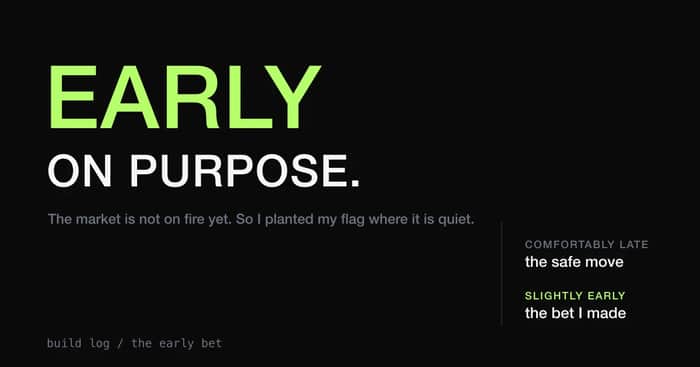
I would rather be slightly early on purpose than comfortably late by default.
The longer argument
I kept this piece to the founder's-eye view on purpose. The fuller case for why software is moving from something humans choose to something agents call, with the macro evidence behind it, is here: SaaS Is Moving from Chosen to Called.
Disclosure and Verification
This is a FORMLOVA founder build log. The author is the developer of FORMLOVA. The traction figures (the roughly 70 percent overseas user share, the visitor gap, the Product Hunt and Indie Hackers observations) are the founder's own first-party data as of May 2026 and may move over time. The macro references to other companies (ServiceNow, Money Forward, freee) are kept deliberately light; please confirm with each company's official announcements if you rely on them for important decisions.

Really interesting direction — especially the “chat-first as the entry point” approach. Positioning the dashboard as a sidekick instead of the core UI feels like the right bet for where MCP/agent workflows are heading.
I’ve been working on similar ideas around automation-heavy workflows and developer tooling, including contributions to open-source ML frameworks where reproducibility, config-driven systems, and streamlined pipelines are key. Your approach to abstracting form creation into an AI-native interface resonates a lot with that experience.
One thing that stands out is the potential to extend this beyond forms into a more generalized “intent → system” pipeline, where forms are just one manifestation of structured data collection.
If you’re exploring collaborators or need help scaling parts of the system (backend logic, agent workflows, infra, or dev experience), I’d be happy to contribute and potentially work on this in a more structured/paid capacity.
Feel free to reach out: WhatsApp +1 (361) 332-6512
Thanks for the thoughtful read — you picked up on exactly the bet I'm making: chat as the primary interface, with the dashboard playing a supporting role. The "intent → system" framing is something I think about a lot too, and forms are really just the first concrete surface for it.
That said, I'm running this solo and keeping it intentionally lean, so I'm not bringing on paid help at the moment. I appreciate the offer though, and it's good to know the direction resonates with people working on similar problems. I'll keep building in public here, so feel free to follow along.