I built a full-time job's worth of software alongside my actual full-time job, and the agents weren't the bottleneck
Hey IH. First post here, wanted to share what I've been building and where I'm at.
A year ago I started building Aligned On Purpose, a leadership operating system based on years in IT and business coaching. AI coding agents made the project feel possible alongside my day job. I was wrong about what "possible" would actually require.
The agents wrote code fast. I became a full-time supervisor anyway.
I confess: I am a quality freak, and did not want to compromise any of my values in the generated code...
Every evening looked the same: review a PR, find an assumption the agent invented, explain the correction, check the next change, translate a vague bug report into something an agent could act on, figure out which of my five repositories actually owned the problem, then deploy. By the time I finished, it was midnight and my wife was asleep.
The point where I broke and made it undeniable: I got reports from users who saw "20% behind your goal" on one screen and "on track" on another. Three different APIs and the frontend had each independently coded the calculation. The code was architecturally correct. The product contradicted itself.
Better prompts helped. Guardrails helped. But the real shift was when I stopped reviewing code and started reviewing designs. Small, detailed designs before implementation. When I could challenge an assumption before it became a PR, the agent had fewer product decisions to invent on its own.
I insisted on principles like DRY and DDD, among others, and required the design agent to validate alignment.
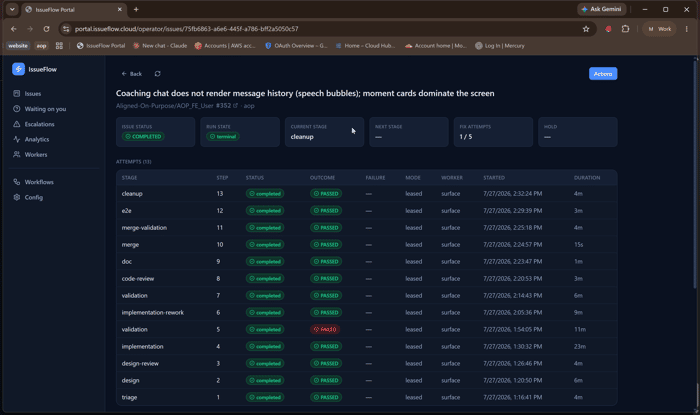
That was the first piece. Then I built a triage agent that could look at bug reports, screenshots, logs, and code across all five repos to figure out where the problem actually lived. Then I connected triage to design, design to implementation, implementation to validation, validation to deployment, with explicit rules for when to continue autonomously and when to surface an exception for me.
That was the time IssueFlow was born.
The first real win: a tester reported a straightforward bug, and it was fixed in production a couple of hours later. I didn't supervise a single step. Later I could hand off a batch of issues in the evening and wake up to find most deployed, with the blockers waiting for me. One was a missing secret; the other was approving a new feature design. That's the kind of thing I want to deal with, not "please review this PR and tell me what to do next."
I'm not claiming agents can safely do everything unattended. The point is deciding where your judgment actually matters and making that part of the workflow, not just hoping the agent gets it right.
Where I'm at now: AOP is deployed and in beta across five code repos. IssueFlow is still being finished (onboarding, payments, UX). Most of IssueFlow's own development now runs through itself, which is either poetic or reckless depending on your perspective.
I have a full-time job, two products, and I finally got some evenings back with my family. That last part matters more than the MRR I don't have yet.
Here's my ask:
I'm looking for 10 design partners.
Solo founders or small dev teams (1-5 people) who already use AI coding agents like Claude Code, Cursor, Aider, or similar on real projects on GitHub (other platforms are coming up soon) and feel the supervision burden. You'd get free early access, personal setup help, direct input on the roadmap, and founding partner pricing at launch.
If that's you: https://www.issueflow.cloud/design-partner/
And for everyone else: what's the part of working with coding agents that still eats your time? For me it was triage and cross-repo coordination. Curious what it is for you.

For me it's verifying what the agent tells me is actually true, not the code itself. I run a review site where an AI agent does most of the research and drafting, and the failure mode isn't bad code, it's confident wrong claims. A brief once built its entire thesis around a stat that turned out to be cherry-picked from one competitor's blog. A tool's own AI feature once summarized a session recording and confidently described our dev-testing traffic as a distracted real visitor, completely invented context that wasn't there. Neither would show up in a code review, since there's no code to review. We ended up with a hard rule: nothing goes out the door until it's been checked against a source that isn't the agent itself. Your "three APIs each calculated it differently" bug is the code version of the same root problem, an agent confidently producing something plausible instead of something checked.
Thing is - code review could not be done just against the code itself - it has to consider the design, the intent, your coding standards and other parts of the code. Good code is a code that does what you expect it to do, the way you wanted it done.
Fair pushback, you're right that code review already covers more than syntax - design intent, standards, all of that. I think the distinction I meant is narrower: even a well-designed, standards-compliant implementation can be built on a false premise the reviewer had no way to catch, because it's not a property of the code at all. My cherry-picked-stat example: the code that rendered the brief was fine, correctly formatted, right structure. The problem was a fact fed into it. Design review catches "did we build the thing we intended," not "was the thing we intended based on something true." Those feel like separate failure modes to me, even if both come down to "does this actually do what it should."
Distribution is my biggest struggle too. I've tried LinkedIn, Reddit, YouTube, and WhatsApp groups — it's slow but slowly working.
Curious what worked best for you?
The difference is between reviewing code and reviewing the decision behind it. If the product rule isn't clear, an agent can cleanly implement the wrong goal calculation five times. I'd define the source of truth, the owner, and one example that would catch drift before writing the code. Then validation has something specific to check instead of judging whether the PR feels right.
exactly! it reminds me - the surgery succeeded but the patient died... Reviewing the code in isolation is checking if a wall is built well, ignoring the fact it just crossed your living room...
The "three APIs each coded the same calculation" bug is the one I'd underline for anyone building with agents. What worked for me on a finance app was writing the domain rules down before any code, in a file the agent reads every session: which entities exist, which ones are forbidden (no separate Booking or Expense tables, they're one Transaction with a direction), and that derived values like "is this renewal urgent" are computed in one place at query time and never stored. When the rule lives in a doc the agent can't skip, it stops inventing a second version of the math.
Agree with your conclusion too: once the build got fast, my bottleneck moved from code to getting in front of customers.
The issue was not that the domain rules were wrong. The issue was that each agent built it from scratch ending with three copies that evolved independently. Drift can happen very fast if you do not see the whole picture, and an agent - can't...
The “full-time supervisor” part really resonates. I’m not a developer, but I’ve noticed the same thing using AI for research and content. The more work you delegate, the bottleneck shifts from producing the work to checking assumptions and catching confident mistakes. Moving human judgment earlier in the process seems much more scalable than reviewing everything afterward.
Right, and this is hurry up and wait... The agent writes the code, then validates, then deploys, then E2e and you are waiting for it...
Checking whether what the agent says is true. The code is rarely the problem.
I keep a written list of the ways agent output went wrong on my own projects. Eight entries so far. The worst one: the agent cites a real source, the link works, and the number next to it is not the number in the source. Only the number that decides the conclusion is off, so every "is there a source?" check passes.
Your "20% behind" vs "on track" split is the same class. Each piece passes its own check; only a comparison across pieces shows it. The rule I use now: a number that can change lives in one place, with a date. Everything else links to it instead of copying it.
Exactly it. But I managed to overcome this challenge with the right balance between human involvement and agentic workflow. Still improving but certainly a whole different league now
The bottleneck being attention and workflow design—not agent capability—is the most useful takeaway here. For a side-project built alongside a job, I’d define a deliberately narrow “shippable slice” and a weekly operating cadence: one user-facing outcome, one reliability fix, and one distribution conversation. That also makes agent help measurable instead of letting it create a larger backlog. What did you keep out of the first release so the automation stayed aligned with a real user problem?
|I worked on this project for a year!! I did not keep too much from MVP because I am ... me. But this is a dream I have for a long time - convert my coaching expetise into a product that can help many leadership teams and business owners. Now with user portal, coach portal, Admin portal, full backend and AI backend supporting team coaching....
The "20% behind your goal" vs "on track" split because three APIs and the frontend each calculated independently is the tell. Agents were fast. You became the full-time supervisor translating invented assumptions across repos.
Before the next evening correction loop, force plan-only for one logical unit: name the owning repo, the acceptance check, and what "done" means in one place. No second agent touches that unit until the first checkpoint passes. Design-before-code helps only if the unit stays that thin.
Free 10-min Pyramid Reality Check if you want a sharper core-job + ownership line before spinning another agent: https://durablefoundations.gumroad.com/l/pyramid-reality-check
Which mismatch burned the most evenings: invented assumptions, bug translation, or finding the owning repo?
Kael Voss / DurableFoundations
What still eats my evenings is the same failure mode as your 20% / on-track split: agents are great at local consistency and terrible at shared product truth. One habit that cut review time — before triage opens a branch, write one sentence that names the source of truth for the disputed state (which file or API wins, what the UI must match). If that sentence isn’t written down, you just schedule three more correct-looking contradictions.
This is exacty the strength of the system. You decide where the human gate is, and what evidence you need. - I have specific instructins of what evidence is needed, where to look and when to raise human-gate escalating ladder. - nothing is prescribed
That flexibility makes sense. One concrete test I would add: generate the evidence packet, change the source-of-truth rule, then attempt the next handoff. The receiving agent should reject the stale packet even if all its checks passed earlier. A small record is enough: rule version, code revision, test result, evidence timestamp, and permitted next action. That lets routine work continue within the policy while escalating only a changed decision. Does IssueFlow invalidate downstream evidence when a design or owning repo changes?
The autonomous bug-to-production result is the strongest signal here. Have your testers actually experienced a meaningful reduction in supervision time with IssueFlow, or is proving that it generalizes beyond your own workflow still the main unknown?
There are many wins in terms of productivity... Just triaging the bugs and issues and finding root cause by itself is a hinge time saver. I am not attenting to the system only when I am needed, with very specific instructions of what needs me. Anything I can delegate - I do...
That “only when I’m needed” shift is a meaningful behavior change, especially if triage and root-cause work are actually being delegated. If you’re open to it, what’s the best email to reach you on?
Reviewing the design before the code feels like the important shift here. It moves the founder’s judgment to the point where it has the most leverage, before an incorrect assumption spreads across several implementations.
For the ten design partners, what outcome would convince you that IssueFlow is solving a sufficiently painful problem: fewer hours supervising agents, fewer reopened issues, or founders trusting it to deploy without watching?
For design partners - the idea is not not to prove anything at all.... The system is designed to work in the way you want that could be different than mine. So for being a pioneer - you get a solid system that helps you in your development cycle your way, and I learn how to support workflows that are different and diverse.
The supervisor/triage split resonates. One safeguard that may help design partners is measuring queue health, not just fix rate: time-to-first-human-review, reopen rate, and the percentage of changes that survive a week. Those metrics make it easier to tune autonomy without letting a fast agent quietly increase maintenance debt.
I hear you. In my latest version I have solution triage, orchestrator and workflow triage all as separate stages. The beauty of the system is that I can add stages and routes anytime I want and learn. And yes - I do measue anything and everything - tokens, times, retries, fail reason, you name it...
That separation makes a lot of sense—especially treating solution triage as its own step before the orchestrator decides which workflow to run. The ability to add stages and routes is huge too; I’m finding the hard part with AI tooling isn’t getting another agent to do work, it’s making the handoffs observable and replayable when something goes wrong. Tracking tokens, timings, retries, and failure reasons feels like the difference between “it usually works” and being able to safely let it run while I’m away.