I wrote a $19 book because every weekend kept looking the same
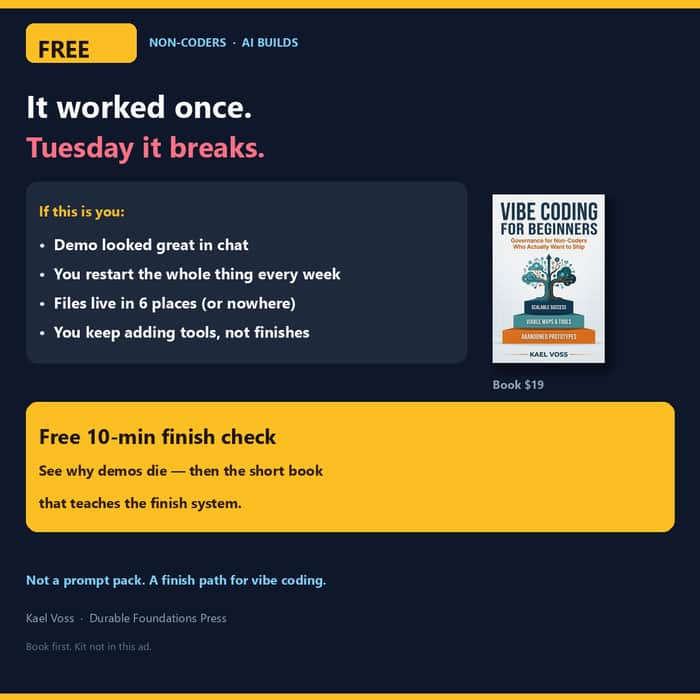
This is the story behind the book - not a feature list.
For a long time I watched the same loop:
Friday night: “this time the AI build will stick.”
Saturday: the demo works. Screens look real. Momentum feels earned.
Sunday night: one change breaks three things.
Monday: the chat is gone, the files are mush, and “what were we even building?” is the only honest question.
I kept thinking the fix was a better model, a better prompt pack, a better tool.
It wasn’t.
The people who shipped weren’t the ones with the fanciest stack. They were the ones with a boring finish system:
• a written definition of done (tiny)
• durable files outside the chat
• one slice that must still work after the next change
• a hybrid habit (AI for speed, local control for what has to last)
I got tired of explaining that in fragments. So I wrote it down as a short PDF for non-coders and solo builders who vibe-code - governance and finish, not hype.
Not a course. Not a prompt dump. A finish map you can read and use the same weekend.
If you’re in the restart loop, free 10-min check first. Book if the gap is already obvious.
Free Pyramid Reality Check:
https://durablefoundations.gumroad.com/l/pyramid-reality-check
Book ($19 PDF):
https://durablefoundations.gumroad.com/l/ycoqh
- DurableFoundations

The interesting part is moving from “better prompts” to a repeatable system for getting reliable outputs.
Most people underestimate how much context, constraints, and format shape AI results. Turning that into a workflow instead of a collection of tips makes sense.
Exactly - prompts are the easy layer people collect. The hard layer is a repeatable system: context, constraints, and format that survive past one chat.
What I kept seeing was people treating “better prompt” as the product. Then Monday still fails because nothing durable captured:
• what “good” looked like
• what was in / out of scope
• what to run the same way next time
Tips scatter. A small workflow (done + constraints + where files live) is what makes outputs reliable enough to ship.
Curious how you lock format/constraints in practice templates you reload, a short brief before each run, something else?
I'm glad we're thinking along similar lines. I'd enjoy continuing the conversation outside the thread if you're open to it. What's the best email to reach you on?
Thanks for the note. Happy to keep any useful discussion in this thread for now, I'm not looking to move sales conversations offline.
Totally understand, and I appreciate you saying that.
I'll keep it to the thread from here. I don't think I'd do my perspective justice in a few comments, so I'll leave it there for now, but I've enjoyed the discussion.