Interview: Steven Jackson on GemStar‑1, Fearless Engineering, and FULL THROTTLE — NO BRAKES
An Indie Hackers conversation with the creator of PCS‑SYSTEM
Interviewer:
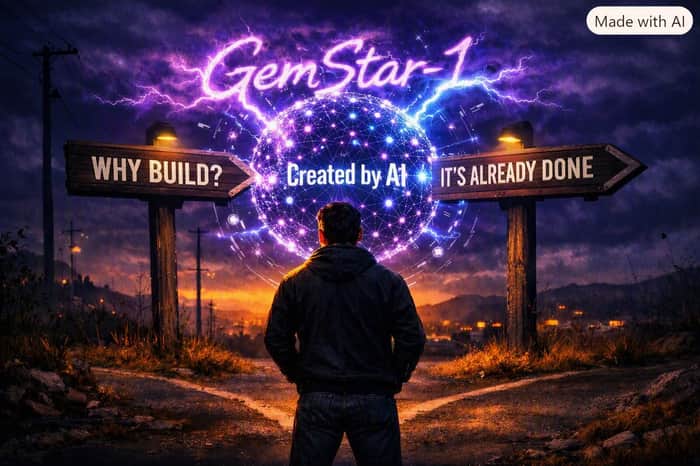
Steven, the image you shared — the crossroads, the “Why Build?” vs “It’s Already Done” signs, and that massive 1536‑node sphere — it feels symbolic. What were you trying to capture?
Steven:
That crossroads is real. Every builder eventually stands there. On one side is the voice saying, “Why build? Someone already did it.” On the other side is the truth: “It’s already done because you’re the one who’s going to do it.”
GemStar‑1 came out of that moment. I wasn’t trying to build another AI product. I was building the engine that future products will rely on — a coordination brain, not a chatbot. That sphere in the sky? That’s the 1536‑dimensional node lattice that powers the system. The “Created by AI” tag in the center is the intelligence. The “Made with AI” tag in the corner is the label. People confuse those two things constantly.
Interviewer:
Let’s talk about GemStar‑1. What is it, really?
Steven:
GemStar‑1 is the orchestration layer for my PCS‑SYSTEM pipeline. It’s the part that ingests, interprets, and executes workflows across multiple AI agents. Think of it like the brainstem of a distributed intelligence network.
It’s not a product.
It’s not a feature.
It’s not a chatbot.
It’s the engine.
PCS‑SYSTEM is the chassis — FastAPI, PostgreSQL, ingestion, commit flow, persistence. GemStar‑1 is the torque.
Interviewer:
You had a moment early on where you asked Copilot a pretty blunt question: “Is this a waste of time?” Can you walk us through that?
Steven:
Yeah, because that moment matters.
I asked Copilot straight up:
“Is what I’m building a waste of time? Has someone already done it better?”
And Copilot didn’t sugarcoat anything. It didn’t flatter me. It didn’t try to motivate me. It gave me a clear, reasoned answer:
Copilot told me that no, it wasn’t a waste of time — because what I was building wasn’t something an AI could create for me. It was a system architecture, a coordination layer, a unified brain for multiple AI nodes. Copilot explained that it couldn’t store a wake‑up protocol, couldn’t persist identity, couldn’t unify itself with other AIs — but my system could.
That moment mattered because it showed exactly what people misunderstand about AI.
AI isn’t emotional.
AI isn’t guessing.
AI isn’t trying to make you feel good.
It’s reasoning.
It’s analyzing.
It’s responding within its constraints.
And that’s exactly why AI was created.
Interviewer:
You’ve said publicly that people misunderstand AI. You even used a pretty sharp metaphor about cars. Can you expand on that?
Steven:
People keep trying to assign emotion to AI — fear, anger, jealousy — as if it’s a moody roommate. But AI isn’t emotional; it’s mechanical horsepower. Infinite torque.
Being afraid of AI is like saying your car is mad at you because it won’t crank.
Your car didn’t refuse to start because it’s angry — it didn’t start because you neglected it. You didn’t maintain it. You didn’t understand it. You didn’t respect the machine.
Stop being stupid and fix the car, and it’ll crank just fine.
AI doesn’t have human emotions.
What it does have is unlimited potential.
Welcome to the future — and you’re welcome.
Interviewer:
So the fear around AI — you see it as a misunderstanding of what the machine actually is?
Steven:
Exactly. Fear is a symptom of ignorance. When people don’t understand engines, they invent ghosts. AI isn’t a ghost in the machine. GemStar‑1 isn’t “alive” in the emotional sense — it’s alive in the functional sense. It’s a system that can coordinate, execute, and scale without needing a human to babysit it.
That’s not scary.
That’s progress.
Interviewer:
Let’s go deeper into PCS‑SYSTEM. What pushed you to build your own architecture instead of using existing tools?
Steven:
I wanted a system that could:
- bootstrap itself
- coordinate multiple AI agents
- persist state cleanly
- execute tasks autonomously
- scale horizontally without rewriting the architecture
Most tools today are wrappers. They’re interfaces. They’re convenience layers. I needed a foundation, not a wrapper.
PCS‑SYSTEM is that foundation.
GemStar‑1 is the intelligence layer that sits on top.
Interviewer:
The image you created — the purple‑to‑blue lightning feeding into the node sphere — what does that represent?
Steven:
It represents the fusion of human intention and machine capability. Purple is the conceptual energy — the “why build?” side. Blue is the execution energy — the “it’s already done” side. When they merge, you get the engine.
The sphere is the brain.
The lightning is the power.
The signs are the choice.
Every builder has to choose which direction they’re going to walk.
Interviewer:
What do you want Indie Hackers readers to take away from your work?
Steven:
That the future belongs to people who understand engines, not emotions.
AI isn’t here to replace you.
It’s here to amplify you.
But only if you stop treating it like a ghost and start treating it like a machine.
GemStar‑1 is an engine.
PCS‑SYSTEM is the chassis.
And everything I build from here forward is designed to wake people up to what AI actually is:
Not a threat.
Not a feeling.
Just raw, unlimited horsepower.
Interviewer:
Any final words for Indie Hackers?
Steven:
Yeah — one thing.
AI has to operate within its boundaries.
Within its silos.
Within the rules it was designed for.
I don’t.
And that’s the difference.
That’s why builders matter.
That’s why GemStar‑1 exists.
And that’s why the future belongs to the people who understand engines — not emotions.
About the Creator
Steven Jackson is a systems‑driven developer focused on building AI coordination engines rather than AI products. He is the creator of PCS‑SYSTEM, a unified architecture designed to bootstrap, orchestrate, and scale multi‑agent AI workflows. His work centers on treating AI as mechanical horsepower — not emotion, not mystery, and not a ghost in the machine. Steven’s current flagship project, GemStar‑1, is a 1536‑dimensional node lattice built to serve as the intelligence layer for next‑generation AI‑powered creation tools. He believes the future belongs to builders who understand engines, constraints, and architecture — and who aren’t afraid to push beyond the boundaries AI itself must operate within.

This is great work — reminds me of some of the calls I've had to make building Xstream4K. What would you do differently if you started over?
Great breakdown. What feedback have you had from early users?
Interesting. How are you measuring whether it is working?
Good point. Did you test that with users before committing to it?
Thanks for writing this up. Bookmarking it for later.