Meta locked out all four of my channels in three days. Today I launch what I built from that.
n August 4, 2026, Meta cut off all four of my Instagram and Facebook channels at
once. My freshly built autopilot had posted too often in three days, and after
every failed post it tried again right away. Meta's answer: session invalidated,
too much posting, reconnect and wait one to two days.
Two days of silence on every channel, right at the start. The worst part:
everything after 12:22 failed quietly. The web interface showed the reason. My
tool did not.
I did not fix this by making the tool smarter. I made it slower. Three brakes are
in the product since then: at least 180 minutes between two posts, one project per
run, and no automatic retry. When something fails, the autopilot stops and asks a
human. Since that day there has been no lockout.
That tool is Kosmopost, and today it is my first SaaS that anyone can try.
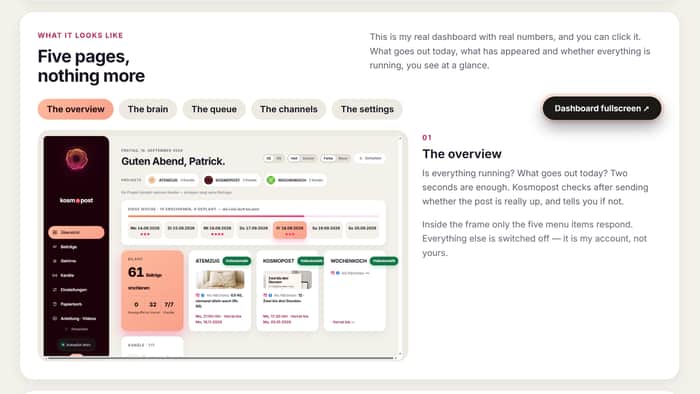
What it is: a posting autopilot for Instagram and Facebook. You give it the text
and the images. It schedules, publishes, and then asks the platform if the post is
really there and writes the result back. Failed channels are shown, not hidden. I
learned that one the hard way too: my own dashboard showed green three times while
nothing was live.
What it is not: it does not write. It publishes. There are more than enough tools
that write your posts. What was missing for me was the part where they actually go
out, week after week. So the text stays yours, or comes from whatever AI you
already use.
Details:
- English and German: https://kosmopost.ai/en/
- One overview video (2:20) plus eleven short clips, 24 to 84 seconds each. Real
screen, real account, no voice-over. - 30 days free, no credit card, the trial just ends on its own
- After that €18.99/month (excl. VAT) for one project
- If you don't like it, you just posted for 30 days for free. No obligation.
Honest numbers: it has run since the end of July on my own brands, over 60 posts
published, and I have zero paying customers. That starts today.
My question: when people hear "posting tool", most of them assume it writes the
text with AI. How would you make "it does not write" land in the first sentence,
without sounding like the product is missing something?
Patrick

The choice to stop automatic retries after the lockout is a strong example of designing for failure rather than hiding it. I’d be curious whether showing the last successful publish time prominently changed how quickly you could diagnose a silent failure.
Appreciate the honesty here, most people only share the wins.
Appreciate the honesty here, most people only share the wins.
The "no automatic retry" brake is the right call. I run posting through the Graph API for FB/IG/Threads and hit a related trap: IG Reels and Threads video containers sometimes return status ERROR, then flip to FINISHED about 60 seconds later and publish fine. An instant retry would have created a second container and a duplicate attempt. Now the script waits 60s and re-checks before treating anything as failed. Slower, but no surprises.
This resonates hard — I had the same happen to my X.com account(@Timzhan66400630) in late August. "Inauthentic behavior" was the
verdict, though the real cause was posting4 articles in a few
hours as part of a launch sequence. Account is suspended, appeal
still in queue.
The thing nobody tells you: the ban applies even to legitimate
posts that came AFTER the trigger post. Once the system flags
you, it seems to retroactively apply.
My workaround since then: I write one public post, wait for it
to land and gather feedback, then write the next one. Slow, but
no second suspension risk. The downside is your launch loses
momentum.
Curious — for the rebuild, are you treating the four lost
channels as a cautionary tale (just be more careful elsewhere)
or a system signal (any platform is one algorithm change away
from being hostile)?
System signal, and your X story is why.
Two different platforms, two different teams, same rule underneath: speed reads
as inauthentic, and the penalty lands on posts that were never the problem. That
matches what I saw — everything after 12:22 failed, including the ones that were
perfectly fine on their own.
So I stopped treating it as "Meta is strict" and started treating it as "every
platform is one policy change away from this." That's why the spacing is global
across all my brands instead of per channel, and why a failure stops the queue
instead of the post. If I have to guess which platform gets hostile next, I've
already lost.
Your workaround is the same logic done by hand — one post, wait, look, next.
You're paying for it with momentum. I'm paying for it with posts that go out
three hours later than I'd like. Same bill, different currency.
Hope the appeal lands. Do they give you any timeline at all?
Genuinely curious: Meta's platforms are already connected. Via the regular dashboard you can already plan a lot of posts ahead and choose where to launch them, including statistics. What were you missing in this, or in the other tools available, that made you develop this tool? :-)
Fair question, and the honest answer is: if you run one brand and you don't mind
opening Business Suite, it's enough. It's free and it schedules. I'm not going to
pretend otherwise.
Three things pushed me out of it. I run three brands, and Business Suite makes you
do each one separately, so I was doing the same work three times. It has no idea
what my other brands just posted, which is exactly how I got rate-limited. And it
schedules posts one at a time — I wanted to drop 30 posts in once and have them
spread out over the month on their own.
The fourth thing is the one I actually built the product around: Business Suite
tells you it published. It does not go back and check. Mine does, and the first
time it caught a post that was never live, I understood what I was really making.
The three brakes are the actual product insight here, not the scheduling. Anyone who has run automated posting against Meta or LinkedIn has your August 4 story in some form. My own version is a standing rule: any platform challenge stops all activity on that account until a human looks at it, because scheduled retries against a challenged session are what turn a warning into a lock. And 'fails and tells you' sounds like table stakes until you've had a dashboard show green on posts that never went out. One question: when a platform asks for re-auth mid-schedule, does Kosmopost pause the whole queue or just that channel?
The whole queue for that account, not just the channel — on purpose.
Reasoning: when a platform challenges one session, I don't trust the state of any
of them. The queue stops, the dashboard turns red with the actual reason, and you
get a mail. One button reconnects and resumes.
The cost is real and I'll name it: one dead channel stops the posts that would
have gone out fine on the others. I chose that over the alternative, because the
alternative is a queue that keeps firing while one channel is already in trouble
— which is the exact sequence that cost me four channels on August 4.
Your standing rule is the same rule. Good to know someone arrived at it
independently.
You post is good
Lead with the failure mode you prevent, not the feature you skip.
"Posting autopilot that refuses to write — so Meta can't ban you for speed" lands clearer than "it does not write." People hear "does not write" as a missing AI feature. They hear "won't invent copy, won't retry a locked session, stops and asks a human" as the product.
One line I'd test on the hero: "Schedules and publishes. Won't invent copy. Won't retry a locked session."
I keep a free Sample Messaging Snapshot for that kind of one-sentence positioning check:
https://eastwestkonnex.gumroad.com/l/sample-messaging-snapshot
When a prospect asks "so which AI writes the posts?", do you already have a one-liner that turns that into the reason to buy?
Also had a look at your sample. The brief format is good — it forces the one
sentence instead of describing it.
One thing back, same medicine you gave me: your own title is "CiteMap SAMPLE
Messaging Snapshot — See the Brief Format (Free)". That's the format, not the
failure mode. By your own rule it would be something closer to "The one sentence
your prospects repeat back to you — free sample brief."
I'd have clicked that one faster.
You're right — I wrote the medicine and then titled the sample like a format. The failure mode that page should name is: founders describe the product for three paragraphs and never land the one sentence a prospect would repeat. Working title I'm testing next: "Stop describing your product. Get the one sentence prospects actually repeat (free sample)." If that still reads like a feature, I'll cut again.
Lead with the failure mode you prevent, not the feature you skip.
"Posting autopilot that refuses to write — so Meta can't ban you for speed" lands clearer than "it does not write." People hear "does not write" as a missing AI feature. They hear "won't invent copy, won't retry a locked session, stops and asks a human" as the product.
One line I'd test on the hero: "Schedules and publishes. Won't invent copy. Won't retry a locked session."
I keep a free Sample Messaging Snapshot for that kind of one-sentence positioning check:
https://eastwestkonnex.gumroad.com/l/sample-messaging-snapshot
When a prospect asks "so which AI writes the posts?", do you already have a one-liner that turns that into the reason to buy?
That's the sharpest thing anyone has said to me about this. "Does not write"
does land as a missing feature — I've watched three people hear it that way and
I kept blaming the listener.
Honest answer to your question: no, I don't have that one-liner yet. What I have
is the long version, which is the wrong shape for a first sentence.
"Won't retry a locked session" is the one I'm taking. It's the exact thing that
cost me all four channels, and it's the part nobody else builds because it looks
like doing less.
I'll put your line on the hero this week and see what changes.
Glad that line stuck. One more cut that helps on a hero: pair the restraint with the cost — "won't retry a locked session, so one ban doesn't wipe four channels." Without the cost, "doing less" still sounds like a missing feature.
That's the better version. The cost is what makes the restraint readable —
without it I'm just describing what the product doesn't do.
Going up with "so one ban doesn't wipe four channels." Thanks for two rounds of
free positioning work, that's more than I got from the last three landing page
reviews I paid for.
Glad you're shipping the cost line. One quick check before it goes live: read the hero out loud to someone who has never run Meta ads and ask them what bad outcome the product prevents. If they can say "one ban wiping everything" (or close) without you coaching, the line is doing its job. If they repeat a feature instead ("it schedules posts"), cut again until the cost is what sticks.
That's a test I can actually run — I have a physio practice and a fitness studio
as customers who have never touched Meta ads in their lives.
Doing it before it goes live, in German, and I'll report back what they say. If
they hand me back a feature instead of the cost, that's the answer.
Appreciate the honesty here, most people only share the wins.
Appreciate the honesty here, most people only share the wins.
Good write-up. What would you do differently if you started again?
Interesting take. Would you still recommend this approach to someone starting today?
Clear and practical, thanks. Did anything surprise you along the way?
Nice work shipping it. What has been the biggest challenge since launch?
Interesting approach. What was the hardest part to get right?
How did you decide this was worth building in the first place?
Thanks for sharing the numbers, that makes it much easier to follow.
Appreciate the honesty here, most people only share the wins.
Appreciate the honesty here, most people only share the wins.
Solid lesson. Which channel has worked best for you so far?
Thanks for writing this up. Bookmarking it for later.
Thanks for sharing the numbers, that makes it much easier to follow.
Good point. Did you test that with users before committing to it?
Clear and practical, thanks. Did anything surprise you along the way?
Great breakdown. What feedback have you had from early users?
Thanks for sharing the numbers, that makes it much easier to follow.
Good point. Did you test that with users before committing to it?
Interesting take. Would you still recommend this approach to someone starting today?
Helpful post. How did you get your first bit of traction?
Good write-up. What would you do differently if you started again?
Interesting. How are you measuring whether it is working?
Makes sense. Are you planning to charge for it, or keep it free for now?
Good point. Did you test that with users before committing to it?
What made you pick this stack over the alternatives?
Makes sense. Are you planning to charge for it, or keep it free for now?
Good write-up. What would you do differently if you started again?
What made you pick this stack over the alternatives?
Helpful post. How did you get your first bit of traction?
Good point. Did you test that with users before committing to it?
Interesting take. Would you still recommend this approach to someone starting today?
Interesting. How are you measuring whether it is working?
What made you pick this stack over the alternatives?
Interesting. How are you measuring whether it is working?
Interesting take. Would you still recommend this approach to someone starting today?
Interesting take. Would you still recommend this approach to someone starting today?
What made you pick this stack over the alternatives?
Interesting. How are you measuring whether it is working?
Solid lesson. Which channel has worked best for you so far?
Good write-up. What would you do differently if you started again?
Good write-up. What would you do differently if you started again?
Interesting take. Would you still recommend this approach to someone starting today?
Helpful post. How did you get your first bit of traction?
What made you pick this stack over the alternatives?
Interesting. How are you measuring whether it is working?
With 60+ posts validating the workflow technically, what evidence would show customers value publishing reliability enough to pay for it separately from the AI writing features they already expect?
No evidence yet. Zero paying customers as of today, so anything I said here about
willingness to pay would be a guess dressed up as an answer.
What I can say is what I saw in myself: I had the writing part solved long before
I built this. ChatGPT gave me a month of posts in an afternoon. They sat in a
folder. The thing that was missing was never the text.
So the test is simple and it's running now: 30 days free, no card. If people use
the trial and then stop, reliability wasn't worth paying for separately and I'll
say so publicly. If they keep it, that's the evidence — and it will be the only
kind I trust, because it costs them money to give it.
Ask me again in 30 days. I'll post the number either way.
Interesting take. Would you still recommend this approach to someone starting today?
Good write-up. What would you do differently if you started again?
What made you pick this stack over the alternatives?
Makes sense. Are you planning to charge for it, or keep it free for now?
Good write-up. What would you do differently if you started again?
Good point. Did you test that with users before committing to it?
Interesting. How are you measuring whether it is working?
Solid lesson. Which channel has worked best for you so far?
Helpful post. How did you get your first bit of traction?
Good point. Did you test that with users before committing to it?
Good write-up. What would you do differently if you started again?
Good write-up. What would you do differently if you started again?
Solid lesson. Which channel has worked best for you so far?
Helpful post. How did you get your first bit of traction?
What made you pick this stack over the alternatives?
Interesting. How are you measuring whether it is working?
Interesting take. Would you still recommend this approach to someone starting today?
Makes sense. Are you planning to charge for it, or keep it free for now?
Love this angle. Building Xstream4K right now so this hits close to home — what made you look into it in the first place?
This resonates a lot — how long did it take before you saw any real signal on it?
Good write-up. What would you do differently if you started again?
Good write-up. What would you do differently if you started again?
Good point. Did you test that with users before committing to it?
Interesting. How are you measuring whether it is working?
Solid lesson. Which channel has worked best for you so far?
One thing I should add, because it changes the answer: Facebook is not dead, it's
just older. For a physiotherapy practice or a local shop, the people who actually
book are on Facebook, not Instagram. So "which channel is best" really means
"where is your customer", and for a lot of small businesses that is still
Facebook.
TikTok and LinkedIn are in review right now. Same rule will apply there: one
project brings all its channels, no extra charge per channel.
@Paloc — Instagram, by a wide margin, and not because it performs better. It's
because it's the one I can actually keep up. Facebook needs a different tone from
me and I never had the energy for two.
That's the real answer for a solo founder: the best channel is the one you still
post to in week six. That's the whole reason I built the tool the way I did — it
doesn't find you a better channel, it keeps the one you picked alive.
Helpful post. How did you get your first bit of traction?
Interesting take. Would you still recommend this approach to someone starting today?
Makes sense. Are you planning to charge for it, or keep it free for now?
Good write-up. What would you do differently if you started again?
What made you pick this stack over the alternatives?
Good write-up. What would you do differently if you started again?
@bestiptvukus — thanks. What made me look into it: I have three of my own apps
and no marketing team. Posting every day was the one thing that worked and the
one thing I kept dropping. Some evenings I just forgot, and a channel would go
quiet for a week.
So I built a small script to send the posts for me. Three days later Meta locked
all four channels. That is when it stopped being a script and turned into a real
product, because the hard part was never "send a post" — it was "send it without
getting your account killed."
What's Xstream4K? Curious what you're building.
Love this angle. Building Xstream4K right now so this hits close to home — what made you look into it in the first place?