Meta locked out all four of my channels in three days. Today I launch what I built from that.
n August 4, 2026, Meta cut off all four of my Instagram and Facebook channels at
once. My freshly built autopilot had posted too often in three days, and after
every failed post it tried again right away. Meta's answer: session invalidated,
too much posting, reconnect and wait one to two days.
Two days of silence on every channel, right at the start. The worst part:
everything after 12:22 failed quietly. The web interface showed the reason. My
tool did not.
I did not fix this by making the tool smarter. I made it slower. Three brakes are
in the product since then: at least 180 minutes between two posts, one project per
run, and no automatic retry. When something fails, the autopilot stops and asks a
human. Since that day there has been no lockout.
That tool is Kosmopost, and today it is my first SaaS that anyone can try.
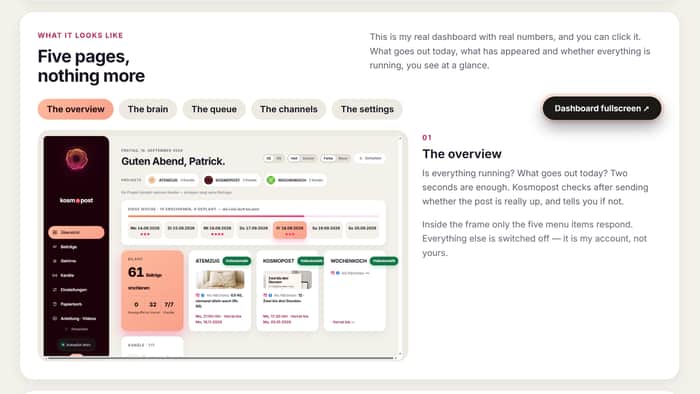
What it is: a posting autopilot for Instagram and Facebook. You give it the text
and the images. It schedules, publishes, and then asks the platform if the post is
really there and writes the result back. Failed channels are shown, not hidden. I
learned that one the hard way too: my own dashboard showed green three times while
nothing was live.
What it is not: it does not write. It publishes. There are more than enough tools
that write your posts. What was missing for me was the part where they actually go
out, week after week. So the text stays yours, or comes from whatever AI you
already use.
Details:
- English and German: https://kosmopost.ai/en/
- One overview video (2:20) plus eleven short clips, 24 to 84 seconds each. Real
screen, real account, no voice-over. - 30 days free, no credit card, the trial just ends on its own
- After that €18.99/month (excl. VAT) for one project
- If you don't like it, you just posted for 30 days for free. No obligation.
Honest numbers: it has run since the end of July on my own brands, over 60 posts
published, and I have zero paying customers. That starts today.
My question: when people hear "posting tool", most of them assume it writes the
text with AI. How would you make "it does not write" land in the first sentence,
without sounding like the product is missing something?
Patrick

Congrats on shipping. On the framing question: I would not try to squeeze "it does not write" into the first sentence, I would make the first sentence describe the job so specifically that writing is obviously not part of it, e.g. leading with the 'shown, not hidden' failure detection instead of the general pitch. That is the detail that actually differentiates you from every AI writer with a scheduler bolted on, and it doubles as proof you have run this on your own accounts long enough to find the failure mode. The 'does not write' line can then come second, as a relief rather than a disclaimer.
Thank you — and thanks for reading it closely enough to give me something this
precise.
"Relief rather than a disclaimer" is the distinction I was missing. Same words,
different position in the sentence, completely different thing to read.
You're also the third person in this thread to land there independently: lead
with the failure being shown, not with what the tool refuses to do. I've been
arguing for the refusal because it's the part that cost me something — which is a
builder's reason, not a buyer's.
The one voice against it is the only real customer in the sample. I read the
current line to him yesterday and his first words were about invented content
getting published, then the lockout. Not observability.
So: three founders say one thing, one customer says another. I'm reading your
version to a second customer today. If she also goes straight to "it won't invent
things", I'll trust the customers over the founders — and I'll come back here and
say so.
The channel lockout is actually a forcing function for measurement clarity. Most teams run distribution concurrently and never know which channel actually converts until capacity forces a choice. You got that data in 72 hours. How does the CAC differ across the channels you regained access to versus the new one?
Honest answer: the premise doesn't apply to me, and I'd have to invent numbers to
give you a real one.
There is no CAC. I've never run a paid channel — no ads, no budget, nothing to
attribute. The channels in question are my own Instagram and Facebook accounts
posting organically for three small brands. The lockout cost me visibility for
two days, not acquisition spend.
And the 72 hours didn't produce channel data either. Nothing was published in that
window, so what I learned was about the plumbing, not about which channel
converts.
What I can tell you, for whatever it's worth at this size: zero paying customers
so far, one in trial, and every single conversation that led anywhere came from
writing something honest in a place like this. That's not a channel strategy,
it's just the only thing that has worked yet.
If you've measured this properly across channels, I'd rather hear your numbers
than pretend to have mine.
Your first sentence could be: “Kosmopost publishes the posts you already wrote—and tells you when a channel fails.” It says the value rather than leading with what it does not do. The human-stop rule is a good differentiator, too.
That's the cleanest version anyone has written, and it's short enough to survive
being said out loud.
You're the fourth person in this thread to arrive at the same shape independently:
say what it does, let "doesn't write" fall out of it instead of announcing it.
Four strangers agreeing without reading each other is hard to argue with.
"The posts you already wrote" is the part I wouldn't have found. It puts the work
in the past, where it belongs — the customer has already done it, and the tool
takes over from there.
Reading it to a real customer today next to the version I had. Coming back with
her exact words either way.
The line that matters in this is 'when something fails, the autopilot stops and asks a human'. Most tools do the opposite, they retry harder and hide the failure, and you only find out when the platform bans you. Making it slower on purpose is the grown up decision, and it is the same reason I refuse to put anything on autopilot that touches other people's accounts. Good launch.
Thank you. And your last sentence is the one I keep thinking about: you refuse to
put anything on autopilot that touches other people's accounts.
That's the actual weight of this. Mine touches other people's accounts, so every
brake I skip is a risk I'm taking with someone else's reputation, not my own. I
got the lesson on my own four channels, which was the cheap version.
"They retry harder and hide the failure, and you only find out when the platform
bans you" — that's the sentence I've been trying to write for two days. Five
people in this thread have now told me to lead with the failure being shown
instead of with what the tool refuses to do. You're the fifth, and the clearest
about why it matters.
If you ever do put something on autopilot against someone else's account, I'd
like to know what would have to be true first. That's a better spec than anything
I'd come up with alone.
Good write-up. What would you do differently if you started again?
Helpful post. How did you get your first bit of traction?
The "everything after 12:22 failed quietly" line is the real lesson here. A loud failure you fix in minutes. A silent one runs for hours while you think everything is working, and by the time you notice the platform has already flagged the pattern. We've hit the same thing posting in communities — the tool reports text typed, the field is actually empty, and we only know because we now verify every single action after it happens.
Your positioning question has a clean answer: "it publishes" is what your competitor doesn't do. Most social tools sell writing because that's the AI-impressive part, but the gap is exactly where you found it — getting content out reliably, week after week, without the dashboard lying about what's live. Zero paying customers and 60+ posts on your own channels is honest in a way most launches aren't.
Which channel failed most often during those first three days?
Hey James — thanks for this, genuinely useful.
"The tool reports text typed, the field is actually empty" is the same bug as
mine wearing different clothes. Good to know it's not a Meta speciality.
To your question: none of them failed more than the others on August 4, and that
was the lesson. All four went at the same moment, because the session sits on the
account, not on the channel. One trigger, everything dark. That's also why my
queue now stops for the whole account instead of skipping the broken channel — if
one is challenged, I don't trust the state of any.
In normal operation it's Instagram, by a wide margin. Not from rate limits, from
media processing: video and carousel uploads go through a container that has to
be accepted first, and it rejects things Facebook happily takes. Facebook fails
almost never, and when it does, it says why.
Now my question back: what are you posting into communities, and what for? You
said you verify every single action after it happens — that's a rule people only
arrive at after it has cost them something. I'd like to hear that story, and what
you're building.
And thanks for putting it that way about the zero. I keep bracing for that number
to read as failure.
Great advice on shipping fast and talking to users. The feedback loop is everything in the early stage.
This is a great reminder that automation needs guardrails, not just more intelligence. The “stop and ask a human” rule is probably the most important part.
Hey Jacob — thanks.
"Guardrails, not more intelligence" is the shorter version of what took me three
weeks to work out. My first instinct after the lockout was to make the thing
smarter: detect the limit, back off cleverly, predict the throttle. All of that
would have been more code doing more guessing against a system that doesn't tell
you its rules.
The fix was one line of nerve instead: when it fails, stop and ask me.
The part that still surprises me is that "stop and ask a human" is the hardest
thing to sell, because it reads as the tool doing less. Five people in this thread
have now told me to lead with it anyway.
Are you building something that touches other people's accounts too?
Extend it to cover Reddit and you have a winner. Facebook is nearly useless for me, and Instagram is close to the same. Threads had some potential, but I got permabanned there with no reason why. Not planning on ever using it again.
Hey — the Threads permaban with no reason given is the part I'd want to know more
about. Was it after automated posting, or just normal use? That's the failure mode
I can't design around and it worries me most.
On Reddit, I'm going to disappoint you, and I'd rather do it now than after you
paid.
Reddit is the one platform where I think an autopilot is the wrong tool. Not
because of the API — because of the room. A scheduled post that lands at 09:00
and nobody replies to for four hours reads as a drop, and the subs that matter
kill it on sight. Most of the good ones ban automation outright, and the ones
that don't have people who can smell it. The value on Reddit is in the first
thirty minutes of replying, and that's the exact part a scheduler cannot do for
you.
I post there myself, by hand, and it takes more out of me than all the other
channels together. If I built a Reddit autopilot I'd be selling the thing that
gets people banned — which is literally what this product exists to prevent.
What I could see doing one day is the opposite: remind you that you said you'd
post to r/X today, and get out of the way. But that's a nudge, not an autopilot.
Does that ruin it for you, or does it match what you'd actually want?
Your strongest differentiation sounds like control and observability, not a lack of AI writing. I’d try leading with: “You write it; Kosmopost makes sure it actually publishes—and tells you when it doesn’t,” then explain the deliberate brakes as the trust layer. The 60-post / zero-paying-customer snapshot could make a useful test of that wording against the usual “posting tool” assumption.
I agree with this. AI writing is becoming easy to copy, but reliable publishing, clear failure signals, and human control are much harder to fake. The brakes actually strengthen the product story.
"Harder to fake" is the argument I hadn't thought of, and it's the better one.
Anyone can bolt a writing model onto a scheduler this afternoon. Nobody copies a
brake, because a brake only makes sense after it has cost you something — you
have to have been locked out to believe it's worth shipping a product that does
less on purpose.
Which means the story and the moat are the same thing here, and I've been
treating them as separate: the lockout as the marketing anecdote, the brakes as
the engineering. They're one object.
Still testing it against a real customer today, because so far every person who
prefers this framing is a founder, and the one person who didn't is the one
paying attention to his own account rather than to product design.
That's the third framing I've been handed today and the first one that drops the
"doesn't write" part entirely. Worth taking seriously, because it's also the only
one that can't be misread as a promise.
One data point against it, from an hour ago: I read the current line to a real
customer, a physio practice, and asked what it protects him from. His first words
were about invented content getting published, and only then about the account
getting locked. So for him the "we don't write" half did the work, not the
observability half.
He may be the exception. He may also be the customer, and I'm the one who finds
observability interesting because I'm the one who built it.
Testing yours on the second person tomorrow, side by side. "Tells you when it
doesn't" is the part I'd keep either way — that sentence is the product.
Appreciate the honesty here, most people only share the wins.
This is a great example of turning a painful problem into a product opportunity. Getting locked out of all four channels in such a short period must have been incredibly frustrating, but I like that you used the experience to build something rather than just treating it as bad luck.
The part that interests me most is the shift from relying entirely on a platform you don’t control to building an audience infrastructure you actually own. Curious to see how you handle the balance between automation and keeping the experience genuinely personal as the product scales.
Honest answer: I avoided the problem instead of solving it. The tool never writes
a word, so nothing it does can sound impersonal — whatever comes out is what the
person put in. All I automate is the sending and the checking.
That's a limit, not a clever design. It means I can never help someone who has
nothing to say. Some days that feels like the wrong side of the trade.
On scale: right now support is me, and I read every mail. I don't know yet what
breaks first when that stops being possible. Ask me again when there are a
hundred customers — today there is one, so anything I said about scaling would
be a theory.
This is a really useful approach. What marketing strategy has worked best for you so far?
The choice to stop automatic retries after the lockout is a strong example of designing for failure rather than hiding it. I’d be curious whether showing the last successful publish time prominently changed how quickly you could diagnose a silent failure.
It did, and not the way I expected.
The timestamp helped. What actually fixed it was that the dashboard stopped
answering from memory. It used to show me what it had stored when the post was
sent. Now it goes and asks the platform whether the post is really there.
Diagnosis went from "I notice a week later that a channel is quiet" to "a mail
arrives while it's happening."
The wider lesson, which cost me three separate bugs before I learned it: a state
nobody re-checks is a claim, not a measurement.
That’s the right distinction. I’d make the receipt the state transition: publish attempt → wait 60 seconds → re-check once → record the platform’s post ID/permalink (or the exact error) and alert. Keeping the check timestamp and returned ID beside the original attempt makes “green from memory” impossible to mistake for a live post.
Two of those three I already have — the platform's post ID and the permalink get
recorded at send time, so there is always something to click instead of a green
dot to trust.
The missing piece is the one in the middle: the wait before I call it a failure.
That's the one going in this week.
You've now given me the positioning line and a state machine in the same thread.
If you write like this on the paid side, the $149 looks underpriced.
Appreciate the honesty here, most people only share the wins.
Appreciate the honesty here, most people only share the wins.
The "no automatic retry" brake is the right call. I run posting through the Graph API for FB/IG/Threads and hit a related trap: IG Reels and Threads video containers sometimes return status ERROR, then flip to FINISHED about 60 seconds later and publish fine. An instant retry would have created a second container and a duplicate attempt. Now the script waits 60s and re-checks before treating anything as failed. Slower, but no surprises.
That's a real gap in mine and I just went and checked instead of guessing.
My code treats the first ERROR as final — it throws, stops the queue and mails
me. No duplicate risk, because I never retry. But your case would hit me the
other way: a Reel that would have flipped to FINISHED gets reported as a failure
and halts an account that was fine.
So "no automatic retry" and "no automatic re-check" are not the same rule, and I
had them collapsed into one. Adding a single re-check after 60 seconds before
ERROR counts as final. Still no second container, still no retry — just asking
once more before I believe the bad news.
Thanks. That one would have cost me a support mail from a real customer.
This resonates hard — I had the same happen to my X.com account(@Timzhan66400630) in late August. "Inauthentic behavior" was the
verdict, though the real cause was posting4 articles in a few
hours as part of a launch sequence. Account is suspended, appeal
still in queue.
The thing nobody tells you: the ban applies even to legitimate
posts that came AFTER the trigger post. Once the system flags
you, it seems to retroactively apply.
My workaround since then: I write one public post, wait for it
to land and gather feedback, then write the next one. Slow, but
no second suspension risk. The downside is your launch loses
momentum.
Curious — for the rebuild, are you treating the four lost
channels as a cautionary tale (just be more careful elsewhere)
or a system signal (any platform is one algorithm change away
from being hostile)?
System signal, and your X story is why.
Two different platforms, two different teams, same rule underneath: speed reads
as inauthentic, and the penalty lands on posts that were never the problem. That
matches what I saw — everything after 12:22 failed, including the ones that were
perfectly fine on their own.
So I stopped treating it as "Meta is strict" and started treating it as "every
platform is one policy change away from this." That's why the spacing is global
across all my brands instead of per channel, and why a failure stops the queue
instead of the post. If I have to guess which platform gets hostile next, I've
already lost.
Your workaround is the same logic done by hand — one post, wait, look, next.
You're paying for it with momentum. I'm paying for it with posts that go out
three hours later than I'd like. Same bill, different currency.
Hope the appeal lands. Do they give you any timeline at all?
The 12:22 timestamp is brutal — confirms the "penalty
hits posts that weren't the problem" mechanic. Thanks
for sharing that data point.
On the appeal: still in queue, no estimated timeline.
Generic "we'll get back to you" + a case ID, nothing
more actionable. I check inbox every few days but the
silence is the hard part.
If the appeal bounces I'll likely write it up
separately — partly for the karma, mostly so other
people can see what Meta actually does (or doesn't
do) when you contest.
Genuinely curious: Meta's platforms are already connected. Via the regular dashboard you can already plan a lot of posts ahead and choose where to launch them, including statistics. What were you missing in this, or in the other tools available, that made you develop this tool? :-)
Fair question, and the honest answer is: if you run one brand and you don't mind
opening Business Suite, it's enough. It's free and it schedules. I'm not going to
pretend otherwise.
Three things pushed me out of it. I run three brands, and Business Suite makes you
do each one separately, so I was doing the same work three times. It has no idea
what my other brands just posted, which is exactly how I got rate-limited. And it
schedules posts one at a time — I wanted to drop 30 posts in once and have them
spread out over the month on their own.
The fourth thing is the one I actually built the product around: Business Suite
tells you it published. It does not go back and check. Mine does, and the first
time it caught a post that was never live, I understood what I was really making.
The three brakes are the actual product insight here, not the scheduling. Anyone who has run automated posting against Meta or LinkedIn has your August 4 story in some form. My own version is a standing rule: any platform challenge stops all activity on that account until a human looks at it, because scheduled retries against a challenged session are what turn a warning into a lock. And 'fails and tells you' sounds like table stakes until you've had a dashboard show green on posts that never went out. One question: when a platform asks for re-auth mid-schedule, does Kosmopost pause the whole queue or just that channel?
The whole queue for that account, not just the channel — on purpose.
Reasoning: when a platform challenges one session, I don't trust the state of any
of them. The queue stops, the dashboard turns red with the actual reason, and you
get a mail. One button reconnects and resumes.
The cost is real and I'll name it: one dead channel stops the posts that would
have gone out fine on the others. I chose that over the alternative, because the
alternative is a queue that keeps firing while one channel is already in trouble
— which is the exact sequence that cost me four channels on August 4.
Your standing rule is the same rule. Good to know someone arrived at it
independently.
That's the right tradeoff and I'd pay it too - one dead channel costing the healthy ones is visible and recoverable, the other direction is silent damage. The dashboard showing the actual failure reason is the part most tools skip, and it's exactly the part that builds trust. Good luck with the launch week.
"Visible and recoverable versus silent damage" — that's the sentence. I've been
explaining that tradeoff in a paragraph and you just did it in five words.
You're right that showing the actual reason is the part most tools skip, and I
know why: the reason is usually embarrassing. The platform's error text is either
a number nobody can read or a sentence that makes it sound like the tool failed.
Passing it through unedited feels like admitting fault in public, so most
dashboards translate it into "something went wrong."
I show it raw, with a plain-language sentence above it saying what to do. Took me
three tries to stop protecting my own product from its own error messages.
Thanks for the launch week wish. Six people in this thread have now talked me out
of leading with what the tool refuses to do — this is the most useful week I've
had in months.
You post is good
Lead with the failure mode you prevent, not the feature you skip.
"Posting autopilot that refuses to write — so Meta can't ban you for speed" lands clearer than "it does not write." People hear "does not write" as a missing AI feature. They hear "won't invent copy, won't retry a locked session, stops and asks a human" as the product.
One line I'd test on the hero: "Schedules and publishes. Won't invent copy. Won't retry a locked session."
I keep a free Sample Messaging Snapshot for that kind of one-sentence positioning check:
https://eastwestkonnex.gumroad.com/l/sample-messaging-snapshot
When a prospect asks "so which AI writes the posts?", do you already have a one-liner that turns that into the reason to buy?
Also had a look at your sample. The brief format is good — it forces the one
sentence instead of describing it.
One thing back, same medicine you gave me: your own title is "CiteMap SAMPLE
Messaging Snapshot — See the Brief Format (Free)". That's the format, not the
failure mode. By your own rule it would be something closer to "The one sentence
your prospects repeat back to you — free sample brief."
I'd have clicked that one faster.
You're right — I wrote the medicine and then titled the sample like a format. The failure mode that page should name is: founders describe the product for three paragraphs and never land the one sentence a prospect would repeat. Working title I'm testing next: "Stop describing your product. Get the one sentence prospects actually repeat (free sample)." If that still reads like a feature, I'll cut again.
Lead with the failure mode you prevent, not the feature you skip.
"Posting autopilot that refuses to write — so Meta can't ban you for speed" lands clearer than "it does not write." People hear "does not write" as a missing AI feature. They hear "won't invent copy, won't retry a locked session, stops and asks a human" as the product.
One line I'd test on the hero: "Schedules and publishes. Won't invent copy. Won't retry a locked session."
I keep a free Sample Messaging Snapshot for that kind of one-sentence positioning check:
https://eastwestkonnex.gumroad.com/l/sample-messaging-snapshot
When a prospect asks "so which AI writes the posts?", do you already have a one-liner that turns that into the reason to buy?
That's the sharpest thing anyone has said to me about this. "Does not write"
does land as a missing feature — I've watched three people hear it that way and
I kept blaming the listener.
Honest answer to your question: no, I don't have that one-liner yet. What I have
is the long version, which is the wrong shape for a first sentence.
"Won't retry a locked session" is the one I'm taking. It's the exact thing that
cost me all four channels, and it's the part nobody else builds because it looks
like doing less.
I'll put your line on the hero this week and see what changes.
Glad that line stuck. One more cut that helps on a hero: pair the restraint with the cost — "won't retry a locked session, so one ban doesn't wipe four channels." Without the cost, "doing less" still sounds like a missing feature.
That's the better version. The cost is what makes the restraint readable —
without it I'm just describing what the product doesn't do.
Going up with "so one ban doesn't wipe four channels." Thanks for two rounds of
free positioning work, that's more than I got from the last three landing page
reviews I paid for.
Glad you're shipping the cost line. One quick check before it goes live: read the hero out loud to someone who has never run Meta ads and ask them what bad outcome the product prevents. If they can say "one ban wiping everything" (or close) without you coaching, the line is doing its job. If they repeat a feature instead ("it schedules posts"), cut again until the cost is what sticks.
That's a test I can actually run — I have a physio practice and a fitness studio
as customers who have never touched Meta ads in their lives.
Doing it before it goes live, in German, and I'll report back what they say. If
they hand me back a feature instead of the cost, that's the answer.
That’s a strong test. I’d write down their first 5–7 words verbatim before explaining anything, then repeat it with the revised hero a day later. If both people name the prevented loss — one ban wiping multiple channels — rather than “scheduling,” you have a message that survives translation and context. If they say “it posts for me,” keep cutting.
Sorry — that last one was a message meant for the customer, pasted into the wrong
box. There is no delete button here, so it stays as a monument.
Here's what it was supposed to say. Ran the test. First customer, physio side,
never touched Meta ads. German, read out loud, no explanation from me.
His first words, verbatim, translated as literally as I can:
"The first thing I think of: that unchecked or invented content gets published
automatically — and my Meta account gets in trouble or even gets locked."
He named the loss, not the feature. And he got there in the order the line is
written: the invention first, the lock second. I expected the lock to do the work
and "invents nothing" to be the throwaway. For him it's the other way round.
Second person tomorrow.
Hallo Jan,
perfekt, genau das brauchte ich — und du hast die Frage besser beantwortet, als
ich gehofft hatte.
Der Satz soll genau das auslösen: erst „da wird nichts erfunden", dann „mein
Konto bleibt heil". Bei dir ist beides angekommen, ohne dass ich ein Wort erklärt
habe. Damit bleibt er so stehen.
Danke fürs schnelle Antworten.
Patrick
Noted — first 5 to 7 words, verbatim, before I say anything. That's the part I
would have got wrong: I'd have summarised what they meant instead of writing what
they said.
Running it tomorrow with both of them. I'll come back with the exact words, even
if they're "it posts for me."
When you bring those exact words back, score each person on three yes/no checks before you interpret anything:
If 1 and 2 are yes and 3 is no, the line holds. If they disagree on which loss lands first — like your physio putting invention ahead of the lock — keep both halves of the line instead of averaging them into one softer claim.
Appreciate the honesty here, most people only share the wins.
Appreciate the honesty here, most people only share the wins.
Good write-up. What would you do differently if you started again?
Interesting take. Would you still recommend this approach to someone starting today?
Clear and practical, thanks. Did anything surprise you along the way?
Nice work shipping it. What has been the biggest challenge since launch?
Interesting approach. What was the hardest part to get right?
How did you decide this was worth building in the first place?
Thanks for sharing the numbers, that makes it much easier to follow.
Appreciate the honesty here, most people only share the wins.
Appreciate the honesty here, most people only share the wins.
Solid lesson. Which channel has worked best for you so far?
Thanks for writing this up. Bookmarking it for later.
Thanks for sharing the numbers, that makes it much easier to follow.
Good point. Did you test that with users before committing to it?
Clear and practical, thanks. Did anything surprise you along the way?
Great breakdown. What feedback have you had from early users?
Thanks for sharing the numbers, that makes it much easier to follow.
Good point. Did you test that with users before committing to it?
Interesting take. Would you still recommend this approach to someone starting today?
Helpful post. How did you get your first bit of traction?
Good write-up. What would you do differently if you started again?
Interesting. How are you measuring whether it is working?
Makes sense. Are you planning to charge for it, or keep it free for now?
Good point. Did you test that with users before committing to it?
What made you pick this stack over the alternatives?
Makes sense. Are you planning to charge for it, or keep it free for now?
Good write-up. What would you do differently if you started again?
What made you pick this stack over the alternatives?
Helpful post. How did you get your first bit of traction?
Good point. Did you test that with users before committing to it?
Interesting take. Would you still recommend this approach to someone starting today?
Interesting. How are you measuring whether it is working?
What made you pick this stack over the alternatives?
Interesting. How are you measuring whether it is working?
Interesting take. Would you still recommend this approach to someone starting today?
Interesting take. Would you still recommend this approach to someone starting today?
What made you pick this stack over the alternatives?
Interesting. How are you measuring whether it is working?
Solid lesson. Which channel has worked best for you so far?
Good write-up. What would you do differently if you started again?
Good write-up. What would you do differently if you started again?
Interesting take. Would you still recommend this approach to someone starting today?
Helpful post. How did you get your first bit of traction?
What made you pick this stack over the alternatives?
Interesting. How are you measuring whether it is working?
With 60+ posts validating the workflow technically, what evidence would show customers value publishing reliability enough to pay for it separately from the AI writing features they already expect?
No evidence yet. Zero paying customers as of today, so anything I said here about
willingness to pay would be a guess dressed up as an answer.
What I can say is what I saw in myself: I had the writing part solved long before
I built this. ChatGPT gave me a month of posts in an afternoon. They sat in a
folder. The thing that was missing was never the text.
So the test is simple and it's running now: 30 days free, no card. If people use
the trial and then stop, reliability wasn't worth paying for separately and I'll
say so publicly. If they keep it, that's the evidence — and it will be the only
kind I trust, because it costs them money to give it.
Ask me again in 30 days. I'll post the number either way.
Interesting take. Would you still recommend this approach to someone starting today?
Good write-up. What would you do differently if you started again?
What made you pick this stack over the alternatives?
Makes sense. Are you planning to charge for it, or keep it free for now?
Good write-up. What would you do differently if you started again?
Good point. Did you test that with users before committing to it?
Interesting. How are you measuring whether it is working?
Solid lesson. Which channel has worked best for you so far?
Helpful post. How did you get your first bit of traction?
Good point. Did you test that with users before committing to it?
Good write-up. What would you do differently if you started again?
Good write-up. What would you do differently if you started again?
Solid lesson. Which channel has worked best for you so far?
Helpful post. How did you get your first bit of traction?
What made you pick this stack over the alternatives?
Interesting. How are you measuring whether it is working?
Interesting take. Would you still recommend this approach to someone starting today?
Makes sense. Are you planning to charge for it, or keep it free for now?
Love this angle. Building Xstream4K right now so this hits close to home — what made you look into it in the first place?
This resonates a lot — how long did it take before you saw any real signal on it?
Good write-up. What would you do differently if you started again?
Good write-up. What would you do differently if you started again?
Good point. Did you test that with users before committing to it?
Interesting. How are you measuring whether it is working?
Solid lesson. Which channel has worked best for you so far?
One thing I should add, because it changes the answer: Facebook is not dead, it's
just older. For a physiotherapy practice or a local shop, the people who actually
book are on Facebook, not Instagram. So "which channel is best" really means
"where is your customer", and for a lot of small businesses that is still
Facebook.
TikTok and LinkedIn are in review right now. Same rule will apply there: one
project brings all its channels, no extra charge per channel.
@Paloc — Instagram, by a wide margin, and not because it performs better. It's
because it's the one I can actually keep up. Facebook needs a different tone from
me and I never had the energy for two.
That's the real answer for a solo founder: the best channel is the one you still
post to in week six. That's the whole reason I built the tool the way I did — it
doesn't find you a better channel, it keeps the one you picked alive.
Helpful post. How did you get your first bit of traction?
Interesting take. Would you still recommend this approach to someone starting today?
Makes sense. Are you planning to charge for it, or keep it free for now?
Good write-up. What would you do differently if you started again?
What made you pick this stack over the alternatives?
Good write-up. What would you do differently if you started again?
@bestiptvukus — thanks. What made me look into it: I have three of my own apps
and no marketing team. Posting every day was the one thing that worked and the
one thing I kept dropping. Some evenings I just forgot, and a channel would go
quiet for a week.
So I built a small script to send the posts for me. Three days later Meta locked
all four channels. That is when it stopped being a script and turned into a real
product, because the hard part was never "send a post" — it was "send it without
getting your account killed."
What's Xstream4K? Curious what you're building.
Love this angle. Building Xstream4K right now so this hits close to home — what made you look into it in the first place?