Most indie products are just a few good APIs held together by caffeine and edge cases
One thing I’ve learned building and shipping side projects:
A lot of indie products are not built from scratch anymore.
They’re assembled.
You use one API for auth, another for payments, another for email, maybe one for AI, maybe one for geolocation, maybe one for scraping or messaging — and suddenly your “simple MVP” depends on 6 external services and a prayer.
That’s not a bad thing.
APIs are one of the biggest reasons small teams can build things that used to require a full company. A solo dev can launch products today that would have taken a team of 10 a few years ago.
But here’s the part nobody talks about enough:
Not all APIs are equal.
Some APIs feel like a cheat code:
clean docs
obvious pricing
sane auth
real examples
predictable responses
decent free tier
no weird sales process
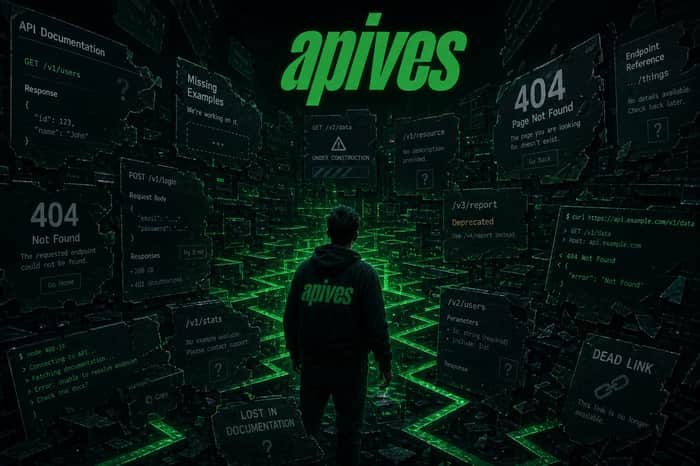
And some APIs feel like a side quest you never asked for:
pricing hidden behind “contact sales”
docs that explain everything except the thing you need
no example requests
auth instructions written like a riddle
rate limits buried somewhere on page 17
endpoints that may or may not still exist
If you’re an indie hacker, that stuff matters a lot.
Because when you’re building alone, every hour spent fighting bad docs is an hour not spent shipping your product.
That’s a big part of why I’m building Apives.
What I think is missing in API discovery
When I look for APIs, I usually want answers to very practical questions:
Is there a free tier?
Is pricing transparent?
Is this API stable enough to build on?
How does authentication work?
What does the actual request/response look like?
Can I test something quickly without building a full integration first?
A lot of API directories stop at “here’s the name and category.”
That’s useful, but not enough.
As a developer, I want the stuff that helps me decide fast:
clear pricing
stability signals
access types
real endpoint examples
actual dev usefulness, not marketing copy
So with Apives, the goal is simple:
help developers find APIs faster, evaluate them faster, and ship faster
Not by adding more fluff — by removing it.
Why this matters for indie hackers specifically
Indie hackers usually optimize for:
speed
low cost
low maintenance
flexibility
not getting trapped by a bad dependency
A good API can help you launch in days.
A bad API can quietly wreck your roadmap.
I’ve seen this happen with:
payment providers that are easy to start but painful to scale
AI APIs with unclear token costs
email APIs with poor deliverability docs
data APIs with inconsistent response formats
auth providers that look simple until you hit edge cases
“free” APIs that become expensive the moment you get traction
So choosing APIs is not just a technical decision.
It’s a product decision.
Sometimes even a business decision.
The kinds of APIs indie hackers usually care about
A few categories come up over and over:
-
Payments
The obvious one. If the integration is clunky, checkout suffers. If pricing is unclear, margins suffer. -
Auth / identity
Seems easy until you deal with sessions, tokens, social login, roles, and edge-case users. -
Email / messaging
Transactional email, OTPs, notifications, campaigns — it all sounds simple until you debug deliverability. -
AI APIs
Super powerful, but pricing, latency, model behavior, and rate limits matter more than the landing page suggests. -
Data / enrichment APIs
Can save tons of time, but quality and consistency are everything. -
Geo / maps / location
Often great APIs, but usage costs can surprise you if you don’t pay attention early. -
File, image, and media APIs
Useful for thumbnails, uploads, processing, transformations — but response speed and reliability matter a lot.
That’s why I think API discovery should feel less like browsing and more like developer due diligence.
The Apives tools I wanted as a dev
Besides API discovery, I also wanted a small toolbox for common API work.
So Apives includes free tools like:
Live API Runner – test requests quickly without setting up extra junk
JWT Decoder – because token debugging always shows up at the worst time
API Response Formatter – make ugly responses readable
cURL Converter – turn requests into code faster
Mock Server – useful when the real API isn’t ready or you just want to move
ApivesAI – AI-powered API search to find relevant APIs faster
Nothing revolutionary there.
Just useful tools devs actually need when working with APIs.
I like products that reduce friction by a few minutes at a time.
That adds up fast when you’re shipping alone.
A few things I believe about good APIs
This is probably my bias showing, but I think good APIs usually share a few traits:
-
Pricing should be obvious
If I need a detective board to understand cost, that’s already a bad sign. -
Docs should be runnable, not poetic
Show me request, response, auth, edge cases. Less marketing, more examples. -
Stability matters more than hype
A boring API that works is better than a flashy API that breaks your app on launch day. -
Free tiers matter
Especially for indie hackers validating ideas. -
Fast evaluation matters
I should be able to answer “can I build with this?” quickly.
That’s the standard I want Apives to support.
What I’m trying to build
At the end of the day, Apives is for developers who are tired of:
bloated docs
hidden pricing
weak examples
random API directories with no useful context
wasting weekends integrating the wrong service
I want it to be the place where a dev can go from:
“Need an API for this feature”
to
“Cool, I know which one fits, what it costs, how stable it is, and how to test it”
…without opening 27 tabs.
Still early, still improving, still learning.
But I think there’s real value in making API discovery more practical and less noisy.
If you’re building with APIs a lot, I’d love to know:
what makes you trust an API quickly?
what’s your biggest API-related pain point?
which tools do you keep coming back to during integration?
Always curious to hear how other indie hackers evaluate this stuff.
Apives.com: Discover APIs. Deploy Potential.
