Nobody warns you that the real risk in a classifieds marketplace isn't empty listings. It's fake ones.
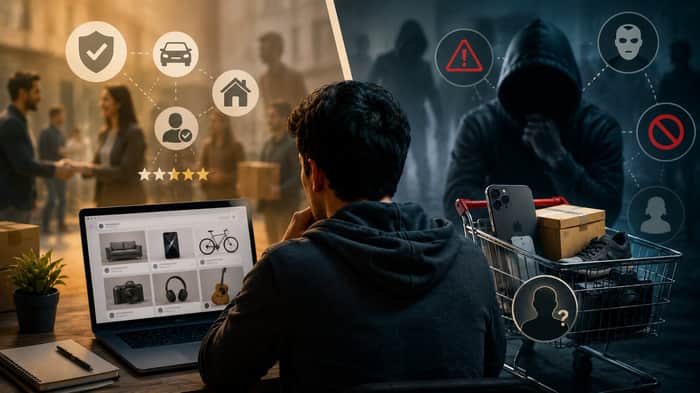
Why is trust harder to solve in classifieds than in most other marketplaces?
Because nobody vets the product before it's listed. Uber inspects a car once, Airbnb reviews a host's ID once, and both cover thousands of future rides or stays. A classifieds site gets a brand-new, unverified item and a brand-new, unverified seller every single time someone posts. Trust doesn't compound here. It resets on every listing.
That's the part I didn't plan for. I assumed the hard problem would be getting enough listings up. It wasn't. Three weeks in, the hard problem was a listing for a "barely used iPhone 13" that turned out to be a screenshot of one, posted by an account that vanished the moment a buyer asked for a video call. One bad experience like that in your first fifty transactions does more damage than a hundred empty scroll sessions ever would, because now the person doesn't just leave, they tell people your site is where you get scammed.
Should you verify sellers before or after their first listing?
After, not before. Verifying upfront kills signup momentum you don't have yet; verifying at the point of a completed transaction protects the buyer without scaring off the seller. Screening at signup felt like the responsible move, so that's where I started, and it was wrong for an early-stage marketplace.
I required a phone number and a selfie-with-item photo before anyone could post. Signups dropped by more than half in the first week I added it. Most sellers, especially the casual ones just clearing out a garage, aren't willing to jump through verification hoops for something they're not sure will sell anyway. What worked instead was letting anyone list freely, then adding a lightweight verification step (photo match, phone confirmation) that only triggers once a buyer expresses real interest, right before contact details get exchanged. The friction shows up exactly where it protects someone, and nowhere else.
What moderation approach actually scales when you're a team of one?
Not full-time manual review, and not full automation either. It's a narrow rule engine that flags obvious patterns (stock photos, prices far below market, brand-new accounts posting high-value items) for a human to glance at, instead of a person reading every listing.
I tried reviewing every new listing by hand for the first month. It worked, and it also ate four hours a day I didn't have. What I built after that was much dumber than I expected it to need to be: a handful of if-this-then-flag rules, reverse image search on anything above a certain price point, and a manual queue that's usually under ten items a day instead of every listing on the site. It's not sophisticated. It catches maybe 70% of the obviously bad stuff, and that 70% turned out to be most of what would've actually hurt someone.
Is a public reviews system worth building early, or is it premature?
Premature, almost always. Reviews only work once you have repeat transaction volume, and early marketplaces don't have that yet. A review section with four ratings on it reads as more suspicious than no review section at all.
I built a full star-rating and written-review system in month one, expecting it to be a trust signal. It sat mostly empty and, if anything, made the site look less credible, not more. A near-empty review page quietly tells a visitor "almost nobody uses this." I ended up hiding it until there was enough transaction volume for reviews to actually mean something, and used simpler trust signals in the meantime, verified badges, response-time indicators, account age, that don't depend on volume to look legitimate.
Anyone else building in this space run into a specific trust problem that the standard marketplace playbooks don't cover? Most of what's written out there assumes a service marketplace with some built-in accountability. Physical goods from strangers seem to be a different animal, and I'm still finding the edges of it.
