Remote Business Setup in the US: What Founders Outside America Actually Need to Know
Remote U.S. business formation lets entrepreneurs form a company, obtain an EIN, and open a business bank account without visiting the U.S. While formation can take 5–15 business days, EIN processing, banking, and ongoing tax requirements may take longer.
What Does "Remote Business Setup" Actually Require?
- Forming an entity. This is officially creating an LLC or corporation by filing Articles of Organization or Articles of Incorporation, respectively, with the Secretary of State. Wyoming, Delaware, and New Mexico are the more common state choices for out-of-state residents forming a business due to lower formation costs, no state income taxes, and less burdensome reporting requirements.
- EIN. An EIN is a nine-digit number issued by the IRS. An LLC must have one to conduct business, open a bank account, and carry out other similar activities.
- A registered agent. Every state requires a business to have a registered agent with a physical address in that state. This is the address where important legal documents are served on the business.
A Social Security number and a green card are not required for any of the above. However, recent regulatory changes in 2023 by the IRS and other US government agencies have slowed and restricted the processing of business formation documents.
How Long Does a Remote Business Setup Take, Realistically?
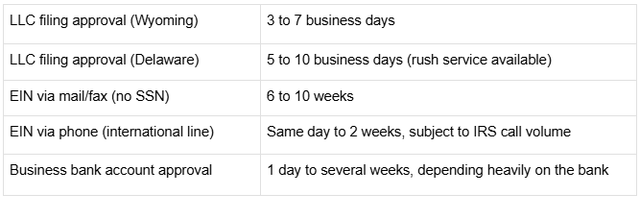
Obtaining an EIN can be one of the biggest delays for remote business founders. Applicants without an SSN or ITIN may need to use fax, mail, or the IRS international phone line, which can take significantly longer than state formation.
Many founders expect to receive their LLC and EIN within a few weeks, but EIN processing can take longer, making it important to plan ahead.
Common Mistakes Founders Make During a Remote Setup
- Choosing a state based only on formation costs. Formation fees vary by state, but founders should also consider annual fees, registration requirements, investor preferences, and future fundraising plans. Delaware may be preferable for businesses planning to raise institutional funding or go public.
- Applying for an EIN before forming the LLC. An EIN is tied to a legally formed entity, so the LLC should be approved before applying for an EIN.
- Assuming every bank supports remote account opening. Many U.S. banks require founders to visit a branch. Non-resident founders may need to look for banks that support remote business account opening.
Overlooking BOI requirements. Beneficial Ownership Information (BOI) reporting requirements can apply to U.S. businesses. Founders should check the latest FinCEN rules and exemptions before filing. - Forgetting annual registered agent fees. Registered agent services typically require annual renewal fees in addition to state fees. Missing a renewal can lead to compliance issues or notices from the state.
Do Non-Resident Founders Have to Pay U.S. Taxes?
Non-resident-owned U.S. businesses may not owe U.S. income tax if they have no U.S. employees, offices, or effectively connected income, but they may still have annual filing requirements. For example, a foreign-owned single-member LLC may need to file Forms 1120 and 5472, with penalties of up to $25,000 for noncompliance.

What made you pick this stack over the alternatives?
Makes sense. Are you planning to charge for it, or keep it free for now?
Appreciate the honesty here, most people only share the wins.
Interesting take. Would you still recommend this approach to someone starting today?
Really relatable. How much time do you put into this each week?
Interesting. How are you measuring whether it is working?
Makes sense. Are you planning to charge for it, or keep it free for now?
Interesting approach. What was the hardest part to get right?
Really relatable. How much time do you put into this each week?
Great breakdown. What feedback have you had from early users?
Thanks for sharing the numbers, that makes it much easier to follow.
Appreciate the honesty here, most people only share the wins.
Appreciate the honesty here, most people only share the wins.
Appreciate the honesty here, most people only share the wins.
Love this angle, honestly. What made you look into it in the first place?