Stop Treating Prompts Like Throwaway Messages
We’re entering a phase where writing software feels closer to having a conversation than writing strict syntax.
Natural language is becoming the interface.
And that changes everything.
Tools like Lumra are emerging not because they’re “nice to have” — but because the way we work with AI is fundamentally shifting.
The Real Problem Isn’t AI — It’s How We Use It
Most workflows today still look like this:
- Open a chat
- Type something quickly
- Get a result
- Move on
No structure. No reuse. No improvement loop.
Which leads to:
- Rewriting the same prompts over and over
- Losing high-quality prompts in chat history
- Inconsistent outputs
- Wasted time on trial-and-error
If prompts are becoming part of the development process, this approach doesn’t scale.
Prompts Are the New Code (But We Don’t Treat Them That Way)
Think about how we treat code:
- We version it
- We refactor it
- We organize it
- We reuse it
Now compare that to how prompts are handled.
It’s basically copy-paste chaos.
This is where Lumra quietly changes the game — by treating prompts like first-class assets, not disposable inputs.
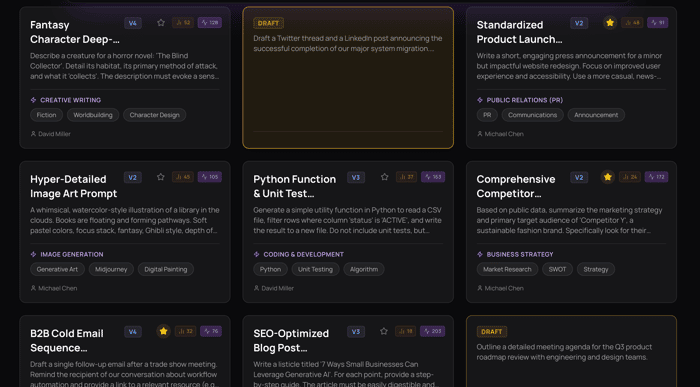
What a Structured Prompt Workflow Looks Like
Instead of randomness, you get systems:
Prompt Chaining
Break complex tasks into smaller, reusable steps.
More control, better outputs, less noise.
Versioning
Iterate on prompts like you would with code.
Small improvements compound over time.
Drafts & Categorization
No more lost ideas or scattered notes.
Everything lives in an organized, searchable structure.
Everywhere Access
VSCode, Chrome, Web — your prompt library follows you.
No context switching, no friction.
The Compounding Effect Most People Miss
The difference between:
“let me try another prompt”
and
“I have a refined, versioned prompt system for this”
…is massive.
One is guessing.
The other is engineering.
And that gap grows over time.
The Shift Is Already Happening
We’re moving from:
- writing instructions → designing systems
- asking questions → building workflows
- generating outputs → refining pipelines
At that point, randomness just doesn’t make sense anymore.
So Why Are We Still Improvising?
If better structure = better results
and
better results = less time + higher quality
Then continuing with scattered prompts is just friction we’ve accepted.
Platforms like Lumra exist to remove that friction — not by adding complexity, but by giving prompts the structure they’ve been missing all along.
Less guessing. More systems. Better outcomes.

Really like this framing — especially ‘prompts as code’. The gap between random prompting vs structured systems is very real.
But I think there’s an interesting layer on top of this — even with well-structured prompts, most early-stage builders still struggle with one thing: getting real validation fast.
I’ve been seeing some founders run small, capped experiments (like fixed low entry, limited slots, high upside) to test demand quickly alongside building systems — and it’s surprisingly effective.
Feels like this approach + something like Lumra could actually complement each other well. Curious if you’ve explored validation loops like this?
Really like the framing here, especially the shift from random prompting to repeatable systems.
I think there is one more layer to this once prompts start touching real front-end projects: structure alone is not enough. You also need continuation inside the actual workspace. Once HTML, CSS and JS are already alive, the hard part becomes making focused changes without losing context, breaking the preview, or rewriting too much.
That is where the workflow starts to matter more than the prompt itself.