Top 10 Warning Signs Your SaaSProduct-Market Fit Is Expiring
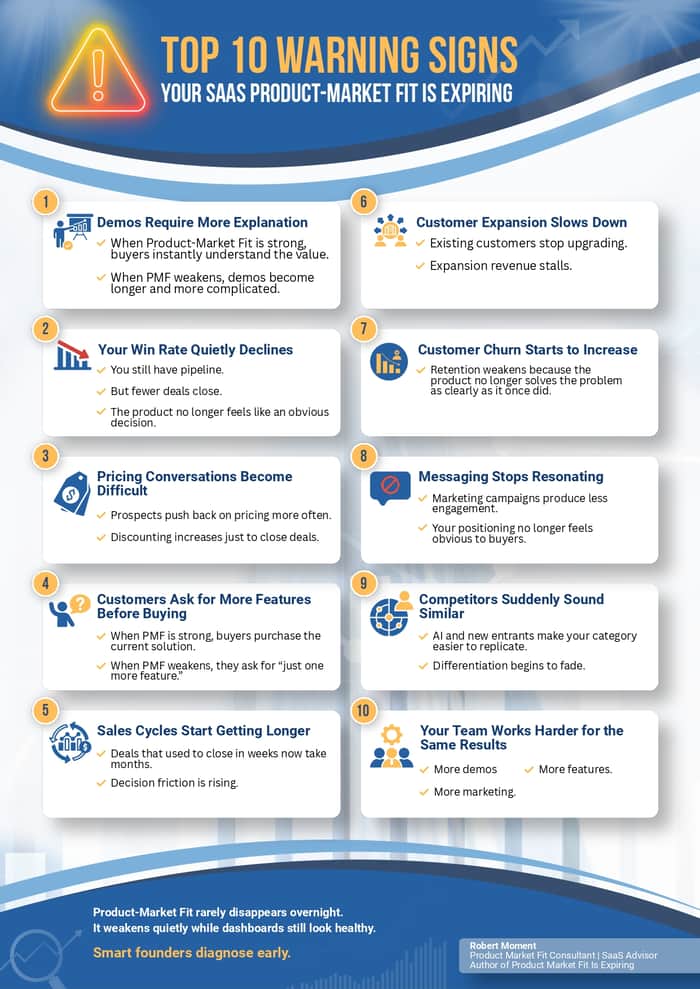
How SaaS Founders Can Diagnose PMF Drift Before Revenue Slows, Growth Stalls, and Competitors Win Your Customers
The Dangerous Myth Most SaaS Founders Believe About Product-Market Fit
Most SaaS founders assume that when Product Market Fit (PMF) disappears, they will see it coming. They imagine a dramatic inflection point mass cancellations, revenue collapse, a market rejection event they cannot miss. But that is almost never how Product-Market Fit loss actually unfolds.
Product-Market Fit expires quietly. It drifts. It erodes in small, almost invisible increments. And by the time most founders acknowledge the problem, they have already lost months sometimes years of competitive advantage.
This article is your definitive guide to diagnosing Product-Market Fit drift early, rebuilding your PMF before the market passes you by, and implementing actionable SaaS growth strategies that will protect and extend your PMF in an AI-driven, hyper-competitive software market.
Product-Market Fit is no longer a destination. It is a dynamic living alignment that must be continuously protected, measured, and rebuilt as markets evolve
Why SaaS Product-Market Fit Now Expires Faster Than Ever
In the early days of SaaS, a well-built product with strong PMF could sustain competitive advantage for years. Today, that window has compressed dramatically. Here is why
AI-powered competitors now launch functional MVPs in weeks, not months
Buyer expectations escalate continuously as new tools raise the baseline
Market segments fragment, meaning your ICP evolves faster than your playbook
Integration ecosystems shift, making previously essential tools suddenly redundant
Pricing compression from new entrants makes perceived value harder to defend
The result: what earned you strong Product-Market Fit 18 months ago may no longer resonate today. And the early warning signs are almost always subtlehe Top 10 Warning Signs Your SaaS Product-Market Fit Is Expiring
Warning Sign #1: Your Demos Require More Explanation
When Product-Market Fit is strong, demos feel like revelations. Prospects immediately connect what they see to a pain they have been carrying. They say things like: 'This is exactly what we have been looking for.' When PMF begins to drift, something subtly changes in the room or on the Zoom screen.
Your sales team starts front-loading context. Reps say things like 'Let me walk you through how this works' before a single feature has even been shown. The product still functions. The demo still runs. But the value is no longer self-evident. Buyers are cognitively working harder to connect the dots between your product and their problem.
This is one of the earliest and most underappreciated warning signs of PMF erosion. When buyers must think harder to understand value, conversion rates declin even when lead quality remains constant. The problem is rarely the demo. It is almost always a widening gap between your product's positioning and your buyer's current worldview.
Coaching Questions
When prospects see your product for the first time today, do they instantly recognize the value
or do they need context first?
What part of your demo required the least explanation 12 months ago that now requires the most?
Are your best sales reps compensating for a positioning problem with exceptional presentation skills?
If a new prospect watched your demo without any narration, what would they understand about your value proposition?
Warning Sign #2: Your Win Rate Is Quietly Declining
A declining win rate is one of the most powerful early indicators of expiring Product-Market Fit and one of the most frequently misdiagnosed. When deals stop closing at the rate they once did, the natural reflex is to examine the sales process. Are reps following the playbook? Is qualification rigorous enough? Are proposals compelling?
These are valid questions. But when win rate decline is systemic happening across reps, segments, and channels the root cause is almost never purely a sales execution problem. It is a PMF problem. Your product simply feels less inevitable to buyers than it once did.
Strong Product-Market Fit creates buying urgency. Prospects move quickly because they perceive a clear gap between where they are now and where your product can take them. When PMF weakens, that urgency evaporates. Deals stall, alternatives feel more appealing, and 'no decision' becomes the most common outcome.
Track your win rate on a rolling 90-day basis, segmented by deal size, industry vertical, and buyer persona. A consistent 5–10 percentage point decline over two quarters is a serious signal that warrants immediate investigation.
Coaching Questions
What is your current win rate versus 12 months ago for your primary ICP?
Are you losing more deals to competitors, or to 'no decision'? Each signals a different PMF problem.
Which specific objections have increased most significantly in the past two quarters?
Are there buyer segments where your win rate has held steady or improved? What is different about them?
Warning Sign #3: Pricing Conversations Have Become Uncomfortable
Pricing pressure is one of the most deceptive symptoms of expiring Product-Market Fit because founders almost always treat it as a pricing problem rather than a value problem. When buyers push back on price, the instinctive response is to discount, restructure the offer, or build a more elaborate ROI justification
But when Product-Market Fit is strong, buyers rarely challenge pricing at all. They compare the cost of your product against the cost of the problem you solve and the math feels obvious. Pricing discomfort almost always signals that perceived value has declined relative to the price point, not that the price itself is wrong.
The questions you should be asking are not 'How do we justify our pricing?' but rather 'Why has the perceived value of our product declined in the mind of our buyers?' That is a PMF question, not a pricing question.
Coaching Questions
Have pricing objections increased over the past two to three quarters?
Are buyers comparing you to lower-cost alternatives they would not have considered previously
What is the ROI buyers articulate for your product today compared to two years ago?
Are different buyer segments experiencing pricing friction differently? What does that reveal about your ICP?
Warning Sign #4: Sales Cycles Are Consistently Getting Longer
Every experienced SaaS leader knows that sales cycles naturally fluctuate based on deal size, buyer sophistication, and macroeconomic conditions. But consistent, structural lengthening of sales cycles particularly in your core ICP is a reliable warning sign of PMF drift.
When Product-Market Fit is strong, deals move with momentum. There is urgency on the buyer's side that compresses the decision timeline. When PMF weakens, that urgency dissipates. Buyers schedule more discovery meetings. More stakeholders get pulled in. Proof of concept requests multiply. The buyer needs more reassurance before committing because the value is no longer self-evident.
The danger of lengthening sales cycles extends beyond revenue timing. Longer cycles mean more resources spent per deal, lower rep productivity, more exposure to competitive displacement, and
most critically a signal that your product is being evaluated rather than desired.
Coaching Questions
How has your average sales cycle length changed over the past four quarters?
At which stage of the sales process are deals most frequently stalling today?
Are you receiving more POC or pilot requests than you did 12 months ago?
What does your win rate look like on deals where the sales cycle exceeds your historical average?
Warning Sign #5: Prospects Are Asking for 'Just One More Feature' Before Buying
Feature requests during the sales process are often interpreted as engagement signals
evidence that the prospect is invested enough to envision a future with your product. But when feature requests become a consistent prerequisite for advancement, they frequently signal something more troubling: uncertain value.
When buyers say 'If you add this capability, we will move forward,' they are often articulating a gap between their current pain and the value your product visibly delivers. They are asking for more because what they see does not yet justify the commitment. The additional feature is not really what they need certainty is what they need.
This does not mean you should ignore all pre-sale feature requests. But when the pattern is persistent when deals consistently require product additions before advancing the root cause is usually a positioning or PMF problem, not a feature gap.
Coaching Questions
What percentage of deals in your pipeline include pre-sale feature requests as a condition of advancement?
Are the feature requests clustered around a specific use case or buyer persona?
When you have delivered requested features, did it reliably accelerate the deal or did new requirements emerge?
What would need to be true for buyers to feel confident in current product value to commit without additional features?
Warning Sign #6: Customer Expansion Revenue Is Slowing
Net Revenue Retention (NRR) is the single most powerful metric for measuring the true depth of Product-Market Fit in a SaaS business. When customers expand adding seats, upgrading tiers, purchasing additional modules it signals that your product is generating compounding value in their organization. Expansion is customers voting with their budgets.
When expansion slows, the warning signal is often misread as an operational challenge a gap in the customer success motion or insufficient account management coverage. These are worth examining. But persistent, cross-segment expansion slowdown usually indicates that customers are plateauing in the value they derive from your product.
They continue using it. They may even remain satisfied. But they do not feel urgency to invest further. Satisfied customers are not the same as customers experiencing compounding value. You need the latter to drive expansion and expansion is what separates elite SaaS businesses from average ones.
Coaching Questions
What is your current NRR, and how has it trended over the past four quarters?
What percentage of your ARR growth comes from existing customer expansion versus new customer acquisition?
Among your highest-expanding customers, what usage patterns or behaviors do they share?
What would need to change in your product or customer success motion to make expansion feel inevitable for more customers?
Warning Sign #7: Customer Churn Is Gradually Increasing
Churn rarely spikes suddenly in a healthy business. It almost always increases gradually a percentage point here, a cohort underperforming there. By the time churn becomes undeniable on your dashboard, the PMF problem has typically been developing for six to twelve months.
The most dangerous form of churn is 'silent churn' customers who continue paying but have disengaged. They are not yet canceling, but they are no longer achieving outcomes, no longer advocates, and no longer expanding. They are waiting for a compelling reason to leave, or for a competitor to make switching easy enough.
Rising churn signals that your product is losing its must-have status. As optional software, it becomes the first line item cut when budgets tighten, leadership changes, or a newer alternative emerges.
Coaching Questions
What is your current gross and net churn rate, and how has it changed over the past year?
What percentage of churned customers cite product dissatisfaction versus pricing, budget, or strategic change?
Are there specific customer segments, cohorts, or use cases with disproportionately high churn?
What is the average product usage level of customers who churn versus those who renew and expand?
Warning Sign #8: Your Ideal Customer Profile Has Quietly Shifted
One of the most insidious forms of PMF drift happens not because your product changed, but because the market around it evolved. The buyers who represented your strongest PMF three years ago may no longer be your best customers today and your product may now resonate most strongly with a different buyer you have not yet fully recognized or pursued.
This ICP drift manifests subtly: your best new customers look different from your original customers, win rates are highest in segments you have not prioritized, and your existing playbooks feel less effective than they once did. If you are still targeting an ICP defined two or three years ago, you may be investing in the past.
Revisiting and validating your ICP is not an admission of failure it is a competitive discipline. The most resilient SaaS companies treat ICP as a living definition, continuously refined by real customer data, not historical assumptions.
Coaching Questions
When did you last rigorously validate your ICP against real sales and retention data?
Who are your ten highest-value customers today, and how do they compare to your ten highest-value customers three years ago?
In which segments are you seeing the highest win rates and fastest sales cycles right now?
Are there emerging buyer personas showing strong engagement that you have not formally built a motion around?
Warning Sign #9: Competitive Differentiation Is Getting Harder to Articulate
In a market with strong Product-Market Fit, differentiation feels effortless. Your team knows precisely why you win. Buyers understand why you are different. Your positioning is clear, confident, and consistently communicated at every stage of the funnel.
When PMF begins to drift, differentiation becomes murky. Sales reps give inconsistent answers. Marketing messaging feels vague. Leadership debates positioning in every strategy session. Differentiation claims that once felt powerful now feel defensive.
This happens because differentiation is a function of two variables: your product capabilities AND the market context those capabilities exist within. As the market evolves, competitors catch up, and what once felt distinctive now feels standard. If you cannot articulate in a single sentence why a buyer should choose you over every alternative including doing nothing your differentiation has weakened.
Coaching Questions
Can every member of your sales team articulate your differentiation consistently and confidently in one sentence?
What capabilities or attributes did buyers cite as your key differentiators 18 months ago? Are those still true?
When prospects evaluate alternatives, which competitors appear most frequently and why do you win or lose against them?
What would a buyer lose that they could not easily replace if your product ceased to exist tomorrow?
Warning Sign #10: Your Team Has Stopped Talking to Customers
Of all the warning signs on this list, this may be the most preventable and the most common. As SaaS companies scale, the distance between leadership, product, and the actual customer grows. Executive teams spend more time on internal operations and investor relations. Product teams focus on delivery velocity. Sales teams focus on quota. And the discipline of deep, regular customer conversation quietly disappears.
Customer conversations are the immune system of Product-Market Fit. They surface emerging needs, reveal friction, expose competitive threats, and validate or challenge every assumption the business is built on. Without them, PMF drift can go undetected for quarters.
The best SaaS founders treat customer conversation not as a research activity but as a strategic discipline. They do it consistently, personally, and treat what they hear as real-time intelligence about the state of their PMF.
Coaching Questions
How many customer conversations did you personally conduct last month not surveys, but real conversations?
When customers describe the problems your product solves, do their descriptions match the language your team uses internally?
What percentage of your product roadmap is driven by real customer insights versus internal assumptions?
If you discovered today that your PMF was eroding, would your current feedback systems surface that signal in time to act?
5 Powerful Strategies to Rebuild and Protect Your SaaS Product-Market Fit
Strategy #1: Conduct a PMF Audit with Real Customer Data
Before you can rebuild Product-Market Fit, you must accurately diagnose its current state. A PMF Audit is a structured, data-driven process that combines quantitative metrics with qualitative customer insights to map the true health of your product-market alignment.
Start by pulling your core PMF metrics: win rate trends, churn by cohort, NRR trajectory, sales cycle length, and feature request frequency during the sales process. Map these against a timeline and look for inflection points. Then go deeper with voice-of-customer research structured interviews with your best customers, recently churned customers, and recently lost deals. The patterns that emerge will tell you more about your PMF state than any dashboard.
Strategy #2: Revalidate and Redefine Your ICP
Your Ideal Customer Profile is not a static document. It is a hypothesis about who experiences the most value from your product and that hypothesis must be tested against real data continuously. Build a Customer Value Matrix that maps your current customers across two dimensions:
the value they derive from your product and their strategic fit for your business. The customers in the high-value, high-fit quadrant are your true ICP and they may look different from who you thought.
Once you have a data-validated ICP, rebuild your positioning, messaging, and go-to-market motion around those customers. Then ask: where are there more of them?
Strategy #3: Rebuild Differentiation Around Outcomes, Not Features
The most common differentiation mistake SaaS founders make is competing on features. Features can be copied. Outcomes specific, measurable results your customers achieve are much harder to replicate because they depend on the entire system of your product, your customer success motion, and your institutional knowledge.
Conduct an Outcomes Audit with your best customers. Ask specifically: what has changed in their business since implementing your product? Rebuild your positioning and sales narrative around those documented outcomes. Outcome-based selling is more compelling, more defensible, and the foundation of durable PMF.
Strategy #4: Implement Continuous PMF Monitoring
The companies that sustain Product-Market Fit across market cycles monitor it continuously and systematically. Track your PMF metrics monthly win rate, churn rate, NRR, sales cycle length and build a PMF dashboard that surfaces trends, not just snapshots. A single data point tells you very little. Directional trends tell you everything.
On the qualitative side, commit to a specific number of deep customer conversations per month at the executive level. This intelligence where the customer's business is going, how your product fits into that future is irreplaceable
Strategy #5: Build a PMF Recovery Playbook Before You Need It
The worst time to develop a strategy for addressing PMF erosion is after it has already become a crisis. Build a PMF Recovery Playbook proactively a documented process for diagnosing, responding to, and recovering from PMF drift before it reaches critical levels. Your playbook should define the threshold metrics that trigger a PMF review, the team responsible, the sequence of corrective actions, and the success criteria for recovery.
Having this playbook in place means you will respond with urgency and precision rather than hesitation and improvisation when the signals appear.
10 Frequently Asked Questions About SaaS Product-Market Fit Expiration
FAQ #1: What Is Product-Market Fit and Why Does It Expire?
Answer 1: The Definition
Product-Market Fit is the degree to which your software product satisfies a strong, active demand in a specific market segment. When you have strong PMF, your product solves a significant problem for a well-defined group of buyers who are willing to pay your price, recommend your product to others, and expand their investment over time.
Answer 2: Why PMF Was Once Considered Permanent
In earlier SaaS market cycles, strong PMF was often treated as a durable, long-term asset. If you found the right market and built the right product, competitors faced enormous barriers to displacing you. Network effects, switching costs, and data moats created natural defenses that protected PMF for years.
Answer 3: Why PMF Now Expires Faster
The AI revolution has compressed the timeline for PMF erosion dramatically. New entrants can now build functional SaaS products in a fraction of the time previously required. AI-powered capabilities that once represented years of R&D investment can now be replicated in months. Competitive moats that once protected PMF for years now protect it for 12 to 24 months at best.
Answer 4: The Role of Buyer Expectation Inflation
PMF also expires because buyer expectations continuously escalate. As new tools raise the baseline of what 'good software' looks like, your product must continuously evolve to meet rising expectations or it will feel progressively less impressive even if it has not technically degraded. The market moves; your PMF must move with it.
Answer 5: How to Think About PMF as a Dynamic State
The most useful mental model for PMF in the current market is not a destination but a dynamic equilibrium a continuous alignment between your product and a market that is itself continuously evolving. Maintaining that equilibrium requires active investment, not passive protection.
FAQ #2: How Can I Tell the Difference Between a Sales Problem and a PMF Problem?
Answer 1: The Key Diagnostic Test
The clearest way to distinguish between a sales problem and a PMF problem is to examine where in the funnel friction exists. If top-of-funnel metrics are strong but conversion rates are declining, the problem is more likely PMF-related. A sales execution problem typically produces inconsistent results across reps; a PMF problem produces consistent declines across the entire team.
Answer 2: Win Rate by Segment Analysis
Segment your win rate by buyer persona, industry vertical, deal size, and competitive context. If win rates are declining uniformly across all segments, this is almost certainly a PMF issue. If the decline is concentrated in specific segments while others hold steady, you may have discovered ICP drift a PMF problem in some segments, coexisting with strong PMF in others.
Answer 3: The Customer Language Test
Ask your sales reps what language buyers use to describe their problems in discovery calls today then compare that language to your marketing and sales materials. When PMF is strong, buyer language and seller language naturally align. When PMF is weakening, a gap emerges. If reps must 'translate' buyer problems into your product's value language, you have a positioning problem.
Answer 4: The Objection Analysis
Map your most common objections by category: feature gaps, pricing concerns, competitive alternatives, urgency objections, and stakeholder alignment issues. When feature gaps and competitive alternatives dominate, the root cause is typically PMF. When urgency and stakeholder alignment dominate, the root cause is more likely sales execution.
FAQ #3: What Metrics Should I Track to Monitor Product-Market Fit Health?
Answer 1: The Sean Ellis PMF Score
The Sean Ellis PMF benchmark measuring what percentage of your customers would be 'very disappointed' if your product ceased to exist remains one of the most direct indicators of PMF strength. A score above 40% is considered indicative of strong PMF. Track this quarterly with a statistically significant customer sample, and watch for downward trends as carefully as you watch revenue metrics.
Answer 2: Net Revenue Retention
NRR is arguably the single most important quantitative PMF metric. It captures whether existing customers are generating more or less revenue over time, incorporating both churn and expansion. Elite SaaS businesses maintain NRR above 120%. NRR declining below 100% is an urgent signal of eroding PMF.
Answer 3: Win Rate and Sales Cycle Length
Track win rate and sales cycle length on a rolling 90-day basis, segmented by your primary ICP. These two metrics together provide a real-time proxy for market resonance how strongly buyers respond to your product and how urgently they act. Consistent decline in win rate combined with increasing sales cycle length is one of the most reliable early indicators of PMF drift.
Answer 4: Product Engagement Depth
Measure how deeply customers engage with your product's core value features not just logins, but the specific actions and outcomes that represent true value delivery. A decline in engagement depth among newer customer cohorts, even when retention appears stable, often signals early PMF erosion before it surfaces in churn data.
Answer 5: Customer Advocacy Rate
Track referrals, NPS scores, case study participation rates, and review generation. Customers experiencing strong PMF are natural advocates. When advocacy rates decline fewer referrals, lower NPS, reluctance to provide references it signals that the emotional connection between customer and product is weakening, often ahead of behavioral churn.
FAQ #4: How Should a SaaS Founder Respond When They Discover PMF Is Eroding?
Answer 1: Do Not Panic Diagnose
The first and most important response to discovering PMF erosion is to invest rigorously in diagnosis before taking action. PMF erosion has multiple potential root causes market evolution, ICP drift, competitive displacement, product stagnation, positioning misalignment and the corrective action depends entirely on the root cause. Acting before diagnosing is one of the most common and expensive mistakes SaaS leaders make.
Answer 2: Return to Customer Conversations
Regardless of what your data tells you, the most important first step is to re-establish direct contact with customers. Conduct structured interviews with your best customers, your churned customers, and your recently lost deals. Listen for patterns. What has changed in their businesses? What problems are they now prioritizing? The answers will form the foundation of your recovery strategy.
Answer 3: Narrow Before You Expand
When PMF is eroding, the instinctive response is often to expand to add features, pursue new segments, broaden the product. But the more effective response is almost always to narrow: identify the customer segments where PMF remains strongest, double down on serving those customers exceptionally, and rebuild from that foundation.
Answer 4: Rebuild Positioning Before Rebuilding Product
Before assuming PMF erosion requires a product overhaul, examine whether your positioning has kept pace with market evolution. Often, the product is more capable than buyers realize the problem is that your positioning and sales narrative have not evolved to communicate value in the language buyers now use. Repositioning is faster, cheaper, and often more impactful than rebuilding product.
FAQ #5: How Does Artificial Intelligence Impact SaaS Product-Market Fit?
Answer 1: AI as a Compression Force on PMF
Artificial intelligence is the most powerful compression force ever applied to SaaS Product-Market Fit dynamics. It has simultaneously made it easier to build new products, easier to copy existing capabilities, and faster to launch. Competitive moats that once protected PMF for years now erode in months.
Answer 2: AI as a Tool for Rebuilding PMF
The same AI capabilities that threaten your PMF also create opportunities to rebuild and extend it. AI enables SaaS products to deliver increasingly personalized, predictive, and automated value capabilities that can deepen customer engagement, increase switching costs, and create new forms of differentiation that purely feature-based competitors cannot easily replicate.
Answer 3: The Importance of AI-Powered Outcomes
The SaaS products that sustain strong PMF in an AI-saturated market will be those that use AI not just to add features, but to deliver measurably better outcomes. If your AI capabilities produce specific, quantifiable results — time saved, revenue generated, errors prevented they become the foundation of durable differentiation.
Answer 4: Buyer Expectations in an AI-First World
Buyers now expect AI-powered capabilities in virtually every software category. The absence of meaningful AI features is increasingly a PMF liability. More importantly, buyers are developing sophisticated expectations about what AI should deliver. Surface-level AI features that do not produce tangible outcomes will accelerate buyer disappointment and PMF erosion, not prevent it.
FAQ #6: What Is ICP Drift and How Does It Relate to PMF Expiration?
Answer 1: Defining ICP Drift
ICP drift occurs when the customer profile that once represented your strongest Product-Market Fit gradually diverges from the profile of your best new customers. It happens because your product evolves and becomes better suited to different buyers, market conditions change, or competitive dynamics shift.
Answer 2: How ICP Drift Manifests
The most common manifestation is a growing gap between the customers described in your go-to-market strategy and the customers who actually represent your best retention, expansion, and advocacy metrics. Your sales team pursues the customers you told them to pursu but those customers are no longer your strongest PMF customers.
Answer 3: Diagnosing ICP Drift
Conduct a Customer Value Analysis mapping all current customers by retention rate, expansion revenue, NPS score, and customer lifetime value. Identify the common attributes of your highest-value customers. Then compare those attributes to your stated ICP. The gap between these two profiles is your ICP drift.
Answer 4: Correcting Course
Correcting ICP drift requires organizational discipline because it means redirecting investment toward segments not well-established in your go-to-market motion. But building a strong motion around your true ICP
the customers who actually experience the most value
produces dramatically better unit economics than optimizing for the ICP you thought you had.
FAQ #7: Can PMF Be Rebuilt After It Has Significantly Eroded?
Answer 1: PMF Recovery Is Possible But Requires Honest Assessment
Rebuilding significantly eroded Product-Market Fit is one of the hardest challenges in SaaS leadership
but it is absolutely possible. The prerequisite is an honest, unsentimental assessment of the current situation. Founders who are emotionally attached to their original vision often underdiagnose the severity of erosion, delaying the decisive action required for recovery.
Answer 2: The Sequencing of PMF Recovery
Successful PMF recovery almost always follows a specific sequence: first, stabilize
protect your highest-value customer relationships; second, diagnose
understand the root cause through deep customer research; third, narrow
— identify where your product has the strongest resonance and double down; fourth, rebuild
address root causes; fifth, expand
once PMF is re-established in the core segment, build from that foundation.
Answer 3: The Role of Pivoting
Sometimes rebuilding PMF requires a genuine pivot
a fundamental change in who you are targeting, what problem you are solving, or how you are delivering value. Pivots are not failures; they are evidence of intellectual honesty and strategic agility. Some of the most successful SaaS businesses today were built on the foundation of a decisive, well-executed pivot away from an eroding original PMF.
Answer 4: Timeline Expectations
Rebuilding meaningful PMF typically takes 9 to 18 months of sustained, focused effort. Leaders who expect PMF recovery in 90 days almost always underinvest in the fundamental changes required.
FAQ #8: How Often Should SaaS Companies Formally Review Their PMF?
Answer 1: The Quarterly PMF Review
At a minimum, SaaS companies should conduct a formal PMF review quarterly. This review should examine quantitative PMF metrics, qualitative customer insights from recent conversations and support tickets, and competitive intelligence about new entrants, feature releases, and pricing changes.
Answer 2: The Annual PMF Audit
In addition to quarterly reviews, conduct a comprehensive annual PMF Audit
deeper examination that revisits ICP definition, positioning, differentiation claims, and product-market alignment.
This audit should involve structured customer interviews, win/loss analysis, and competitive landscape mapping.
Answer 3: Trigger-Based Reviews
Certain events should trigger an immediate PMF review regardless of the regular cycle: a significant new competitor entering your market, a meaningful acceleration in churn, a quarter where win rate declines by more than five percentage points, or a major technology shift affecting your category.
Answer 4: Making PMF Review a Cultural Practice
The most resilient SaaS organizations treat PMF monitoring not as a periodic exercise but as an ongoing cultural practice
with PMF metrics on executive dashboards alongside revenue metrics, and a shared vocabulary for discussing PMF health across leadership, product, and go-to-market teams
FAQ #9: What Is the Relationship Between Product Roadmap and PMF Protection?
Answer 1: The PMF-Roadmap Alignment Problem
One of the most common causes of accelerating PMF erosion is a product roadmap optimized for internal priorities rather than market alignment. When roadmap decisions are driven by engineering feasibility, competitive feature-matching, or the demands of the loudest customers rather than the needs of the ICP, the product gradually drifts away from strong PMF even as the team ships at high velocity.
Answer 2: Outcome-Driven Roadmap Prioritization
PMF-protective roadmap prioritization starts with customer outcomes, not features. The question should not be 'what feature should we build next?' but 'what customer outcome are we trying to enable, and is this the highest-leverage investment toward that outcome?' This shift consistently produces roadmaps more strongly aligned with PMF.
Answer 3: The Danger of Feature Bloat
A counterintuitive but well-documented PMF risk is feature bloat the accumulation of features that serve edge cases, satisfy squeaky-wheel customers, or chase competitive parity without deepening the core value. Feature bloat increases complexity, raises onboarding friction, and dilutes the core value proposition that drives your strongest PMF
.
Answer 4: Integrating Voice of Customer into Roadmap Process
Establish a formal voice-of-customer input mechanism that connects real customer insights directly to roadmap prioritization decisions. This means structured customer interviews conducted by product leaders, win/loss analysis explicitly identifying product gaps driving competitive losses, and a formal process for translating qualitative insight into quantitative prioritization criteria.
FAQ #10: What Separates SaaS Companies That Sustain PMF From Those That Lose It?
Answer 1: A Customer Obsession Culture
The single most consistent differentiator between SaaS companies that sustain PMF across market cycles and those that lose it is culture specifically, the depth and consistency of customer obsession at the leadership level. Companies that sustain PMF are those where executives maintain direct, regular contact with customers as an irreplaceable strategic discipline, not as an occasional engagement activity.
Answer 2: Willingness to Cannibalize
The SaaS companies with the most durable PMF are willing to make bold decisions that cannibalize existing revenue streams introducing new pricing models, rebuilding products when market evolution demands it, and pivoting go-to-market motions proactively rather than reactively. The willingness to disrupt yourself before competitors do is a defining characteristic of sustained PMF.
Answer 3: Disciplined Focus on Outcomes
Sustained PMF companies obsess over customer outcomes — specific, measurable results their product enables rather than product features or market share metrics. They measure success by whether customers achieve the outcomes they purchased the product to achieve, and they continuously invest in ensuring those outcomes are delivered faster, more reliably, and at greater scale.
Answer 4: Organizational Alignment Around PMF
In companies with sustained PMF, product-market alignment is not just a product or marketing responsibility it is an organizational commitment. Sales, customer success, product, and leadership all operate with a shared understanding of who the ICP is, what outcomes they seek, what value the product delivers, and what would cause PMF to erode.
Answer 5: Treating PMF as a Board-Level Priority
The most resilient SaaS companies treat Product-Market Fit as a board-level strategic priority, not just an operational metric. They discuss PMF health in board meetings alongside revenue metrics, establish clear accountability for PMF monitoring, and ensure that resource allocation decisions are explicitly informed by PMF data.
The Bottom Line: PMF Is Your Most Valuable Strategic Asset
Product-Market Fit is not a milestone you achieve once and preserve forever. It is the most valuable strategic asset your SaaS business owns — and like all valuable assets, it requires active management, continuous reinvestment, and vigilant protection.
The founders and SaaS leaders who build enduring companies will be those who recognize that in today's AI-accelerated market, the window between PMF strength and PMF erosion is shorter than it has ever been. The warning signs are subtle. The drift is gradual. But the consequences of missing those signals are severe.
The good news: every warning sign described in this article is detectable early if you build the right monitoring practices. Every form of PMF erosion is addressable if you diagnose it honestly and respond with urgency and precision.
Your PMF is expiring on a timeline. The only question is whether you will see it coming — and what you will do about it.
The founders who build generational SaaS businesses are not those who found Product-Market Fit once. They are those who rebuilt it continuously — and treated that rebuilding as their most important competitive discipline.
About the Author: Robert Moment
No-Guesswork PMF Consultant | SaaS Advisor | Author
Most SaaS companies do not lose Product-Market Fit overnight. They drift. Sales conversations require more explanation. Win rates soften. Pricing resistance appears. Competitors sound increasingly similar. Growth continues but with more effort.
Robert Moment is a No-Guesswork Product Market Fit Consultant and SaaS Advisor brought in at that exact moment when founders sense something has changed but cannot yet prove it.
He works with B2B SaaS companies scaling between $1M–$20M ARR to diagnose silent Product-Market Fit erosion, clarify positioning, tighten ICP precision, and restore demand momentum before revenue reflects the problem.
Robert's PMF Expiration Audit™ translates ambiguous signals into strategic clarity across messaging, pricing, sales velocity, retention risk, and competitive pressure. The goal is not experimentation. It is confidence.
Founders engage Robert when decisions feel heavier, growth feels less efficient, and guessing becomes expensive.
He is the author of multiple SaaS strategy books including:
Product Market Fit is Expiring
How to Find Product Market Fit for SaaS Startups
How to Scale Your SaaS Startup to $1M ARR
SaaS Sales Demo
SaaS Growth Playbook
Your SaaS Pricing is Costing You Growth
👉 Visit www.noguessworksaasstartupplaybook.com to download the FREE PMF Is Expiring Consulting Guide for SaaS Founders and learn how elite teams detect drift before ARR slows.
🔗 Follow Robert on LinkedIn: https://www.linkedin.com/in/robert-moment-pmf-consultant

Curious how long it took before you saw the first real results?
Strong list. One PMF signal that's almost never on these lists: payment failure response rate.
When a subscription payment fails and the recovery email goes out, how quickly does the customer update their card? In strong PMF conditions, customers who hit a payment failure update their card within hours — they don't want to lose access. In PMF drift conditions, they let the subscription die without taking action. They don't cancel; they just don't fix it.
This is a leading indicator that shows up before cancellation rates move. Track the median time-to-card-update after a payment failure for your cohorts over time. If it's increasing, customers are starting to weigh 'how much do I care about keeping this?' and coming up with lower answers.
The dangerous version of this signal: 'low churn' that's actually 'customers who haven't bothered to cancel yet but also won't bother to save their subscription.' Active retention vs passive non-cancellation are very different things.