Used my own project tool to document the 11 days I spent building it
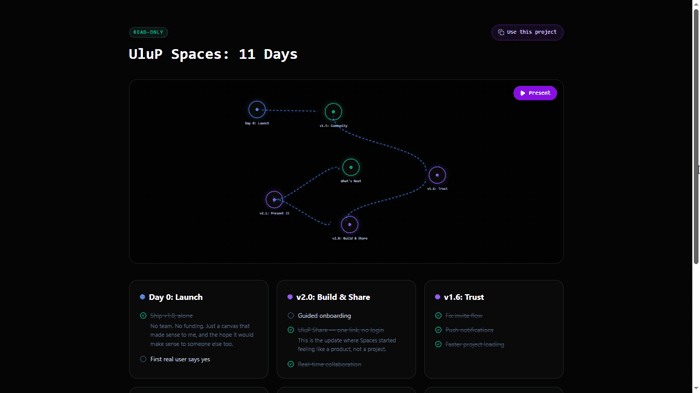
https://www.ulupspaces.com/share/3667026b-da12-410e-9e25-c943142539b1
A few days after my first post here, I hit day 11 with UluP Spaces and realized the most honest demo wasn't a screenshot — it was using the tool on itself.
So I mapped the whole build inside my own app: each node is a version shipped (v1.5, v1.6, v2.0, v2.1), each task is something that actually happened, real notes included. There's a "Present Mode" that walks through it automatically if you don't want to click around.
Curious what people here think of using a product to demo itself like this.

"The most honest demo isn't a screenshot, it's using the tool on itself" is exactly right, and stronger than you framed it. Using it on your own build shows you trust it with something that matters, the only proof that converts. Anyone can mock up a pretty node graph; few run real work through their own early product. That you did is the credibility.
The thing to lean into: this only works as a demo if the map reads to someone who wasn't there. Your build is obvious to you, you lived it. A visitor needs to see v1.5 → v2.1 and instantly get how it evolved, without narration. If they can, the tool sells itself. If not, it's a diary only you can read.
Does a stranger looking at it understand your 11 days, or need you next to it explaining?
That's the right question, and here's my honest answer: Present Mode actually solves the "which order" part directly; it walks a stranger through v1.5 to v2.1 automatically, no guessing where to look next.
What I haven't formally tested is whether the content of each step reads clearly without me narrating; the sequence is guided, but comprehension still depends on whether the notes on each node land on their own. Good callout, going to actually check that with someone who's never seen it.
Present Mode solving sequencing is bigger than it sounds, "which order do I read this in" is where most project maps lose a stranger. You've isolated the remaining risk right: guided sequence, per-node comprehension untested.
A clean way to test: sit a fresh person in Present Mode and say nothing. Just watch. Every place they pause, squint, or ask "what's this" is a node whose notes don't stand alone. Don't explain when they get stuck, that contaminates it, the point is finding what fails without you. Their confusion is the data.
The bar isn't "do they understand everything," it's "can they reconstruct your 11 days from the nodes alone." If yes, the tool sells itself. If not, each stuck node is a specific fix, not a vague "make it clearer."
This is a much better test protocol than what I had in mind, thank you. Their confusion is the data and don't explain when they get stuck that's exactly right, and I wouldn't have thought to stay silent through the stuck moments.
Doing this today. Will actually report back with what specifically failed, not just "it went well" or "it needs work." Thank you again!