We added a user-controlled speaking note for multilingual meetings — useful or distracting?
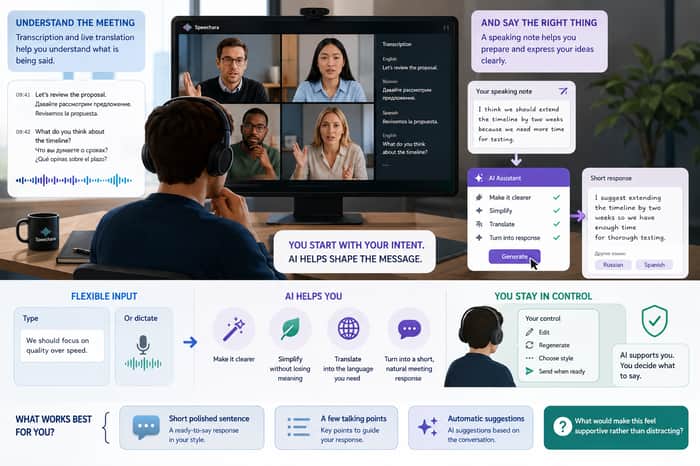
Transcription and live translation solve one half of a difficult meeting: understanding what is being said.
The other half is finding the right thing to say yourself.
Sometimes the answer is obvious. Sometimes the conversation is moving quickly, you are speaking in a second language, and you need a little help forming a clear response in context.
Speechara already has automatic suggestions in the chat. They are useful for some people and distracting for others, so we did not want to make them the center of the experience.
Instead, we added a user-controlled speaking note. Before or during a meeting, you can type a few rough points - or dictate them by voice - and ask the built-in AI to:
- make the note clearer and easier to say out loud;
- simplify it without losing the meaning;
- translate it into the language you need;
- turn it into a short, natural meeting response.
The important distinction is that the user starts with their own intent. The AI helps shape the message; it does not silently decide what they should say.
We are still trying to understand whether this is a useful meeting primitive or just another panel competing for attention.
If you use an AI assistant in multilingual meetings, would a prepared speaking note help? Would you prefer a short polished sentence, a few talking points, or automatic suggestions based on the conversation? What would make this feel supportive rather than distracting?

The user-controlled part is what caught my attention.
You’ve deliberately separated “help me express what I already intend to say” from the assistant deciding what I should say.
Have users actually been asking for that distinction, or is this something you’re testing before you know whether they value it?
Good question. The distinction isn’t between the assistant deciding and the user deciding - we don’t have a mode where the assistant chooses what someone should say. Chat suggestions are also user-triggered: the user asks for help, and the assistant proposes a contextual reply.
The speaking note is a second workflow. The user starts with their own point and asks AI to make it clearer, more natural, or translate it. We’re testing whether users find value in having both options: asking for a contextual reply when needed, or preparing their own message more deliberately.
That makes sense. The distinction between helping someone formulate their own intent and generating a response for them is an interesting product boundary.