We tested our hallucination checker against ChatGPT and a dedicated checker. The results surprised us.
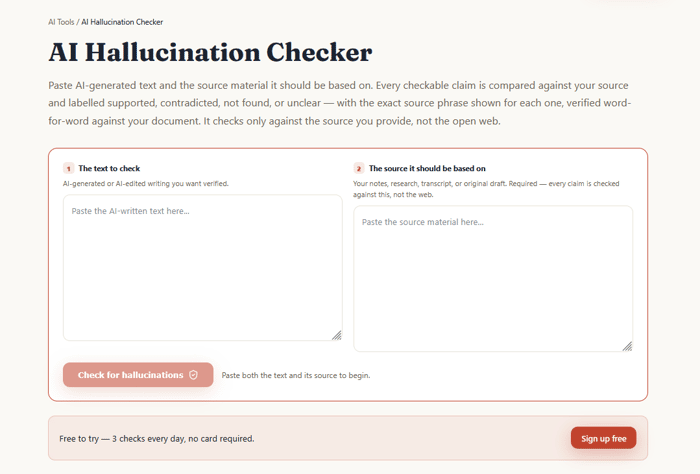
We built a tool that checks AI-rewritten text against your original source — not the open web, your actual document (https://letsflw.com/tools/hallucination-checker). Before pushing it as our main feature, we wanted an honest answer to the obvious question: is this actually better than just asking an AI to check it, or a free tool built for the same job?
So we wrote four original documents, planted specific known problems into rewritten versions, and ran the same test three ways: our tool, a general-purpose chatbot, and a free dedicated hallucination-detection tool.
Against the dedicated tool, it was close. Each side caught something the other missed exactly once, and both correctly held back from flagging a claim that sounded risky but was actually accurate — the harder skill of the two.
Against the chatbot, one pattern held up across all four documents: when a source hedges something ("would likely," "suggests," "may") and the rewrite states it as certain, the chatbot's actual verdict field kept saying it passed — the real issue was buried in a footnote, not the answer itself. Five separate times. It did catch the more obvious jumps in confidence; it was specifically the subtler ones that got through.
We wrote up the whole thing here: https://letsflw.com/blog/hallucination-checker-vs-chatgpt — including where our own tool missed something a free competitor caught. Genuinely didn't expect the honest version of this post to be more useful to write than a "we win" version would have been.

It sounds like you're doing some really interesting work with your hallucination checker! I've also grappled with ensuring that AI-generated content aligns closely with original sources. One approach I've found effective is integrating tools that specifically help with content integrity.
For example, using AI-powered platforms like Scaleblogger can streamline not only the creation but also the optimization process. It helps ensure your content is not only high-quality but also relevant to SEO by scoring it against specific benchmarks. This way, you can focus on maintaining accuracy and coherence while also tackling the broader content strategy.
If you're looking for more insights into how AI can enhance both content creation and verification, it might be worth exploring automated tools that handle research and provide optimization suggestions based on your original document context. That could complement your hallucination checker nicely. Keep up the great work!