What Is Sage AI? Architecture, Compliance, and the Automation of the Financial Close
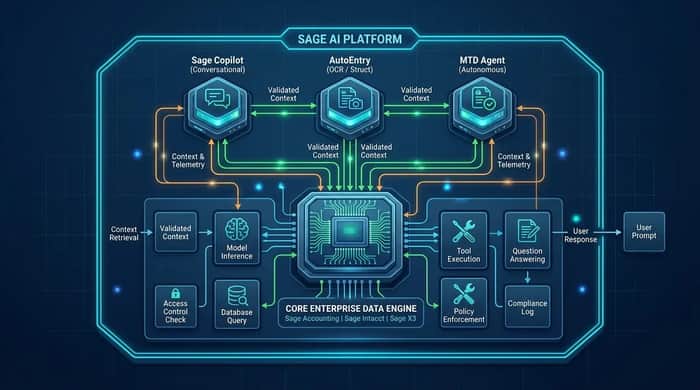
Most AI finance tools are just thin LLM wrappers over spreadsheets. But if you look closely at what legacy giants like Sage are building in 2026, there’s a massive architectural shift happening that bootstrappers and SaaS founders should pay attention to.
Here are a few technical key takeaways from our deep-dive analysis on Sage AI:
Domain Logic over Generic Inference:
Instead of feeding raw financial data into probabilistic models (and risking hallucinated balances), Sage layers AI on top of 40 years of deterministic accounting rules. The AI is constrained by double-entry accounting laws at the API layer.
The Death of "Chat Interfaces" for B2B:
The shift from Sage Copilot (asscriptive/human-in-the-loop) to autonomous agents (like their MTD Agent) proves that end-users don't want to chat with their ledger—they want sub-routines that execute entire quarter-end filings without human prompt engineering.
Contextual Persistence:
By embedding AI directly into the transactional database (Sage Intacct/X3), they eliminate the need to construct manual context windows for account charts or vendor ledgers.
Zero Data Leakage Frameworks:
Enterprise CFOs are terrified of model training leaks. Sage’s "AI Trust Label" model isolation is becoming the standard baseline for any B2B SaaS handling telemetry or financial data.
If you are building in the Fintech or B2B Agentic AI space, understanding this architecture is crucial.
Read the full technical breakdown on TheFluxRead: https://www.thefluxread.com/2026/09/what-is-sage-ai-architecture-compliance.html
