What one week of SEO actually looks like (real numbers)
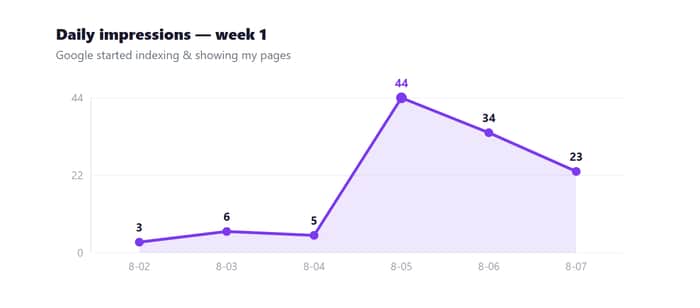
I launched the site for NotebookBloom — my Chrome extension for NotebookLM (now Gemini Notebook) — about a week ago. Here's the first Search Console report, warts and all: 115 impressions, 0 clicks, average position ~34.
Zero clicks. If you only read that number, it looks like a flop. But position 34 is page 3–4 of Google — nobody scrolls that far. Week one isn't about clicks; it's about getting indexed and seen. And that part worked: Google picked up 8 of my pages and daily impressions climbed from 3 to 44. That curve is the crawler waking up, not customers showing up.
The pattern I didn't expect: my niche pages rank best. The post on getting NotebookLM sources into Zotero sits at position 20, "search across notebooks" at 24, and my Kortex-alternative page at 10. Meanwhile the broad "bulk import" page — the one with the most impressions — is stuck at 39. Lesson: a brand-new site can't win generic terms yet, but it can break in on specific, low-competition ones. So that's where I'll double down.
The best surprise was free keyword research. The queries surfacing my pages — "download all sources from notebooklm", "how to duplicate a notebook" — don't match anything I've actually written. Google is stretching nearby pages to cover them. That mismatch is a content roadmap handed to me for free: it's a list of posts people are already searching for.
So the plan for month one: write for the gaps Search Console just revealed, strengthen the niche pages that are already ranking, and — most of all — be patient. SEO is a marathon, not a launch. I'll post these same numbers again in a month.
Building in public, one honest report at a time. 🌱
—
NotebookBloom is my Chrome extension for NotebookLM (Gemini Notebook) — real citation export (APA/MLA/Chicago/BibTeX), cross-notebook search, and Anki export with sources.
Site: https://notebookbloom.com · Chrome Web Store: https://chromewebstore.google.com/detail/fmnhogknjhlaicceielblddajjabjlha

Nice breakdown. The query mismatch is probably the most useful part here: people are searching for actions like “download all sources” and “duplicate a notebook,” not feature names. I’d turn those into very literal pages first, then link back to the extension feature once the page solves the exact task. Week one SEO is mostly finding the words users use before they know your product exists.
yeah, "the words users use before they know you exist" — i'm stealing that, it's the whole thing in one line. and the literal-page-first order is right: solve the task, then mention the tool at the end, not the other way around. one wrinkle i hit — "duplicate a notebook" is something NotebookLM just doesn't let you do, so that page can't end in "my extension does it," it has to honestly say "here's the manual workaround." kind of like it that way though. the pages that only exist to answer the question, not to sell, are the ones i'd actually trust as a reader.