Why a 2.4-Trillion-Parameter Open-Weight Model Matters: The Qwen 3.8 Bet
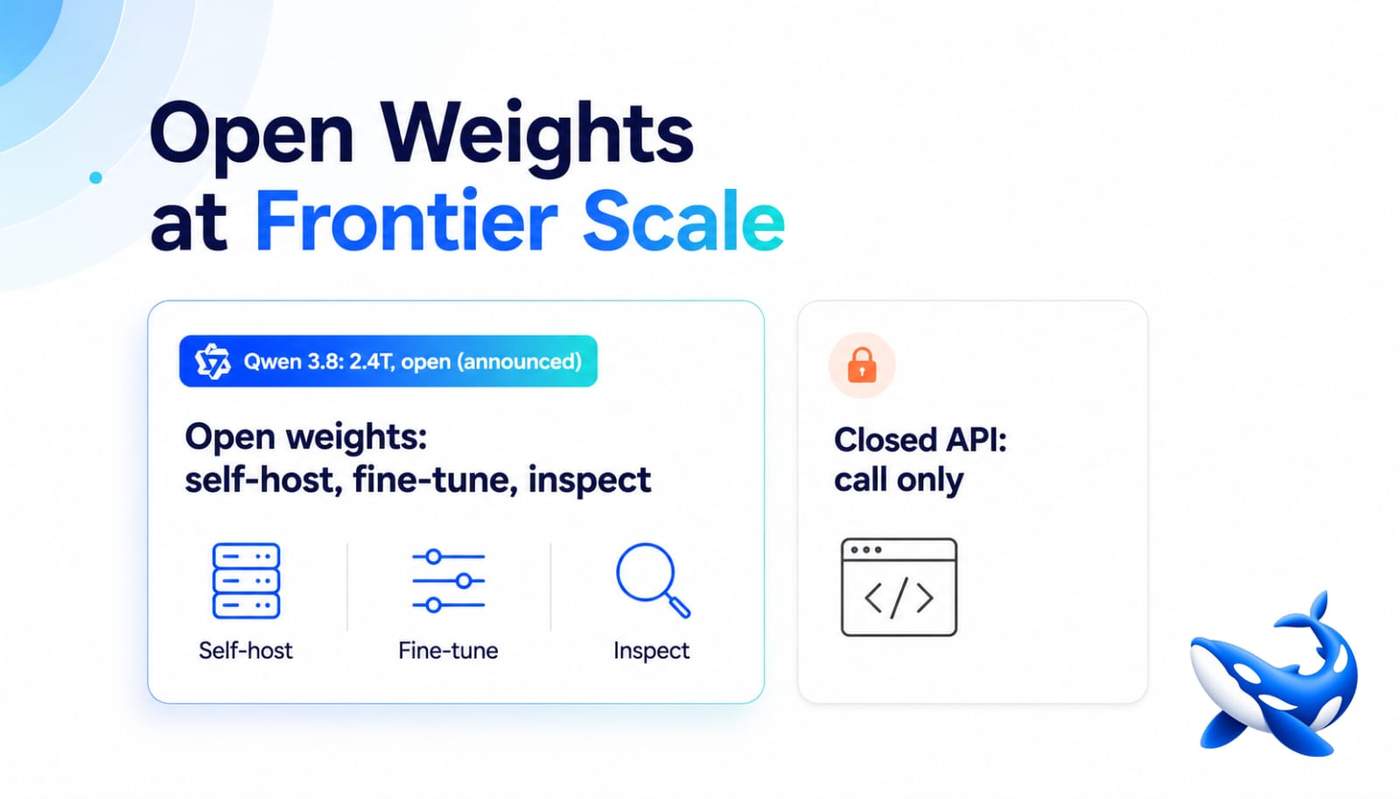
Most AI headlines are about capability — which model tops which benchmark this week. The Qwen 3.8 announcement is interesting for a different reason: not just how good it might be, but how it's being released. Alibaba announced on July 19, 2026 that its next flagship would carry a reported 2.4 trillion parameters and ship with open weights. Frontier-scale models are usually locked behind an API. Releasing one openly is a strategic bet, and it's worth unpacking why that bet matters.
To be clear about status: Qwen 3.8 is announced, not yet generally available. The 2.4T figure and open-weight plan are Alibaba's statements, and there are no independent benchmarks yet, so this article is about the significance of the open-weight move, not a performance review. It is also why keeping your stack model-agnostic matters - with a router like OrcaRouter fronting many models behind one OpenAI-compatible endpoint, adopting an open frontier model when it ships costs you almost no integration work.
What "open weights" actually means
Open weights means the trained model parameters are downloadable, so anyone can run the model on their own hardware, inspect it, and fine-tune it — rather than only calling it through a provider's API. It's the difference between owning a copy and renting access. At small scale this is common; at 2.4 trillion parameters it's rare, because both training and releasing a model this large is expensive and strategically sensitive.
Three things open frontier weights unlock
• Data control. Teams in regulated or privacy-sensitive settings can run a top-tier model entirely inside their own environment, with no data leaving their boundary — impossible with a closed API.
• Customization. Open weights can be fine-tuned on proprietary data, distilled into smaller models, or adapted to a domain, which a closed model doesn't allow.
• Competitive pressure. A capable open release forces closed labs to justify their pricing and pace, which historically pushes the whole market toward cheaper, better options.
The catch: open weights aren't free to run
A 2.4T-parameter model is enormous. "Open" means you can self-host it; it doesn't mean it's cheap or easy to. Serving a frontier-scale model demands serious hardware, and most teams will still access it through a hosted provider rather than running it themselves. So the practical value of open weights is optionality: the ability to self-host when you must (for data control or customization), while using a hosted endpoint the rest of the time. The openness is insurance and flexibility, not a guarantee of low cost.
What to watch as it ships
Two things will decide whether the bet pays off. First, whether the weights actually get released as promised, under a license permissive enough to be useful. Second, whether independent benchmarks confirm the capability — a big open model that underperforms won't move the market, while one that matches closed frontier models would be a genuine milestone. Until both land, keep the enthusiasm calibrated: this is a promising announcement, not a proven result.
How to position for it
If open weights are strategically valuable to you — for compliance, customization, or leverage — Qwen 3.8 is worth tracking closely. A low-effort way to stay ready is to wire up its model ID through an OpenAI-compatible endpoint so you can call it the day it's live. OrcaRouter tracks Qwen 3.8 and routes to it automatically on launch, so you can evaluate it against closed frontier models the moment it becomes testable, and decide then whether the open-weight advantage is worth building around.
The fine print to check on "open weights"
"Open weights" is not a single, standardized thing, and the details decide how valuable the release actually is. When Qwen 3.8's weights land, a few specifics are worth reading carefully. The license is the big one: some open releases permit commercial use freely, while others restrict it, cap usage, or attach conditions — and that determines whether you can build a product on it or merely experiment. Distribution matters too: are the full weights published, or only a subset or a quantized variant? So do the accompanying artifacts — a model card, tokenizer, and inference code make a release usable; their absence makes it academic.
There's also a difference between "open weights" and "open source." Open weights means you get the trained parameters; it doesn't necessarily mean you get the training data, training code, or a permissive software license. For most practical purposes — self-hosting, fine-tuning, data control — open weights is what matters, but it's worth knowing exactly what is and isn't included. The reason to stress this is that the strategic benefits of Qwen 3.8's openness — self-hosting, customization, independence from a vendor — all depend on the license being permissive enough to use for your purpose. A frontier-scale model released under a restrictive license is still interesting, but it delivers far less of the freedom that makes open weights compelling. Read the terms before you build on them.
Frequently asked questions
Why is an open-weight 2.4T model a big deal? Because frontier-scale models are almost always closed. An open release of one enables self-hosting, fine-tuning, and data control, and pressures closed labs on price and pace.
Does open-weight mean free or cheap? No. You can self-host, but running a 2.4T model needs serious hardware. The value is optionality, not automatic low cost.
Is the open-weight release confirmed? Alibaba has stated it will ship with open weights. Treat it as a commitment until the weights actually appear.
Can I judge its capability yet? Not independently — there are no third-party benchmarks yet. Wait for the model to be testable before drawing conclusions.
How do I compare it to closed models when it lands? Access it through an OpenAI-compatible endpoint alongside closed frontier models and benchmark them on your own tasks.
Bottom line
Qwen 3.8's most consequential feature may not be its size but its licensing: a reported 2.4-trillion-parameter model shipping with open weights would be a landmark, unlocking data control, customization, and market pressure on closed labs. The caveats are real — it's not out, the numbers are vendor-stated, and self-hosting a model this large isn't cheap. Track it, wire up the ID so you can test it on day one, and judge the open-weight bet once the weights and independent benchmarks are actually on the table.

