Why Enterprises Are Moving from Spreadsheets to Employee Recognition Platforms
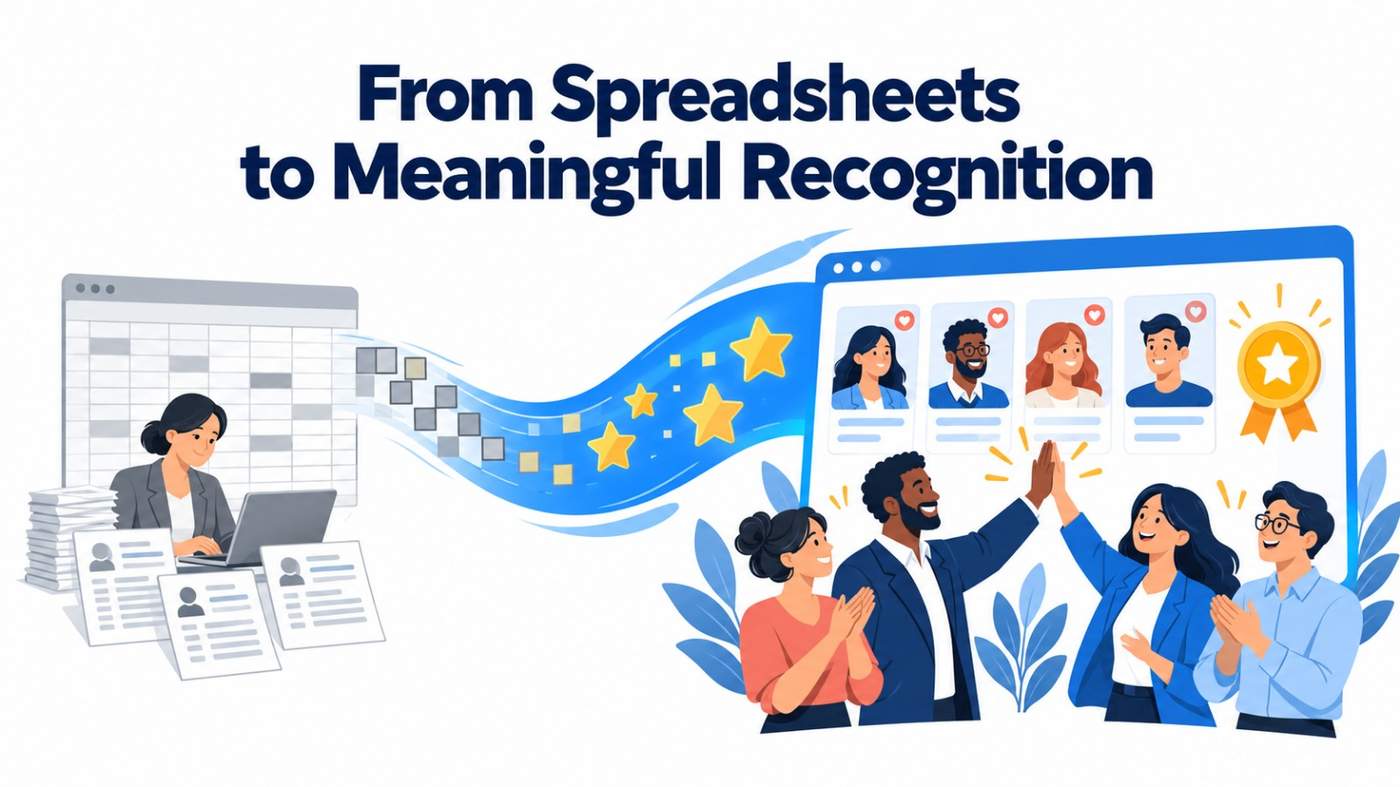
A spreadsheet can record who received an award. It cannot, on its own, make appreciation part of everyday work.
That distinction matters when employee recognition expands across departments, locations, and time zones. What begins as a manageable workbook can become a network of nomination emails, approval reminders, reward files and monthly reconciliations. HR keeps the process running, but employees may experience recognition as something that arrives late, inconsistently, or out of sight.
The case for moving to an employee recognition platform is therefore bigger than administrative convenience. It is about making recognition timely, accessible and accountable without losing the human judgment that gives it meaning.
Why do enterprises replace spreadsheets with recognition platforms?
Enterprises move from spreadsheets to recognition platforms to simplify nominations and approvals, improve reward tracking, make achievements visible, and measure participation across teams. A dedicated platform connects these activities in one workflow, helping HR manage recognition at scale while making it easier for employees and managers to participate.
Spreadsheets still have a useful role in planning, analysis, and occasional award programs. The tipping point comes when coordinating recognition consumes more effort than delivering it.
What is an employee recognition platform?
An employee recognition platform is software for managing appreciation and rewards across an organization. A leading global employee rewards and recognition platform, HiFives can support peer recognition, manager-led awards, nominations, approvals, reward points, milestone celebrations, social feeds, and reporting.
Its central advantage is connection: employee data, program rules, recognition messages and reward transactions can sit within a shared process instead of separate files and inboxes.
The hidden costs of spreadsheet-based recognition
1. Administrative work grows with every handoff
A single award may require someone to check eligibility, collect a nomination, obtain approval, confirm the budget, arrange a reward, and update a tracker. Multiply those steps across business units and award categories, and a seemingly inexpensive process becomes labor-intensive.
The useful question is not whether spreadsheet software is already paid for. It is how much recurring coordination the program requires, and what HR could do with that time instead.
2. Recognition gets trapped in the reporting cycle
When appreciation depends on a monthly consolidation exercise, an employee’s contribution can become yesterday’s news before it is acknowledged. Quarterly and annual awards remain valuable, but they serve a different purpose from timely appreciation for everyday contributions.
A stronger framework combines prompt, specific recognition with structured awards. Recognize the action while its context is fresh; reserve formal selection processes for achievements that warrant deeper evaluation.
3. Files fragment the employee experience
Separate workbooks can produce different eligibility interpretations, outdated reporting lines, and duplicate records. Cloud collaboration and access controls help, but they don't automatically connect nominations, approvals, communication, and reward delivery.
Recognition can also remain visible only to the people processing it. With appropriate permissions and employee preferences, sharing the contribution helps colleagues understand what good work looks like and join in the appreciation.
4. Reporting demands too much manual preparation
Spreadsheets can support sophisticated analysis. The practical limitation is often the work needed to collect, reconcile, and refresh the data. HR may know how much was spent but struggle to see which employees were reached, which teams rarely participated, or how long approvals took.
Centralized reporting can make these questions easier to answer. It does not, by itself, explain why a pattern exists. Low participation might reflect access barriers, unclear rules, or manager habits, rather than employee disengagement.
What should a recognition platform improve?
1. Participation within everyday work
Recognition should be easy to give without becoming thoughtless. Evaluate whether employees can participate through the channels they actually use, including collaboration tools, mobile devices, or other accessible interfaces. Confirm the depth of each integration rather than relying on a list of logos.
A frontline worker without a company email address may need a different access route from an office employee. Inclusion starts with those practical differences, not with a company-wide launch announcement.
2. Governance without unnecessary friction
Look for configurable eligibility rules, approval routes, budget allocations, role-based access, and transaction histories. The aim is proportionate control: a non-monetary thank-you should not necessarily follow the same process as a high-value annual award.
Security capabilities also require verification. Assess SSO, access restrictions, encryption, retention settings, and audit records with IT and security teams. A platform is not automatically secure simply because it replaces a spreadsheet.
3. Meaningful visibility and reward choice
Social recognition can help an individual contribution become a shared learning moment. A useful message explains what the employee did, why it mattered, and what others can learn from it. Public recognition should also respect personal preferences and the sensitivity of the work involved.
Where rewards are included, employees need clear information about point values, available choices, expiry conditions, and redemption steps. A large catalog cannot compensate for a confusing experience.
4. Useful analytics and responsible AI assistance
Prioritize measures that inform action: the percentage of employees recognized, manager participation, recognition distribution, and approval turnaround time. Review these alongside employee feedback rather than treating activity volume as proof of program quality.
AI assistance can help draft clearer messages or surface participation gaps, where available. Managers should verify the wording and the underlying facts. Recognition data alone should not be used to label someone a flight risk or infer burnout.
Does better recognition improve employee retention?
Research supports an association between high-quality recognition and retention. Gallup and Workhuman tracked nearly 3,500 employees from 2022 to 2024 and found that well-recognized employees were 45% less likely to have left their organization two years later.
Those findings concern recognition quality, not software purchases. It does not establish that implementing a platform will produce the same result in every organization.
For HR leaders, the implication is practical: use technology to support better habits, then evaluate outcomes in the organization’s own context. More posts and more points are not enough if appreciation remains generic, uneven, or disconnected from meaningful work.
How to move from spreadsheets to a recognition platform
1. Start with the program, not the feature list
Agree on the behaviors to reinforce, the employees to include, and the problems to solve. Involve HR, IT, Finance, managers, and employee representatives. Set baseline measures such as administration hours, approval time, and recognition coverage before changing the process.
2. Clean the data and simplify the rules
Validate employee identifiers, reporting lines, eligibility, and outstanding reward balances. Resolve duplicates and historical discrepancies before migration. Archive records according to the organization’s retention policy rather than deleting them indiscriminately.
Use the transition to remove redundant approvals and clarify ownership. Automating a confusing process can make the confusion travel faster.
3. Pilot the full experience
Test with a representative mix of teams, locations, and working patterns. Check access, nominations, approvals, notifications, and redemption from the employee’s perspective. Train managers to describe a specific contribution and its impact, not simply to click a recognition button.
4. Measure adoption and quality after launch
Review participation and feedback regularly. Examine who is being missed, whether some teams face more friction, and whether recognition messages contain useful detail. Adjust the program before adding more campaigns or features.
For the business case, compare recurring administrative savings with implementation and operating costs. Treat retention or productivity gains as outcomes to investigate, not automatic savings to claim.
The real shift is from recordkeeping to participation
Moving from spreadsheets to employee recognition software is worthwhile when it changes the experience, not merely the location of the data. Employees should find it easier to appreciate a colleague. Managers should have clearer expectations. HR should spend less time chasing transactions and more time improving the program.
A spreadsheet records that recognition happened. A well-designed recognition program, supported by the right platform, helps meaningful appreciation happen more consistently.
Frequently asked questions
1. When does a recognition program outgrow spreadsheets?
There is no universal employee-count threshold for moving recognition programs out of spreadsheets. Common signals include recurring reconciliation work, delayed awards, inconsistent rules, fragmented records, and difficulty measuring participation across locations or teams.
2. Can spreadsheets still be used after migration?
Yes. Spreadsheets remain useful for planning and ad hoc analysis. A recognition platform can serve as the operational record while controlled exports support specific reporting needs.
3. Does employee recognition always need a monetary reward?
No. Specific, credible appreciation can be non-monetary. Rewards may complement recognition for selected achievements, but they should not replace an explanation of why the contribution mattered.
4. Will automation make recognition feel impersonal?
Recognition automation can feel impersonal if generic messages replace genuine attention. Automate reminders, routing, and routine administration, but keep the recognition message grounded in a real contribution and reviewed by the person giving it.
5. What is the most important recognition platform selection criterion?
Fit the recognition platform with the organization’s recognition program and workforce. Assess access, workflow flexibility, governance, reporting, and reward delivery together, using realistic employee journeys rather than isolated feature demonstrations.

