Why Getting Traffic Is Harder Than Building a Product
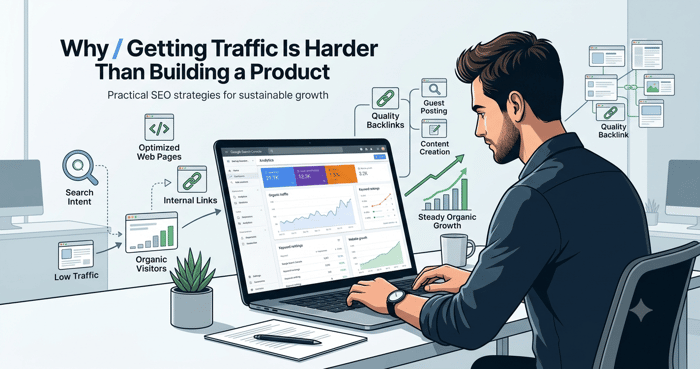
One thing I’ve noticed while working on SEO and digital marketing is that building a product is often only half the battle.
You can have a useful product, a clean website, and a solid offer, but if nobody can find you, growth becomes difficult.
SEO is one of those channels where people often expect results too quickly. A few months of publishing content and building links can feel like a long time when traffic is still low. But instead of looking only at traffic, it helps to understand what is actually happening.
Start With Search Intent
One common mistake is targeting keywords simply because they have high search volume.
A better approach is to understand why someone is searching.
For example, someone searching for “SEO” could be looking for almost anything. But a search like “how to find guest post sites for SaaS” gives you a much clearer idea of what that person needs.
Specific keywords may have lower search volume, but they can bring more relevant visitors.
Don't Ignore Existing Pages
Before publishing 50 new articles, look at the pages you already have.
Google Search Console can show you pages that are getting impressions but very few clicks. Sometimes a better title, clearer content, stronger internal links, or a more useful section can improve the page without starting from scratch.
Small improvements across existing pages can add up.
Backlinks Still Matter
Content alone doesn't always make it easy for a new website to compete.
Relevant backlinks can help search engines discover and understand your website while also bringing referral traffic.
The key word here is relevant.
Instead of trying to get hundreds of random links, focus on websites that are actually related to your industry. Guest posts, digital PR, industry contributions, and partnerships can all be useful ways to build a natural link profile.
For people who regularly need guest posting opportunities, Guest Post Discovery can make the research process easier by helping find websites based on niche and other SEO metrics.
Give SEO Time
SEO isn't usually a quick-growth channel.
A new website may need time to build content, authority, backlinks, and trust. Rankings can also move up and down while Google evaluates pages.
That's why I think it's better to track several signals:
Organic impressions
Clicks
Keyword rankings
Indexed pages
Referral traffic
Leads and conversions
Traffic is important, but it isn't the only measurement that matters.
Final Thought
If your website isn't getting the traffic you expected, don't immediately assume SEO isn't working.
Look at the data and find the bottleneck.
Maybe your pages aren't being indexed. Maybe you're targeting the wrong keywords. Maybe your content doesn't fully satisfy search intent. Or perhaps your website simply needs more authority.
Once you identify the actual problem, SEO becomes much less frustrating—and much more manageable.

Good point. Did you test that with users before committing to it?
How did you decide this was worth building in the first place?
Interesting. How are you measuring whether it is working?
Great breakdown. What feedback have you had from early users?
Makes sense. Are you planning to charge for it, or keep it free for now?
Nice work shipping it. What has been the biggest challenge since launch?
What made you pick this stack over the alternatives?
Interesting approach. What was the hardest part to get right?
Really relatable. How much time do you put into this each week?
Thanks for writing this up. Bookmarking it for later.
Thanks for sharing the numbers, that makes it much easier to follow.
Clear and practical, thanks. Did anything surprise you along the way?
Nice progress. What is the next thing you are focusing on?
Great breakdown. What feedback have you had from early users?
Helpful post. How did you get your first bit of traction?
What made you pick this stack over the alternatives?
Interesting take. Would you still recommend this approach to someone starting today?
Really good writeup, thanks for sharing it. What's the next thing you're planning to try here?
That bottleneck framing resonates—shipping a Notion content calendar (pillars → 7-day board → drafts) is easier than getting it in front of the right people. Week 1: ~18 Gumroad views, 0 sales, so I’m fixing discovery beyond X. Early bird $12.99: https://ttnee.gumroad.com/l/udaglc — curious what you’d change first on the sales page vs acquisition? I’m also tracking impressions, clicks, referrals, and conversions rather than traffic alone.
Honestly, getting people to notice the product can take way longer than building it. The product is only half the work. Getting the right people to find it is the real challenge.