Why the Future of Smart Wearables Belongs to Luxury Jewelry, Not Noisy Screens
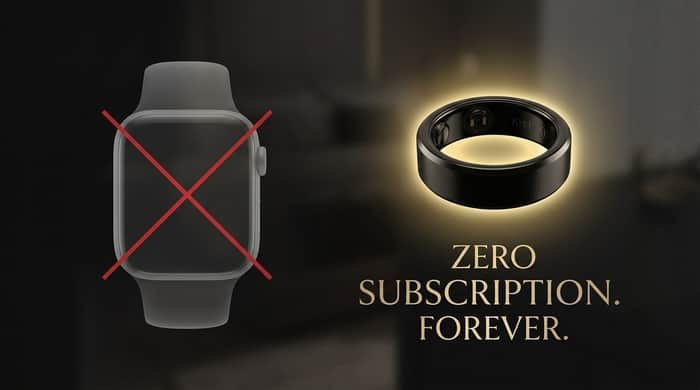
Quiet Luxury and Silent Tech are redefining how the world’s most discerning individuals track their health in 2026.
For more than a decade, the wearable industry has insisted that progress must be visible. Brighter screens, louder notifications, thicker bezels, and ever-more intrusive interfaces became the accepted markers of innovation. Yet a quiet rebellion has been gathering among those who value both performance and presence.The most sophisticated users are no longer willing to sacrifice elegance for data, or calm for connectivity. They are choosing objects that disappear into their lives rather than dominate them. This is the rise of Quiet Luxury in health technology — and the AI Smart Ring sits at its centre.
The Fatigue of the Always-On Wrist
Smartwatches excel at interruption. They excel at pulling attention outward, at turning every physiological signal into a demand for immediate engagement. For high-performing individuals, this creates a paradox: the device intended to optimise life gradually fragments it.Digital fatigue is no longer a vague complaint. It is a measurable drag on decision quality, recovery, and presence. The very people who most need precise biometric insight — executives, founders, creative leaders — are often the ones least willing to tolerate another glowing rectangle on their body.The alternative is not less technology. It is better-behaved technology.
Write on Medium
Silent Tech as the New Standard
An AI Smart Ring designed with haute joaillerie principles operates on an entirely different philosophy. It captures continuous biometric data — heart-rate variability, sleep stages, temperature trends, readiness signals — without ever asking for attention. There is no screen to check during a meeting. No vibration during a private conversation. No light pollution in a darkened bedroom.This is ambient intelligence in its purest form. The technology remains present, precise, and protective, yet it refuses to perform. It simply knows, and waits.In 2026, the most advanced AI Smart Rings are no longer competing on feature lists alone. They are competing on restraint. The brands that understand this distinction are the ones redefining Luxury Health Tech.

The shift from “more visible technology” to “technology that disappears” is an interesting thesis.
I’m curious what evidence you’ve seen that this is actually changing buying behavior, rather than simply describing an appealing direction for luxury wearables?
Hi Aryan, excellent question and a crucial distinction.
The evidence isn't just an appealing thesis; it’s validated by where market capital is moving globally. Oura hitting a $2.5B valuation and selling millions of screenless rings proved the initial behavioral shift: high-net-worth individuals want continuous 24/7 health data without notification fatigue. Now, with Samsung entering the ring space, the "disappearing tech" form factor is fully validated.
However, the current market failure—and our exact opportunity—is that most smart rings still look like sterile "tech gadgets" (basic titanium bands) that clash with traditional luxury watches or fine jewelry.
Our strategy at Macau Ke Hon Technology isn't trying to invent a new buying behavior from scratch. Instead, we are leveraging an asset-light model: tapping into the highly mature precision manufacturing of the Greater Bay Area and fusing it directly with European high-end jewelry craftsmanship (premium electroplating, diamond-encrusting).
We aren't educating the market to ditch their screens; we are capturing the existing, proven demand for screenless wearables and providing the ultimate "luxury upgrade" for a demographic that demands aesthetics as much as algorithms.
Hi Kingston, I’ve just sent you an email about this. Please check it when you get a chance and reply there so we can continue the conversation.