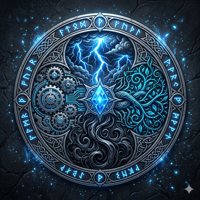
Aetherfall
Building the Fantasy Universe Before the Game
When I started building Aetherfall, I deliberately chose not to begin with the game.
I built the world first: heroes, factions, relics, history, conflicts and the larger mythology connecting everything together.
Recently I reached a milestone that has started changing the relationship between that worldbuilding and the eventual game:
I finished designing the abilities for all 50 Aetherfall heroes.
That means roughly 200 abilities now sit between the narrative identity of these characters and how they could eventually behave mechanically.
This turned out to be more interesting than simply inventing attacks.
A hero's abilities have to answer questions like:
What makes this character immediately recognizable in combat?
Which parts of their lore should actually affect gameplay?
How should two heroes from the same faction feel related without playing identically?
Which mechanics belong to the character, and which should belong to the wider game system?
For example, a commander shouldn't just have four differently named damage abilities because the lore says he's a commander. His mechanics should somehow communicate leadership, battlefield control or coordination.
The same applies to assassins, engineers, storm wielders, ancient beings and every other combat identity in the universe.
This has made me appreciate something about the world-first approach that I hadn't fully anticipated.
The lore is beginning to act as a constraint on the game design.
Instead of asking:
“What ability would be fun, and which character should I give it to?”
I'm increasingly asking:
“Given everything this character already is, what should playing them feel like?”
That distinction seems small, but I think it could become important if Aetherfall eventually makes the transition from an explorable universe into a card-based strategy game.
The next challenge is much harder: taking a large collection of individually interesting abilities and turning them into a coherent system with consistent terminology, mechanics, interactions and balance.
That's what I'm working through now.
Aetherfall is here if you'd like to see the universe behind it:
For people who've built games or systems around an existing fictional world:
Would you rather let lore constrain the mechanics, or change the lore when a better mechanic comes along?


I’ve been building Aetherfall, an original fantasy universe, but I'm approaching it differently from how I originally imagined building a game.
Instead of starting with combat mechanics, cards and progression systems, I'm building the world first.
Aetherfall already has a growing roster of heroes, rival factions, ancient relics, historical ages, conflicts and interconnected lore. I've turned that foundation into an interactive digital Codex where people can explore the universe and interact with parts of its history and characters.
The reason for doing this is simple: I don't want the lore to exist merely because a game needs lore.
I want the eventual game to feel like it takes place inside a world that already has history, characters people recognize, rivalries that matter and mysteries worth discovering.
The longer-term plan is to develop an original card-based strategy game within this universe, but I'm deliberately not rushing there.
Right now, the experiment I'm interested in is:
Can an independent creator make people care about a fictional universe before the main game even exists?
You can explore what I've built so far here:
I'd love feedback from other builders, especially those working on games or entertainment IP:
Would exploring an established world make you more interested in eventually playing a game set inside it, or would you rather discover the world through the game itself?
-
1The world-first approach is interesting, but the real signal seems to be whether lore engagement creates game intent. Are you tracking any behavior that shows Codex users actually want to play the eventual game?
-
1
That’s exactly the signal I’m interested in figuring out. Right now I’m still early enough that I don’t want to claim Codex engagement automatically means game intent.
What I’m looking at first is which parts of the universe people actually choose to engage with — particular heroes/factions, the battle simulator, comparisons, relics and other interactive experiences — rather than just page views.
As the audience grows, I’d like to introduce more explicit signals around the future game, such as following its development or registering interest, so I can start measuring the conversion from “I like exploring this world” → “I want to play something in this world.”
In a way, testing whether that bridge actually exists is one of the most interesting parts of building Aetherfall world-first. If it doesn’t, that’s useful information too.
Appreciate the question — it’s given me something concrete to think about measuring.
-
1That bridge from world engagement to game intent is the key test. I’d be interested in digging into what you learn as those signals emerge. What’s the best email to reach you on?
-
1
Absolutely — I’d be happy to stay in touch and share what I learn as Aetherfall develops. I think that world-engagement → game-intent transition could become a really interesting experiment once there’s enough data to measure it properly.
You can reach me at nishantborthakur@gmail(dot)com
Appreciate the interest, Aryan. Would be great to continue the conversation.
-
1
Thanks! I’ve just sent it over.
Looking forward to hearing your thoughts whenever you have a chance.
-
-
-
-
-
1The world-first approach makes sense, but the key signal seems to be whether Codex interest actually translates into desire for the game. Are you tracking any behavior that tells you someone exploring the lore would eventually want to play?

Comment